
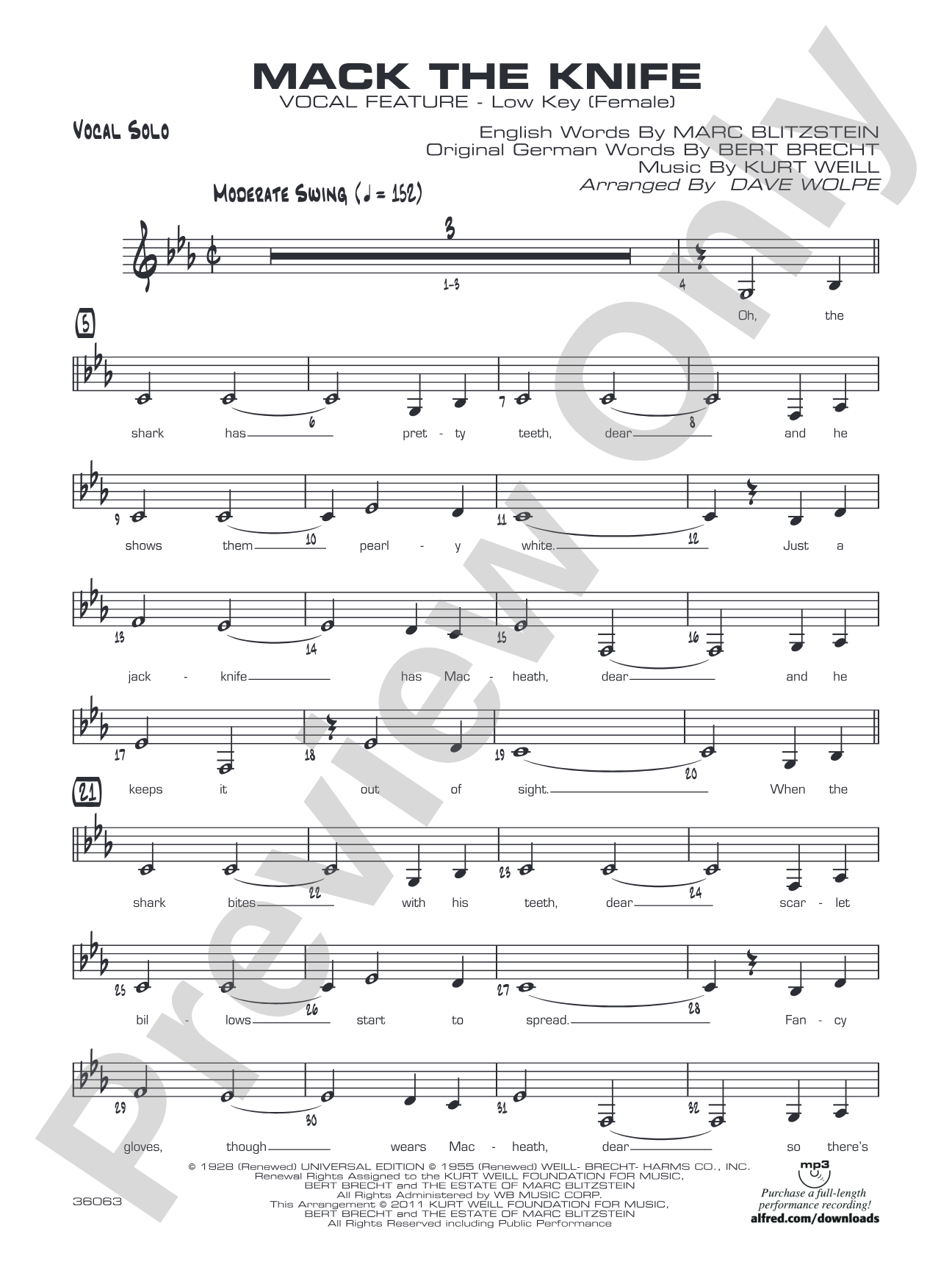
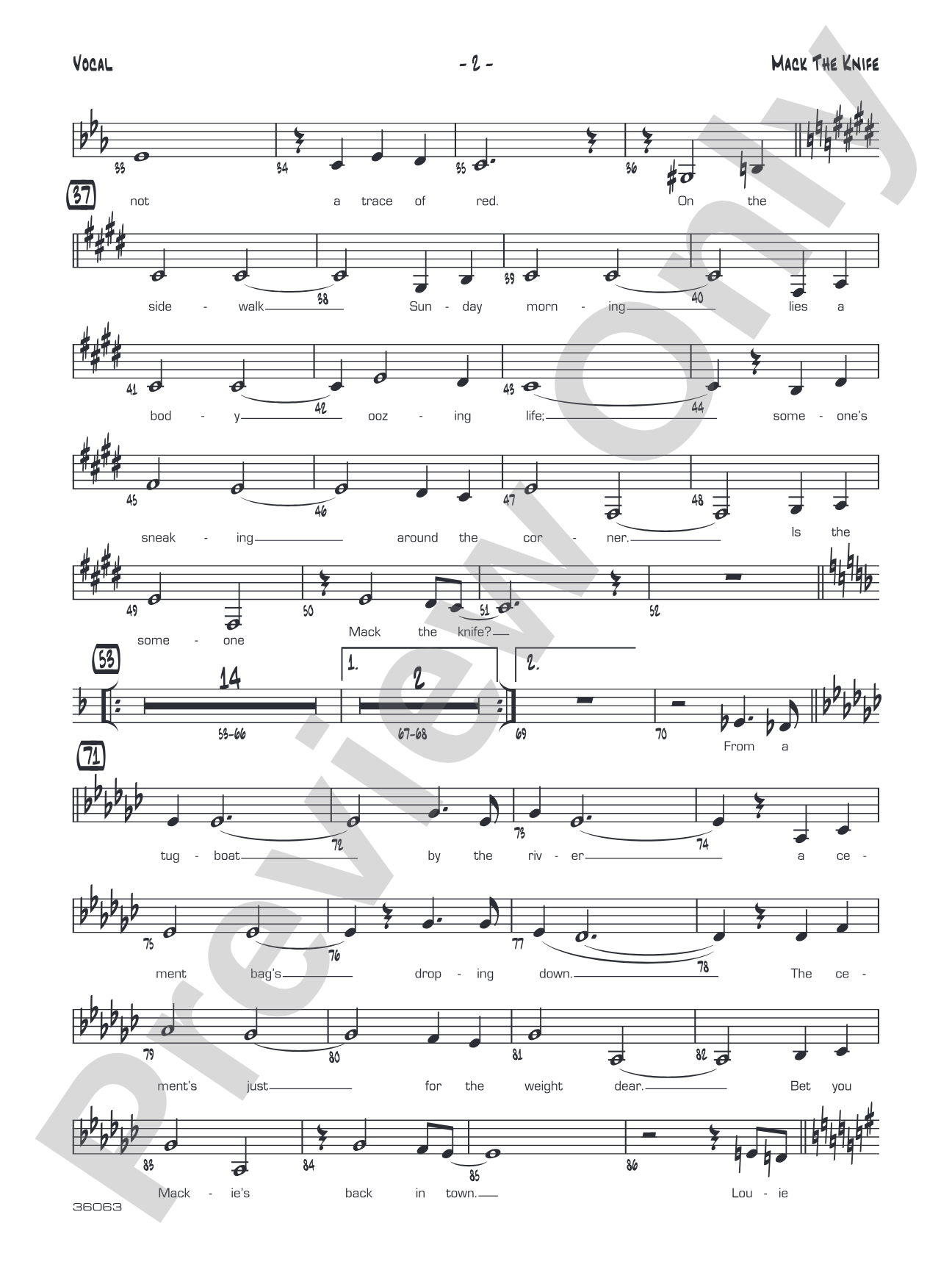

Mack the Knife: Vocal Solo
English words by Marc Blitzstein, original German words by Bert Brecht, music by Kurt Weill / arr. Dave Wolpe
Grade: 3 (Medium)
Item: 00-PC-0017200_VS
$3.00
Pickup currently not available
Description
This awesome vocal chart takes it away with four half-step up modulations. Features a written-out tenor solo and big shout chorus. Arranged in two keys for optimum flexibility. The high key starts out in B-flat (vocal range from middle C to F top line, treble clef) and the low key starts in E-flat (vocal range from low F below middle C to B-flat, second space). (3:50)


Don't just read it, hear it, play along with it, and watch your students grow with it. In MakeMusic Cloud, Mack the Knife: Vocal Solo comes alive with professional accompaniment, adjustable tempo, and built-in practice tools that turn solo practice into real progress.
Open in the Player
Jump straight in and assign it today.
Start Your Free Trial
Open this title and explore the full library in minutes.
Sample Audio
1
Audio File
--:--
0:00
0:00
Sample Video
Additional Details
Series:
Jazz Vocal Series
Publisher:
Alfred Music
Page Count:
118
SKU:
00-PC-0017200_VS
More about this title
About the Composer: Bert Brecht
Bert Brecht was a German dramatist and poet who revolutionized twentieth-century theater through his theory of epic theater, which emphasized critical distance and social commentary over emotional immersion. Working closely with composer Kurt Weill, Brecht created some of the most influential musical-dramatic works of the era, including The Threepenny Opera, from which "Mack the Knife" emerges as one of the most enduring standards in the jazz and popular repertoire.
Weill's sophisticated harmonic language and Brecht's sharp, satirical text created a piece that transcends its Weimar cabaret origins. For music educators, their collaboration represents a masterclass in how theatrical music can be both dramatically compelling and musically substantial, offering performers and ensembles the chance to engage with repertoire that balances accessibility with artistic depth.
Why we love this
This arrangement honors the song's theatrical roots while giving it genuine jazz credentials through those strategic modulations and a written-out tenor solo that demands real musicianship from your ensemble. The two-key option means you can cast singers across your program without compromise, and the big shout chorus provides exactly the kind of ensemble moment that reminds audiences why jazz singing matters.
What to expect
Sophisticated and slightly dangerous, with the cool precision of a jazz standard wrapped around something with genuine dramatic teeth. The modulations pull you forward; the shout chorus lets the whole band crack open together.
Who it's for
Jazz ensemble directors seeking a vocal feature with real musical substance and flexible casting options. This works equally well for a strong vocalist stepping into a concert feature or for festival programming where you want a number that showcases both vocal and ensemble capabilities.
How to get the most out of it
- Balance the vocal line carefully against the ensemble, especially during the written-out tenor solo passages. The band should provide color and pocket rather than volume.
- Map out the four half-step modulations in rehearsal so the band commits to each key change as a dramatic event, not a technical hurdle. This is where the arrangement earns its sophistication.
- Let the shout chorus breathe as a full ensemble moment. This isn't a time for the vocalist to dominate; it's the moment the band steps forward and swings together.
- Pay attention to the era and cynical wit of the original text. The arrangement's sophistication should be matched by the vocalist's understanding of the song's satirical edge.
How to use it
This is a natural fit for a concert where you're balancing contemporary jazz originals with standards that have proven their staying power. The theatrical heritage makes it a bridge piece if you're mixing jazz and musical theater, and the duration (3:50) gives it enough substance to stand as a meaningful moment without overshadowing the rest of your set.
Skills your students will build
- Navigating multiple key centers and modulations in jazz context
- Balancing vocal soloist with ensemble accompaniment
- Executing rhythmic precision in written-out jazz solos
- Sustaining ensemble swing through key changes
- Interpreting lyrical content with jazz sensibility