
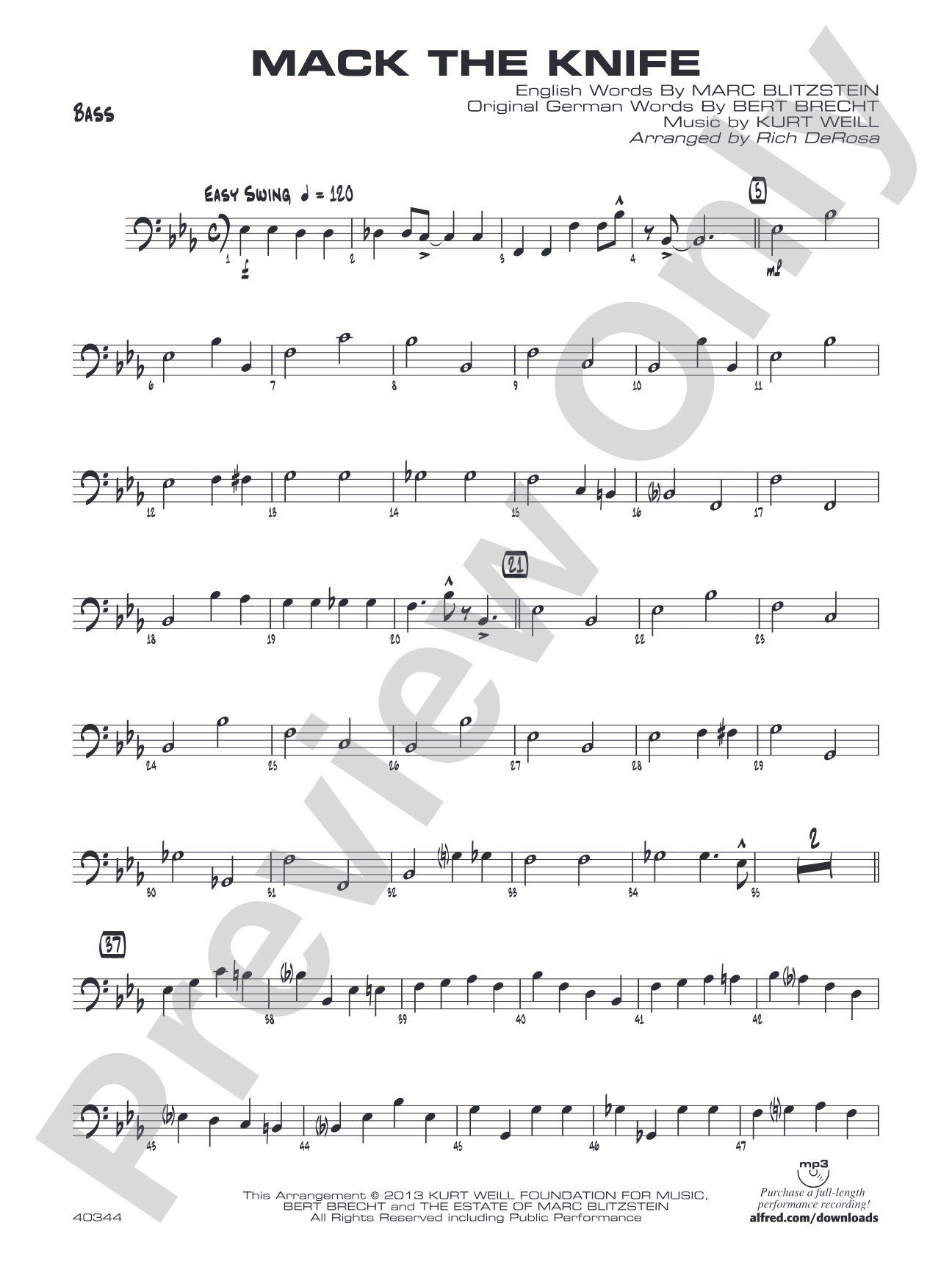

Mack the Knife: String Bass
English words by Marc Blitzstein, original German words by Bert Brecht, music by Kurt Weill / arr. Rich DeRosa
Grade: 1 (Easy)
Item: 00-PC-0017245_SB
$3.00
Pickup currently not available
Description
Swing! At a tempo around 120 BPM, this wonderful swing tune will be very a great choice for young players. Arranger Rich DeRosa provides written piano, alto and trumpet solos and a swingin' shout chorus. Look for clear and accurate rhythm section writing, optional vibes, flute, clarinet, horn, baritone horn and tuba. An excellent chart. This title is available in MakeMusic Cloud.


Don't just read it, hear it, play along with it, and watch your students grow with it. In MakeMusic Cloud, Mack the Knife: String Bass comes alive with professional accompaniment, adjustable tempo, and built-in practice tools that turn solo practice into real progress.
Open in the Player
Jump straight in and assign it today.
Start Your Free Trial
Open this title and explore the full library in minutes.
Sample Audio
1
Audio File
--:--
0:00
0:00
Sample Video
No sample videos found.
Additional Details
Series:
First Year Charts for Jazz Ensemble
Publisher:
Alfred Music
Page Count:
84
SKU:
00-PC-0017245_SB
More about this title
About the Composer: Kurt Weill
Kurt Weill (1900-1950) was a German-American composer who bridged classical training and popular music with remarkable fluidity. His theatrical works, including The Threepenny Opera, revolutionized musical theater by embedding jazz idioms, blues inflections, and vernacular rhythms into formally sophisticated structures. Weill's ability to write memorable melodies that served both artistic and commercial purposes made him a model for composers seeking to reach wide audiences without compromising craft.
For jazz educators, Weill's catalog offers accessible entry points into swing repertoire with genuine compositional substance. His songs have become standards precisely because they balance singability with harmonic and rhythmic interest, making them ideal vehicles for young ensemble players developing their ear and stylistic sensibility.
Why we love this
Rich DeRosa's arrangement captures the swagger and sophistication of this Weill standard while keeping the technical demands genuinely accessible for first-year jazz ensembles. The inclusion of written solos (piano, alto, trumpet) and a shout chorus gives students an immediate sense of how jazz charts work without requiring improvisational readiness, while the optional instrumentation lets you shape the ensemble to your available players.
What to expect
Urbane and confident, with the kind of melodic directness that stays in your students' heads long after rehearsal ends. The tune has a slight noir edge that Weill perfected, balanced here by DeRosa's warm orchestration and the bracing clarity of a straightforward swing groove at a comfortable tempo.
Who it's for
Young jazz ensemble directors looking for a legitimate swing standard that doesn't require soloists with advanced improvisational chops. This works for ensembles with limited instrumentation as well as fuller lineups, thanks to the optional parts, making it accessible whether you have twelve players or twenty.
How to get the most out of it
- Shape the phrasing around the swing eighth-note feel rather than laying back on every note; let the rhythm section establish the groove first, then have the horns lock in with conviction.
- Treat the written solos as models for the style rather than as untouchable statements; encourage soloists to listen to classic recordings and internalize the articulation and dynamics Weill intended.
- Balance the shout chorus so that it swings without overpowering; young players often play too hard and lose the relaxed pocket that makes swing breathe.
- Use the optional voices strategically: the flute and clarinet doublings add color without complexity, while the vibes can anchor the harmonic texture if you have a capable player.
How to use it
Pair this with other First Year Charts as a concert set, or use it as a standalone opener that establishes jazz idiom for an audience unfamiliar with the style. The accessibility and recognizability of 'Mack the Knife' make it an excellent bridge between jazz appreciation and active performance, ideal for winter or spring concerts where you're introducing young ensembles to the public.
Skills your students will build
- Swing eighth-note feel and phrasing in a jazz context
- Reading and executing written solo sections with appropriate style
- Responding to rhythm section leadership and ensemble balance in jazz textures
- Coordinate ensemble articulation and dynamics across optional and standard instrumentation