
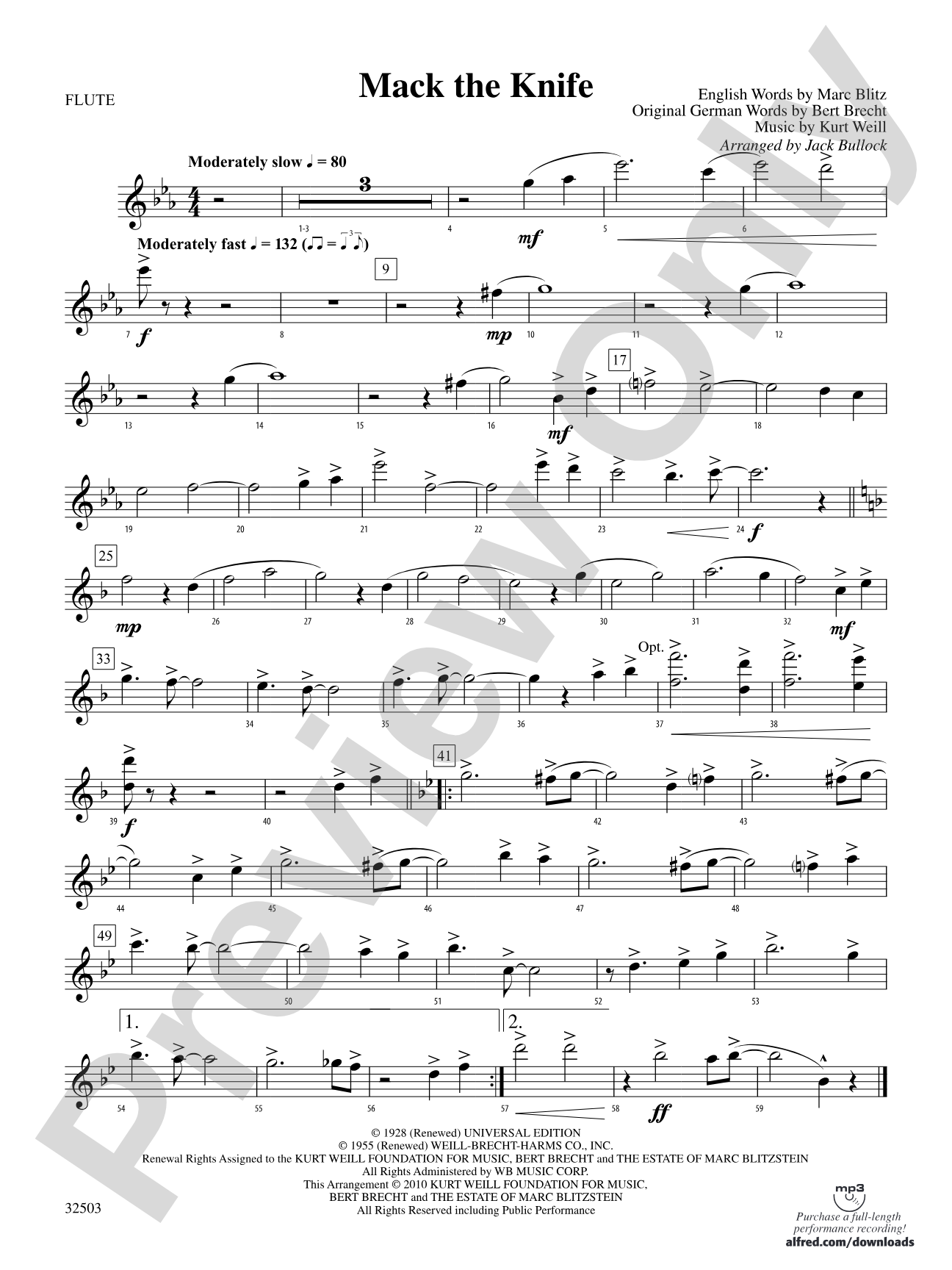

Mack the Knife: Flute
English words by Marc Blitz, original German words by Bert Brecht, music by Kurt Weill / arr. Jack Bullock
Grade: 2 (Easy)
Item: 00-PC-0014381_F1
$3.00
Pickup currently not available
Description
From Kurt Weill's "Three Penny Opera," Jack Bullock has arranged the revered theme composed for the character Macheath, the swashbuckling thief nicknamed Mack the Knife. Charming!


Don't just read it, hear it, play along with it, and watch your students grow with it. In MakeMusic Cloud, Mack the Knife: Flute comes alive with professional accompaniment, adjustable tempo, and built-in practice tools that turn solo practice into real progress.
Open in the Player
Jump straight in and assign it today.
Start Your Free Trial
Open this title and explore the full library in minutes.
Sample Audio
1
Audio File
--:--
0:00
0:00
Sample Video
No sample videos found.
Additional Details
Series:
Pop Young Band
Publisher:
Alfred Music
Page Count:
122
SKU:
00-PC-0014381_F1
More about this title
About the Composer: Kurt Weill
Kurt Weill (1900-1950) was a German composer who fundamentally reshaped musical theater by blending popular idioms with serious compositional craft. His collaborations with lyricist Bertolt Brecht produced some of the 20th century's most enduring theatrical works, including "The Threepenny Opera" (1928), which introduced "Mack the Knife" to the world. Weill's ability to write melodies that stick in the ear while maintaining harmonic sophistication made him a bridge between classical training and vernacular music.
After emigrating to the United States in 1935, Weill continued composing for Broadway and film, proving that serious composers could succeed in popular venues. His influence on American songwriting remains profound; his themes are taught in classrooms because they embody the principle that accessible music can also be artistically substantial.
Why we love this
Jack Bullock's arrangement captures the cunning swagger of this iconic melody while keeping the orchestration lean and transparent at Grade 2, making it accessible without sacrificing character. The chart sits at an ideal difficulty level for bands stepping into popular standards and theatrical repertoire, giving students a genuine masterwork rather than a simplified knockoff. Programming this brings immediate audience recognition and genuine musicianship into the same moment.
What to expect
Mack the Knife carries a taunting, confident energy; the melody struts with the easy menace of someone who knows he's dangerous and enjoys the reputation. Weill's original orchestration for this character is urbane and slightly sinister, and even in a concert band setting at this level, the arrangement preserves that swagger. There's charm here, but charm with an edge.
Who it's for
Band directors preparing Grade 2 ensembles who want to program music with genuine theatrical flair and historical weight. This works equally well for concert bands seeking a crowd-pleasing opener or closer, and for educational settings where students benefit from engaging with a real standard rather than an original composition written in a simplified style.
How to get the most out of it
- Establish a clear pulse from the start; this tune thrives on rhythmic confidence and forward motion. A meandering tempo undercuts Mack's cocky persona.
- Balance the melody across sections so that whoever carries the main theme is always audible. The strength of this piece is its singability, so let it sing.
- Attend to dynamic nuance in the inner parts. Even at Grade 2, the arrangement likely contains supporting figures that need clarity; don't let them disappear into wash.
- Reference recordings of the original to hear how the melody breathes. Weill's songs benefit from a touch of theatrical timing rather than metronomic rigidity.
How to use it
Open a concert with this for immediate engagement, or use it as a palette cleanser between heavier works to remind audiences why they came to hear music. It also pairs naturally with other Great American Songbook standards and theatrical music, allowing you to build a thematic concert around popular standards in concert band dress.
Skills your students will build
- Executing lyrical, singable phrasing in an ensemble context
- Maintaining steady rhythmic integrity while supporting a melody-driven arrangement
- Balancing melody and accompaniment across multiple instrumental lines
- Understanding how popular melodies transfer to concert band instrumentation