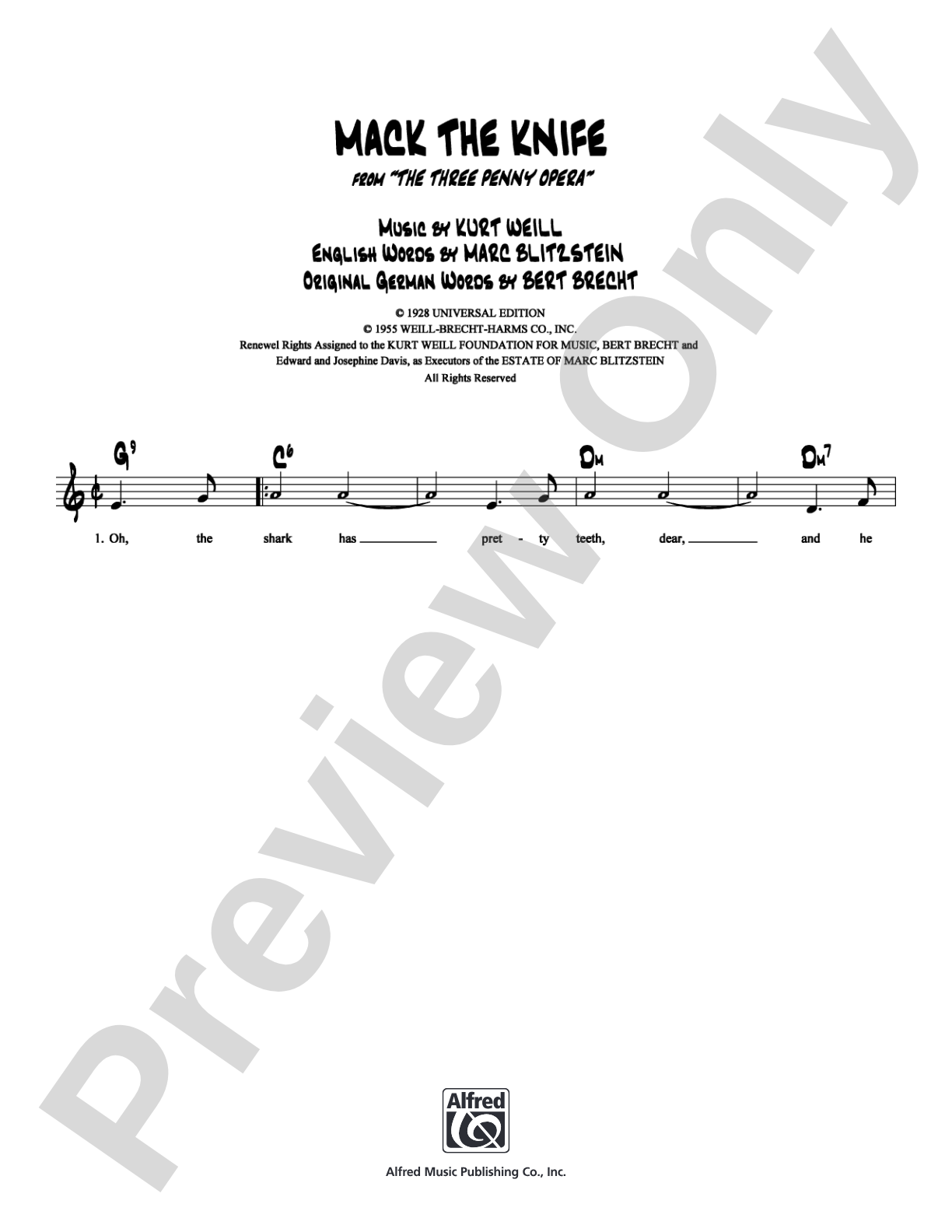
Mack the Knife: Lead Sheet Digital Sheet Music

Mack the Knife: Lead Sheet Digital Sheet Music

Ella Fitzgerald, Frank Sinatra, Bobby Darin, Louis Armstrong, Lotte Lenya

Item: 00-PS-0008469

Digital Download
$1.99
Description

Mack the Knife: Lead Sheet Digital Sheet Music isn't in MakeMusic Cloud just yet...but it could be. Let us know you'd like to see it, and you'll help shape what comes next. In the meantime, start a free trial and dive into thousands of interactive titles your students can play along with today.

Sample Audio
No sample audio found.
Sample Video
Additional Details
SKU: 00-PS-0008469

More about this title

About the Artist: Ella Fitzgerald

Ella Fitzgerald (1917-1996) earned her place as one of the most influential jazz vocalists of the twentieth century through her impeccable intonation, rhythmic precision, and ability to interpret a lyric with both technical mastery and emotional depth. Her scat singing revolutionized jazz vocals, and her interpretations of the Great American Songbook became the standard against which all others are measured. For music educators, Fitzgerald's recordings offer masterclasses in phrasing, swing, and the art of making complex melodic lines sound effortless.

Why we love this

This lead sheet gives singers and musicians direct access to one of the most recorded standards in American music, complete with the melody and changes that defined multiple iconic interpretations. Having the lead sheet means students can study how different artists approached the same tune, comparing Fitzgerald's elegance with Sinatra's swagger or Darin's rock-inflected energy. It's an essential reference for any program exploring jazz standards, American songwriting, or the evolution of a single composition across genres.

What to expect

Darkly witty and rhythmically propulsive, this tune walks the line between cabaret sophistication and street-level menace. The melody sits comfortably in a singer's middle register but demands rhythmic confidence and the ability to phrase like you're telling a story, not just hitting notes. Whether played as a straightforward swing number or reimagined with rock energy, the tune's harmonic foundation stays lean and flexible, letting the performer's personality drive the arrangement.

Who it's for

This lead sheet serves singers preparing for jazz ensemble, small combo, or solo recital work, as well as instrumentalists building fluency with jazz standards and reharmonization. Pianists and guitarists use it to comp and arrange for various situations, from classroom demonstrations to performance. Music theory and jazz history students benefit from having the clear harmonic framework to analyze how composers and arrangers have treated this iconic tune.

How to get the most out of it

  • Study the recorded versions by Fitzgerald, Sinatra, and Darin to hear how each artist shaped the melody and phrasing differently; this shows how the same lead sheet accommodates multiple musical personalities
  • Anchor your swing feel in the rhythm section by locking the pulse with the bassist and drummer rather than rushing the eighth notes, which is where many singers stumble at moderate tempos
  • Shape the melody with subtle dynamics and breath placement to highlight the lyric's darker storytelling; this tune rewards careful attention to text over flash

How to use it

Program this as a centerpiece for a standards showcase or jazz concert, pairing it with contrasting selections from the same era to highlight how a single composition reveals different colors depending on treatment and context. It also serves well in educational settings where you're teaching students to analyze form, harmonic movement, and the relationship between lyric and melody. The multiple recorded versions make it ideal for a listening and comparison activity in music history or jazz ensemble classes.

Skills your students will build

  • Reading lead sheet notation and interpreting chord symbols in performance
  • Swinging the eighth note and maintaining rhythmic confidence at moderate tempos
  • Phrasing a melody to match lyrical content and dramatic intent
  • Harmonic analysis of jazz changes and recognizing common progressions
  • Studying multiple interpretations of the same piece to develop interpretive independence
  • Comping and reharmonization skills for pianists and guitarists

You May Also Like