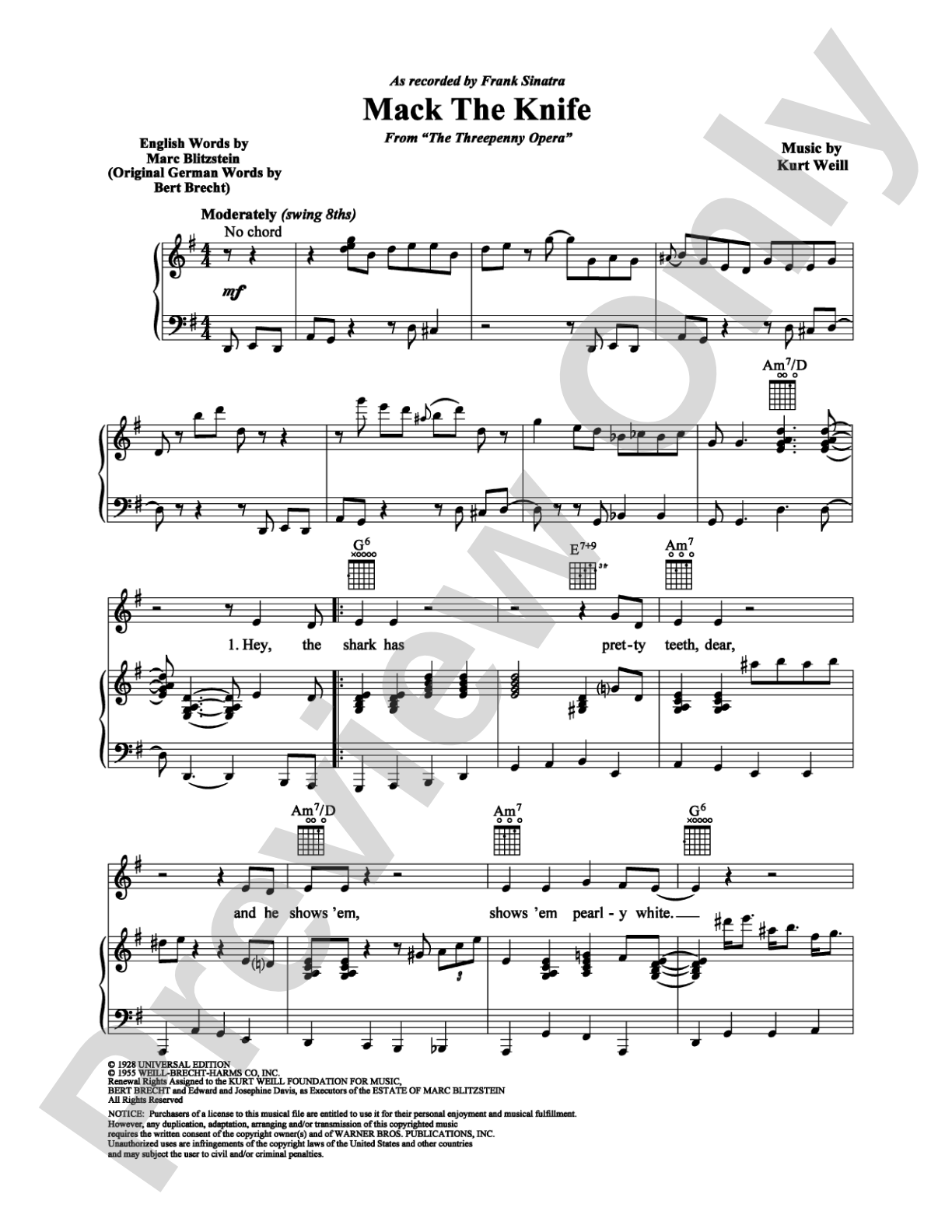
Mack The Knife: Piano/Vocal/Chords Digital Sheet Music

Mack The Knife: Piano/Vocal/Chords Digital Sheet Music

Kurt Weill, Ella Fitzgerald, Frank Sinatra, Bobby Darin, Louis Armstrong

Item: 00-PS-0005313

Digital Download
$3.99
Description

Mack The Knife: Piano/Vocal/Chords Digital Sheet Music isn't in MakeMusic Cloud just yet...but it could be. Let us know you'd like to see it, and you'll help shape what comes next. In the meantime, start a free trial and dive into thousands of interactive titles your students can play along with today.

Sample Audio
No sample audio found.
Sample Video
Additional Details
SKU: 00-PS-0005313

More about this title

About the Artist: Ella Fitzgerald

Ella Fitzgerald (1917-1996) was a jazz vocalist whose technical mastery and interpretive depth set the standard for American vocal performance. Her command of intonation, phrasing, and swing feel made her one of the most recorded artists of the twentieth century and earned her the title "The First Lady of Song."

For music educators, Fitzgerald's recordings offer incomparable models of how to shape a melody, navigate chord changes with precision, and maintain vocal control across an extensive range. Her interpretations of standards like "Mack the Knife" demonstrate how musical intelligence and restraint create compelling performances.

Why we love this

This standard has become a staple of vocal jazz repertoire precisely because the melody sits so naturally for singers and the harmonic structure rewards both straightforward interpretation and creative reharmonization. Fitzgerald's iconic version gives students a benchmark for swing phrasing and lyrical storytelling that transfers immediately to their own singing.

What to expect

The music moves with a predatory cool. The minor tonality and syncopated melody create an edgy, theatrical atmosphere that's both playful and menacing, inviting performers to embrace the song's darkly humorous character while maintaining vocal ease across the range.

Who it's for

This digital sheet music serves singers and pianists preparing to perform or teach a jazz standard, as well as music educators building a collection of accessible repertoire for mixed-level ensembles. It works equally well for solo recital study, jazz combo work, or classroom exploration of how popular songs function harmonically.

How to get the most out of it

  • Study how the melody lands on chord tones versus approach notes; this reveals where to anchor the swing feel and where to float the line.
  • Lock the rhythmic relationship between voice and piano comping. The swing rhythm lives in the conversation between them, not in either part alone.
  • Shape the lyrical arc across the full form. This song tells a story, and your phrasing should reflect the darkly comic narrative.
  • Balance the chord symbols with the written melody. You have freedom to reharmonize or add passing chords, but the foundational changes support the vocal line.

How to use it

This piece bridges jazz history and pop standards naturally, making it suitable for concerts exploring American songbook material or showcasing instrumental and vocal collaboration. It also serves as a teaching tool for understanding how rhythm changes and jazz comping techniques function in a commercially successful song.

Skills your students will build

  • Swing rhythm and phrasing in a jazz context
  • Reading chord symbols and realizing accompaniment voicings
  • Melodic phrasing that honors both lyrical and harmonic content
  • Understanding form and navigating chord progressions with agency
  • Balancing vocal storytelling with technical vocal control

You May Also Like