
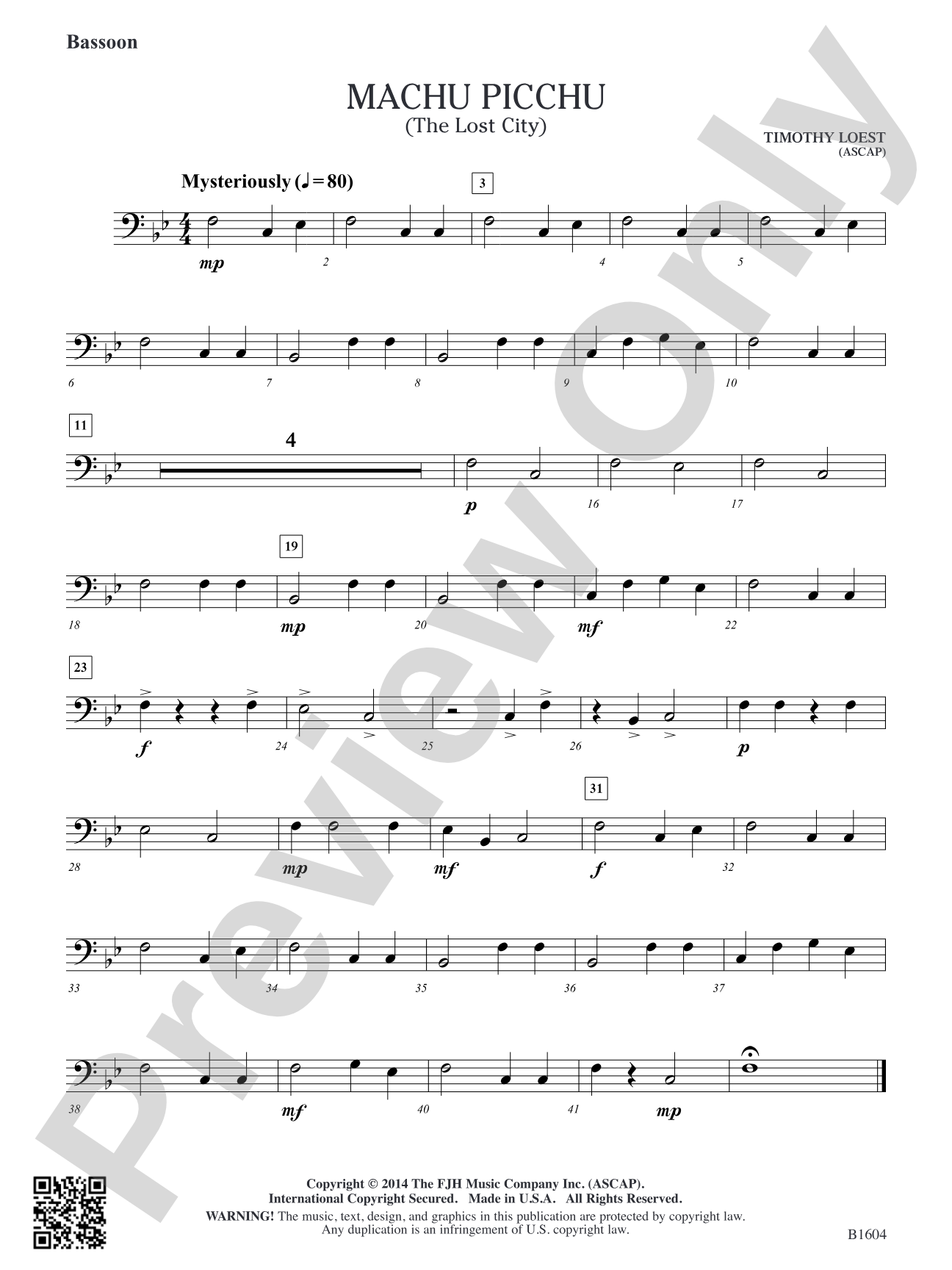

Machu Picchu: Bassoon
By Timothy Loest
Level:.5
Item: 98-PC-DB1604_B1
$7.00
Pickup currently not available
Description
With its modal themes and intriguing percussion, this marvelous work captures the mysterious enchantment of Machu Picchu, the ancient Incan city forgotten by time. Playable by the very youngest of musicians, this gem is destined to become a beginning band standard.


Don't just read it, hear it, play along with it, and watch your students grow with it. In MakeMusic Cloud, Machu Picchu: Bassoon comes alive with professional accompaniment, adjustable tempo, and built-in practice tools that turn solo practice into real progress.
Open in the Player
Jump straight in and assign it today.
Start Your Free Trial
Open this title and explore the full library in minutes.
Sample Audio
1
Audio File
--:--
0:00
0:00
Sample Video
No sample videos found.
Additional Details
Series:
FJH MOS Performance
Publisher:
The FJH Music Company, Inc.
SKU:
98-PC-DB1604_B1
More about this title
About the Composer: Timothy Loest

Timothy Loest has spent over three decades in the classroom while establishing himself as a prolific composer whose works are performed by young ensembles across the country. His compositions balance accessibility with musical substance, earning recognition at the state and national levels; in 2017, his piece Cloud Gate received a performance for over 5,000 spectators at Chicago's Millennium Park, and that same year he received the Illinois Grade School Music Association's highest honor, the Cloyd Myers Memorial Award for Excellence in Music Education.
Loest's publishing history spans major houses including Warner Bros. Publications, C.L. Barnhouse Company, The FJH Music Company, and MakeMusic Publications. His pedagogical reach extends through his association with several bestselling methods: Measures of Success (a comprehensive musicianship band method), Warm-ups and Beyond, Rhythms and Beyond, and Chorales and Beyond. He founded Fanfare Music Press in 2022 to focus on high-quality compositions and arrangements for band, and his music has appeared on network television programs including The Tonight Show Starring Jimmy Fallon, Good Morning America, and Nick Jr. Loest holds degrees in music education from Illinois State University and a master's degree from Northwestern University, and he regularly accepts commissions for band.
Why we love this
Loest has mastered the art of writing for beginning bands without sacrificing musical interest or sophistication. Modal themes and creative percussion writing give this piece genuine character while remaining well within the technical grasp of very young musicians, making it a reliable choice for early-year concerts and festival programming.
What to expect
Machu Picchu conjures the quiet mystery of an ancient city shrouded in mist and time. Modal harmonies and imaginative percussion textures create an immersive soundscape that feels both contemplative and slightly otherworldly, inviting listeners into a place of wonder.
Who it's for
Beginning concert bands in grades 1-2, this work sits at the perfect entry point for ensembles still building fundamental skills and ensemble balance. Directors programming early-season concerts or festival events will find a piece that sounds far more sophisticated than its accessibility level suggests.
How to get the most out of it
- Balance the modal themes so they emerge clearly from the ensemble; the exotic character depends on clean, sustained playing from the melodic sections rather than volume.
- Let the percussion parts drive the rhythmic momentum without overwhelming the band, especially in passages where winds and percussion share the same rhythmic figures.
- Shape the phrasing across the full length of melodic lines rather than breaking them into smaller gestures; young players often need reminding that modal music still requires long-line thinking.
- Use the marked dynamics to guide students toward contrast and shape; even at this level, the piece rewards attention to printed expression marks.
How to use it
Program this as an opening or early-concert selection to set an atmospheric tone for a concert built around world cultures, history, or nature themes. Its distinctive sound and manageable difficulty make it ideal for demonstrating student growth at mid-year concerts or for festival appearances where you want a piece that commands attention while allowing young musicians to experience success.
Skills your students will build
- Reading and executing modal melodies (departing from major/minor harmonic thinking)
- Sustaining balanced ensemble sound across multiple independent parts
- Responding to dynamic and expressive markings to shape musical character
- Maintaining steady rhythm while managing textural variety and percussion independence
- Listening critically for blend and balance in non-traditional harmonic contexts