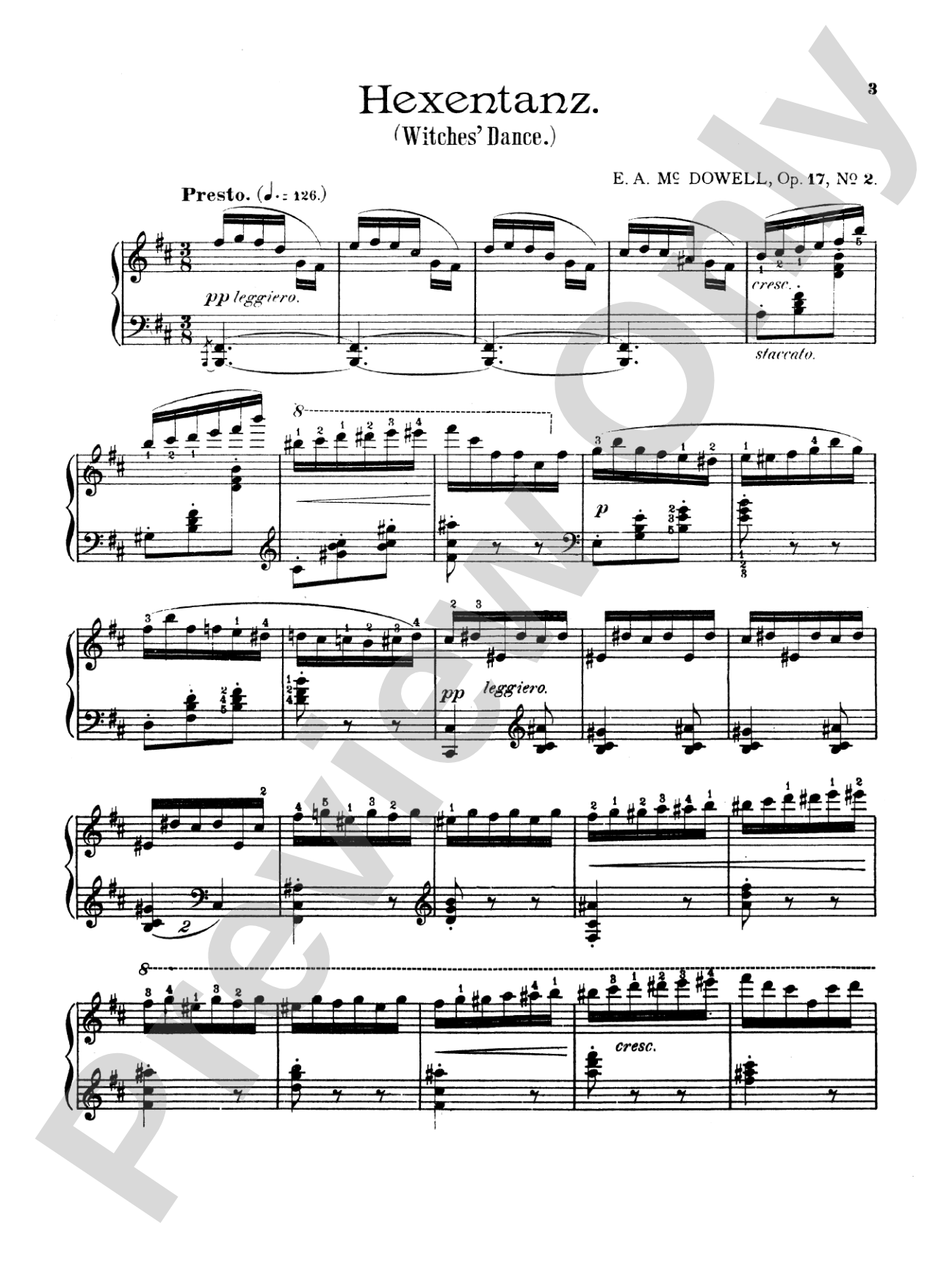
MacDowell: Witches Dance, Op. 17, No. 2 Sheet Music Preview

MacDowell: Witches Dance, Op. 17, No. 2

By Edward MacDowell

Level: Intermediate / Advanced

Item: 00-PC-0008398

Digital Download
$5.99
Description

Don't just read it, hear it, play along with it, and watch your students grow with it. In MakeMusic Cloud, MacDowell: Witches Dance, Op. 17, No. 2 comes alive with professional accompaniment, adjustable tempo, and built-in practice tools that turn solo practice into real progress.

Sample Audio
No sample audio found.
Sample Video
Additional Details
Series: Kalmus Edition
Publisher: Alfred Music
Page Count: 12
SKU: 00-PC-0008398

More about this title

About the Composer: Edward MacDowell

Edward MacDowell (1860-1908) was an American composer and pianist whose romantic sensibilities and technical command made him one of the most performed composers of his era. He studied in Europe under prominent teachers, absorbing influences from Liszt and Raff, then returned to the United States to establish himself as both a virtuoso performer and prolific composer. MacDowell's output spans concertos, symphonic poems, character pieces, and substantial solo piano works that remain central to the American piano repertoire.

His smaller piano compositions, particularly the collections of character pieces, showcase his gift for evoking atmosphere and narrative through economical musical language. These works bridge Romantic tradition with an American sensibility, avoiding the grand gestures of European romanticism in favor of intimate, imaginative storytelling at the keyboard.

Why we love this

Witches Dance delivers exactly what an intermediate-advanced pianist needs: a character piece with genuine dramatic arc, virtuosic passages that build confidence, and Romantic vocabulary that feels fresh after baroque and classical repertoire. The piece sits at that sweet spot where technical demands push students without overwhelming them, and the evocative subject matter keeps practicing engaging across multiple weeks.

What to expect

Witches Dance captures supernatural mischief and gathering momentum. The opening theme establishes an unsettling elegance, then the piece builds through whirling figurations and syncopated accents as though the witches are spiraling into frenzy. There's theatrical flair without pretension, making it genuinely fun to perform and rewarding to hear.

Who it's for

This piece suits intermediate-advanced pianists with solid technique who are ready to move beyond elementary Romantic repertoire into works with real character and dramatic scope. It appeals to students developing their interpretive voice and those preparing for competitions or recitals where a distinctive, manageable-length solo makes an impression.

How to get the most out of it

  • Establish the rhythmic precision of the main theme before layering in the chromatic runs and figurations. This piece lives or dies by clarity of rhythm and articulation.
  • Shape the dynamic contours deliberately rather than playing uniformly. MacDowell's dynamic markings create the theatrical atmosphere, so follow them with specificity.
  • Balance the left-hand accompaniment so it supports but never overshadows the melodic content. The hand-crossing and inner-voice writing requires independence but not prominence.
  • Find the moment where the witches' dance becomes frenetic and unhinged, then play into that character shift. Reserve your aggressive energy for the climax rather than starting there.

How to use it

This works beautifully as a concert opener or a showstopping solo within a student recital, where its dramatic character provides contrast to more introspective pieces. Its length and moderate technical demands also make it ideal for competitions or festival performances where you need a piece that impresses without requiring professional-level virtuosity.

Skills your students will build

  • Hand independence and coordination across sixteenth-note figurations
  • Rhythmic precision in syncopated passages and cross-rhythms
  • Dynamic shaping and interpretation of character-driven narrative
  • Chromatic runs and scalar passages at performance tempo
  • Pedal control to sustain harmonic color without muddiness

You May Also Like