
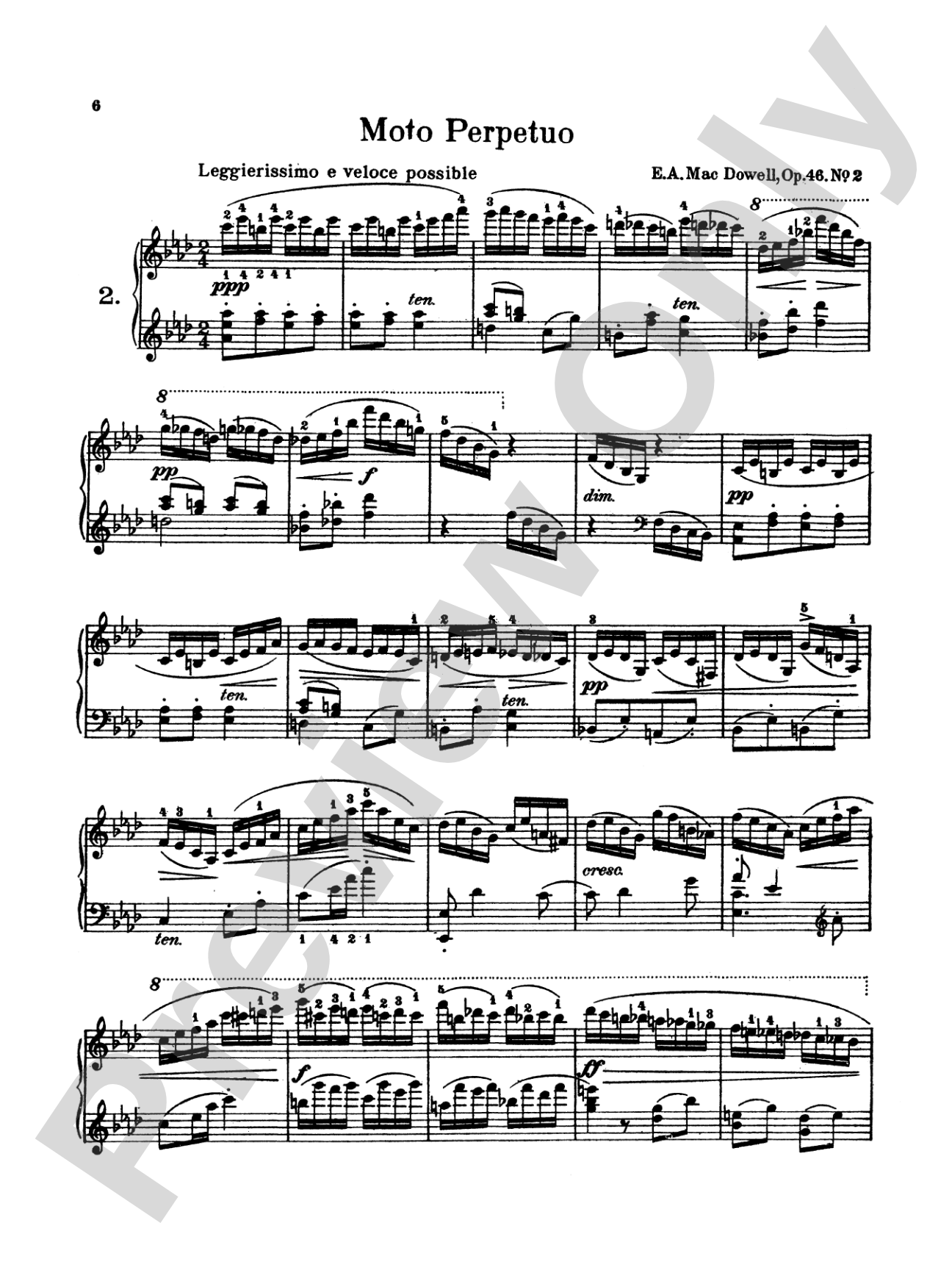

MacDowell: Twelve Virtuoso Studies, Op. 46
By Edward MacDowell
Level: Advanced
Item: 00-PC-0008416
$0.99
Pickup currently not available
Description
Titles: No. 1, Novette * No. 2, Moto Perpetuo * No. 3, Wild Chase * No. 4, Improvisation * No. 5, Elfin Dance * No. 6, Valse Triste * No. 7, Burlesque * No. 8, Bluette * No. 9, Träumerei * No. 10, March Wind * No. 11, Impromptu * No. 12, Polonaise. No. 10, "March Wind" and No. 12, "Polonaise" are Federation Festivals 2016-2020 selections. A Federation Festivals 2020-2024 selection. A Federation Festivals 2024-2028 selection.


Don't just read it, hear it, play along with it, and watch your students grow with it. In MakeMusic Cloud, MacDowell: Twelve Virtuoso Studies, Op. 46 comes alive with professional accompaniment, adjustable tempo, and built-in practice tools that turn solo practice into real progress.
Open in the Player
Jump straight in and assign it today.
Start Your Free Trial
Open this title and explore the full library in minutes.
Sample Audio
No sample audio found.
Sample Video
No sample videos found.
Additional Details
Series:
Kalmus Edition
Publisher:
Alfred Music
Page Count:
52
SKU:
00-PC-0008416
More about this title
About the Composer: Edward MacDowell
Edward MacDowell (1860-1908) was America's most celebrated composer of the 19th century, a virtuoso pianist who shaped the American classical music tradition during a formative era. He studied in Europe under leading pedagogues and composers, absorbing the Romantic idiom while maintaining a distinctive voice rooted in American landscape and character. His keyboard works earned him international recognition and remain central to advanced piano repertoire.
MacDowell's legacy extends beyond composition into music education and institutional leadership. He served as the first director of the newly created Department of Music at Columbia University, where he championed serious music study in America. His piano works, particularly the studies and character pieces, balance technical demands with poetic expression, making them essential repertoire for advanced students navigating the late Romantic style.
Why we love this
These studies honor the Romantic tradition of character-driven technical writing, where musical substance and virtuosity move together rather than against each other. Each piece names a distinct mood or character, anchoring the technical challenges in expressive intent. They appear regularly on festival and competition lists because they demand sophisticated musicianship alongside considerable pianistic skill.
What to expect
These studies capture the full sweep of Romantic keyboard writing: spirited dances and ethereal reveries sit alongside stormy technical cascades and stately formal rhetoric. MacDowell's orchestral sensibility translates to the piano through rich harmonic color and idiomatic figurations that allow the instrument to sing across multiple registers simultaneously. The collection moves between intimate character pieces and grand formal statements, creating a journey that rewards both listener and performer.
Who it's for
Advanced pianists preparing for competition, festival performance, or recital programming, particularly those exploring American Romantic literature. Teachers seeking authentic character studies that blend technical rigor with musical depth will find these twelve pieces invaluable for developing interpretive maturity in advanced students.
How to get the most out of it
- Study the character name and opening material for each piece before working the technical passages; the poetic framework guides interpretive choices about tempo flexibility and rubato.
- Attend to the harmonic language in moments of transition and development; MacDowell's harmonic practice often shifts subtly, and missing these colors flattens the structural arc.
- Balance virtuosity with restraint; these pieces thrive when technical passages support musical storytelling rather than exist for display alone.
- Work through the collection sequentially rather than jumping to favorites; the progression through contrasting characters and technical demands mirrors how MacDowell intended the cycle to develop pianistic and interpretive range.
How to use it
Pair individual selections with other American Romantic works for a thematic recital, or weave them throughout a season of master classes and studio recitals to showcase advancing technique. Their federation festival credentials make them natural choices for competition preparation, and their character-piece format allows flexible programming alongside larger works.
Skills your students will build
- Romantic-era harmonic language and voice-leading conventions
- Pedal coordination across extended harmonic progressions
- Sustained legato and singing tone in scalar and chordal passages
- Rapid figuration and double-note technique (particularly in perpetual motion and chase pieces)
- Tempo flexibility and rubato within structural frameworks
- Program design and narrative arc across a themed collection