Maurice Ravel (1875–1937) was a French composer whose orchestral and chamber works define early twentieth-century modernism. His music balances impressionistic color with classical structure, creating soundscapes that feel both innovative and inevitable. Ravel's meticulous approach to orchestration and his gift for transforming simple material into complex, luminous textures made him one of the most influential composers of his era.
Why we love this
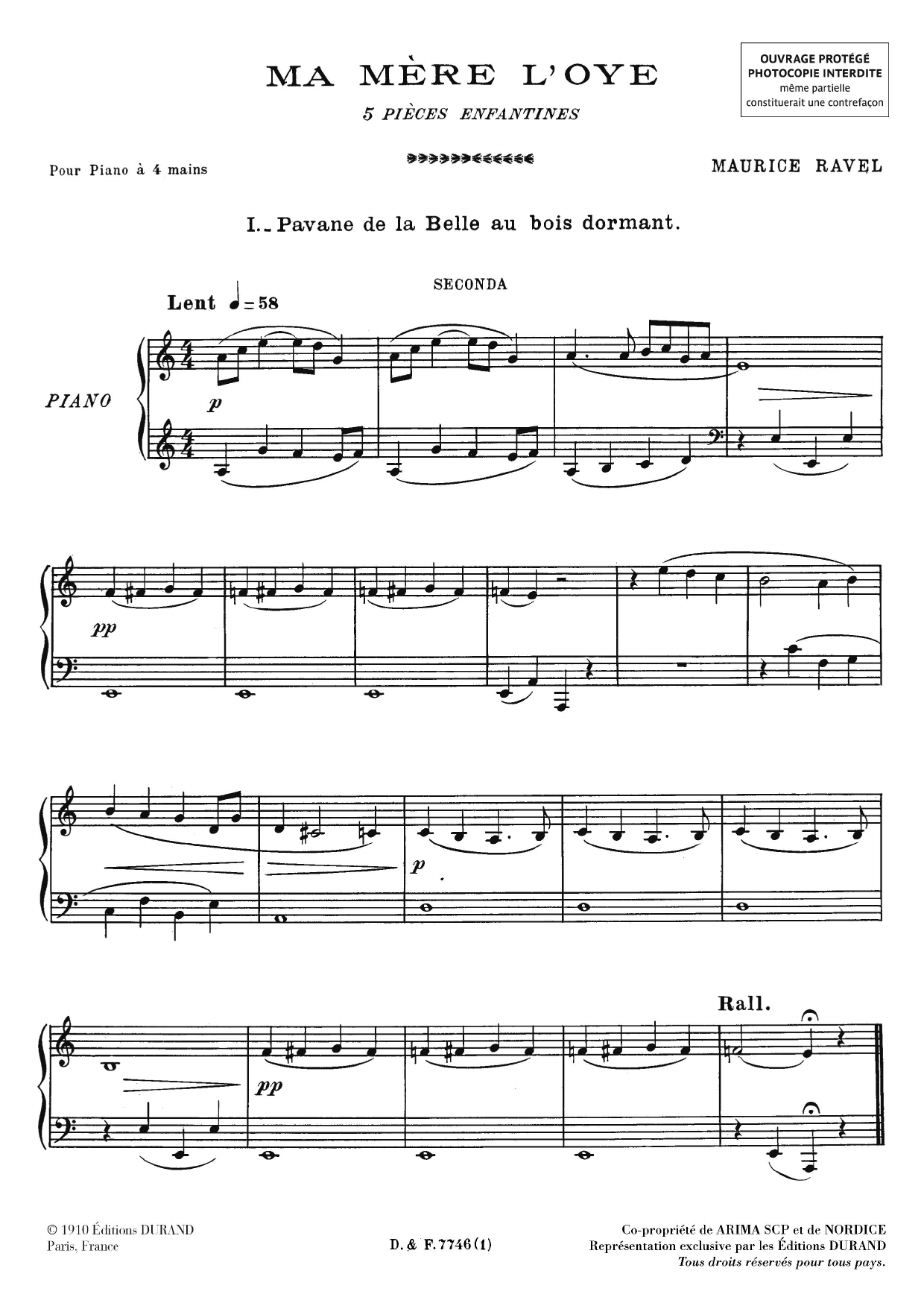
This suite contains some of the most evocative and pianistically rewarding music in the children's repertoire. Ravel's orchestrations shimmer with orchestral color, and this piano reduction captures the harmonic sophistication and timbral imagination that make the original so captivating. Teachers and students encounter genuine compositional artistry here, not condescension.
What to expect
A storybook brought to life through sound. The music moves through landscapes of delicate enchantment, moments of mild drama, and passages of gossamer-thin beauty, all rendered with Ravel's signature clarity and harmonic sophistication. It feels like watching illustrations come alive.
Who it's for
Upper-level pianists and chamber musicians who want to expand beyond standard pedagogical repertoire into genuine concert material. Teachers looking for accessible entry points into twentieth-century classical music will find a work that engages advanced students without overwhelming them.
How to get the most out of it
Track the harmonic movement beneath the decorative surfaces; Ravel's progressions often move slowly and deliberately, which gives performers room to shape individual phrases without rushing.
Balance transparency with color in movements like 'Laideronette'; the delicate figurations need a light touch even when the harmonies grow richer.
Let silence and space breathe, particularly in transitions between movements. Ravel's orchestrations are spacious by nature, and respecting those gaps enhances the fairy-tale atmosphere.
How to use it
Pair this with other twentieth-century French repertoire to build a concert around impressionistic and post-impressionistic aesthetics. It also works beautifully as a vehicle for understanding orchestration and reduction, especially in a masterclass or composition-focused setting.
Skills your students will build
Navigating unequal phrase lengths and asymmetrical phrasing
Interpreting impressionistic harmony and pedal technique
Balancing melodic lines across multiple registers
Understanding orchestral color through piano texture
Maintaining musical coherence across contrasting character movements
You May Also Like
Scan to Complete Your Purchase
Use your phone's camera to scan the code below
You'll log in on your phone and the order will be added to your account