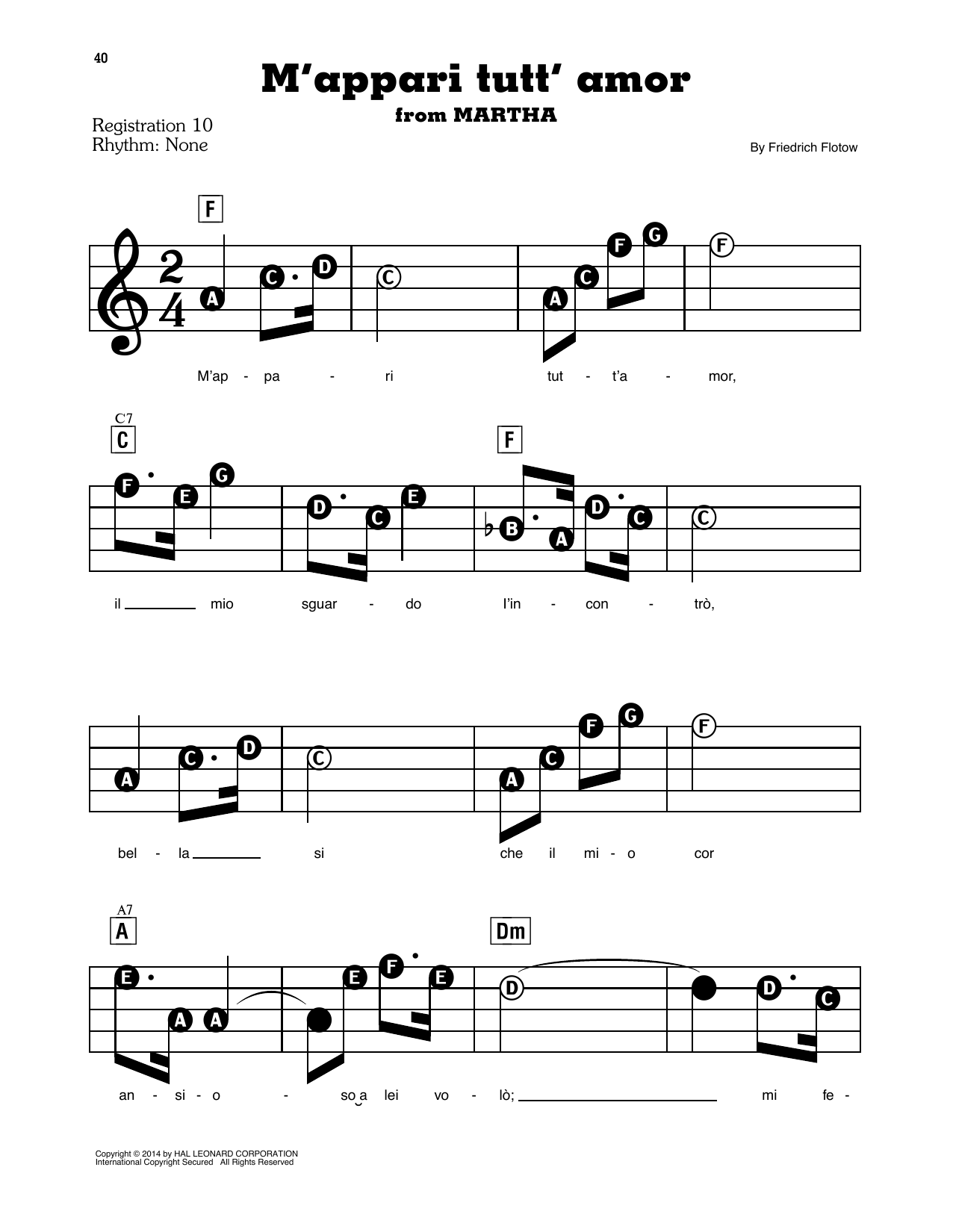
M'Appari Tutt' Amor Sheet Music Preview

M'Appari Tutt' Amor: E-Z Play Today

Item: 35-DS00836504

Digital Download
$4.99
Description

M'Appari Tutt' Amor: E-Z Play Today isn't in MakeMusic Cloud just yet...but it could be. Let us know you'd like to see it, and you'll help shape what comes next. In the meantime, start a free trial and dive into thousands of interactive titles your students can play along with today.

Sample Audio
No sample audio found.
Sample Video
Additional Details
Publisher: Hal Leonard
Page Count: 4
SKU: 35-DS00836504

More about this title

About the Creator: Friedrich von Flotow

Friedrich von Flotow (1812-1883) was a German composer whose gift for melody and theatrical flair made him a fixture in European opera houses during the 19th century. His opera Martha, from which "M'Appari Tutt' Amor" is drawn, premiered in 1847 and became one of the most frequently performed works of its era, celebrated for its tuneful arias and warmly human storytelling.

Why we love this

This aria sits at the heart of every piano teacher's repertoire toolkit because it gives students a chance to play a genuine operatic melody without getting tangled in technical fireworks. The E-Z Play arrangement honors Flotow's gift for songlike phrasing while keeping the focus on lyrical expression and gentle rubato.

What to expect

A tender serenade unfolding in a moonlit garden. The melody carries the warmth of courtship without sentimentality, accompanied by graceful harmonies that feel both supportive and gently romantic. This is music that rewards patience and listening more than speed.

Who it's for

This arrangement welcomes pianists in the early intermediate range who are ready to move beyond simple folk songs but aren't yet hunting for heavy virtuosity. It suits students eager to discover what opera sounds like at the keyboard and teachers building a bridge between basic repertoire and the classical tradition.

How to get the most out of it

  • Shape the melody as though you're singing it yourself; let the breathing and phrasing come naturally rather than mechanically hitting phrase marks.
  • Keep your accompaniment stable and unhurried in the left hand so the right hand melody feels supported, not rushed.
  • Listen for where the tune wants to bloom and where it wants to settle; Flotow's harmonies suggest resting points that may not align with barlines.

How to use it

Pair this with other operatic gems arranged for young pianists to create a "Voices from the Opera House" recital section, or use it as a lyrical interlude between more spirited works. It also works beautifully as a solo encore piece when a student needs something that feels both substantial and approachable.

Skills your students will build

  • Sustaining melodic lines across phrase boundaries
  • Balancing accompaniment texture with melody prominence
  • Interpreting romantic rubato without losing rhythmic integrity
  • Recognizing and responding to harmonic function in classical-era harmony

You May Also Like