Lyric Suite Sheet Music Preview

Lyric Suite: Concert Band Conductor Score & Parts

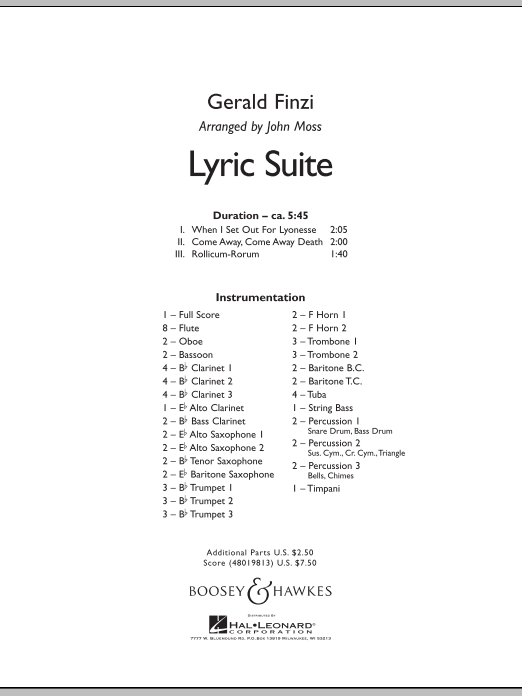
By Gerald Finzi / Arranged by John Moss

Grade: 3

Item: 35-PK00157001

Digital Download
$65.00

Parts Added to Cart!

Description
One of the most popular 20th-century British composers, Gerald Finzi is particularly known for his marvelous works for voice. Influenced by Elgar and Vaughan Williams, his musical style is captivating and distinctive, and adapts beautifully in instrumental settings. This attractive collection includes "When I Set out for Lyonesse," "Come Away, Come Away Death" and "Rollicum Rorum." Marvelous music for the contemporary wind band! Dur: 5:45

Lyric Suite: Concert Band Conductor Score & Parts isn't in MakeMusic Cloud just yet...but it could be. Let us know you'd like to see it, and you'll help shape what comes next. In the meantime, start a free trial and dive into thousands of interactive titles your students can play along with today.

Sample Audio
No sample audio found.
Sample Video
Additional Details
Publisher: Hal Leonard
SKU: 35-PK00157001

More about this title

About the Composer: Gerald Finzi

Gerald Finzi (1901-1956) stands as one of England's most distinctive voices in twentieth-century music, though he remains less performed than his towering contemporaries. His catalogue emphasizes the human voice, yet his instrumental works reveal the same lyrical gift and harmonic sophistication that made his songs unforgettable. Working in the shadow of Elgar and Vaughan Williams, Finzi absorbed their nationalist impulse while forging something entirely his own: music rooted in English pastoral tradition but filtered through a more introspective, often melancholic temperament.

For concert band directors, Finzi's arrangements like this Lyric Suite offer access to some of his most singable material without requiring a vocalist. These transcriptions preserve the melodic directness and warm orchestration that made his original vocal works beloved, proving that his genius extended well beyond the voice and into pure instrumental color.

Why we love this

John Moss's arrangement captures what makes Finzi's songs so immediately appealing: uncomplicated, direct melodies that sing themselves, harmonies that feel both modern and timeless, and a restraint that lets the music breathe. This isn't a complex transcription demanding virtuosity; it's a Grade 3 work that sounds like a concert piece, which is exactly what teachers need for mid-year programming.

What to expect

Three distinct emotional snapshots: the first piece surges with romantic longing, the second settles into something more introspective and bittersweet, the third bounces with folk-song character and English countryside charm. Throughout, there's a sense of genuine storytelling, with orchestration that feels intimate even at concert scale.

Who it's for

Conductors looking for a single work that can anchor a concert with something familiar yet not overdone, and program well alongside both baroque and contemporary repertoire. This suite sits comfortably at Grade 3 while offering musical substance that doesn't embarrass more advanced ensembles.

How to get the most out of it

  • Shape the sustained lines in the upper voices with subtle dynamic swells rather than keeping them flat. Finzi's songs depend on long phrases, and wind players often need permission to give those phrases gentle contour.
  • Balance the voices so the melody doesn't disappear beneath inner parts. Concert band homogeneity can obscure Finzi's often quiet harmonic sophistication.
  • Take a breath before each of the three movements begin, even if the score doesn't mark one. These songs deserve a moment to establish their separate moods.
  • Avoid bleating the dotted rhythms. A relaxed, singing quality in rhythm keeps Finzi's light touch from turning precious.

How to use it

Place this near the midpoint of a concert where you want to shift the energy toward lyricism and show your ensemble's ability to sustain a phrase. It works beautifully as a palate cleanser after something rhythmically active, or as the emotional heart of a concert devoted to British composers.

Skills your students will build

  • Sustaining long melodic lines without losing pitch center
  • Balancing chord voicings where the melody is not in the top voice
  • Responding to subtle dynamic and tempo variations in a through-composed work
  • Articulating dotted rhythms with gentleness rather than heaviness

You May Also Like