
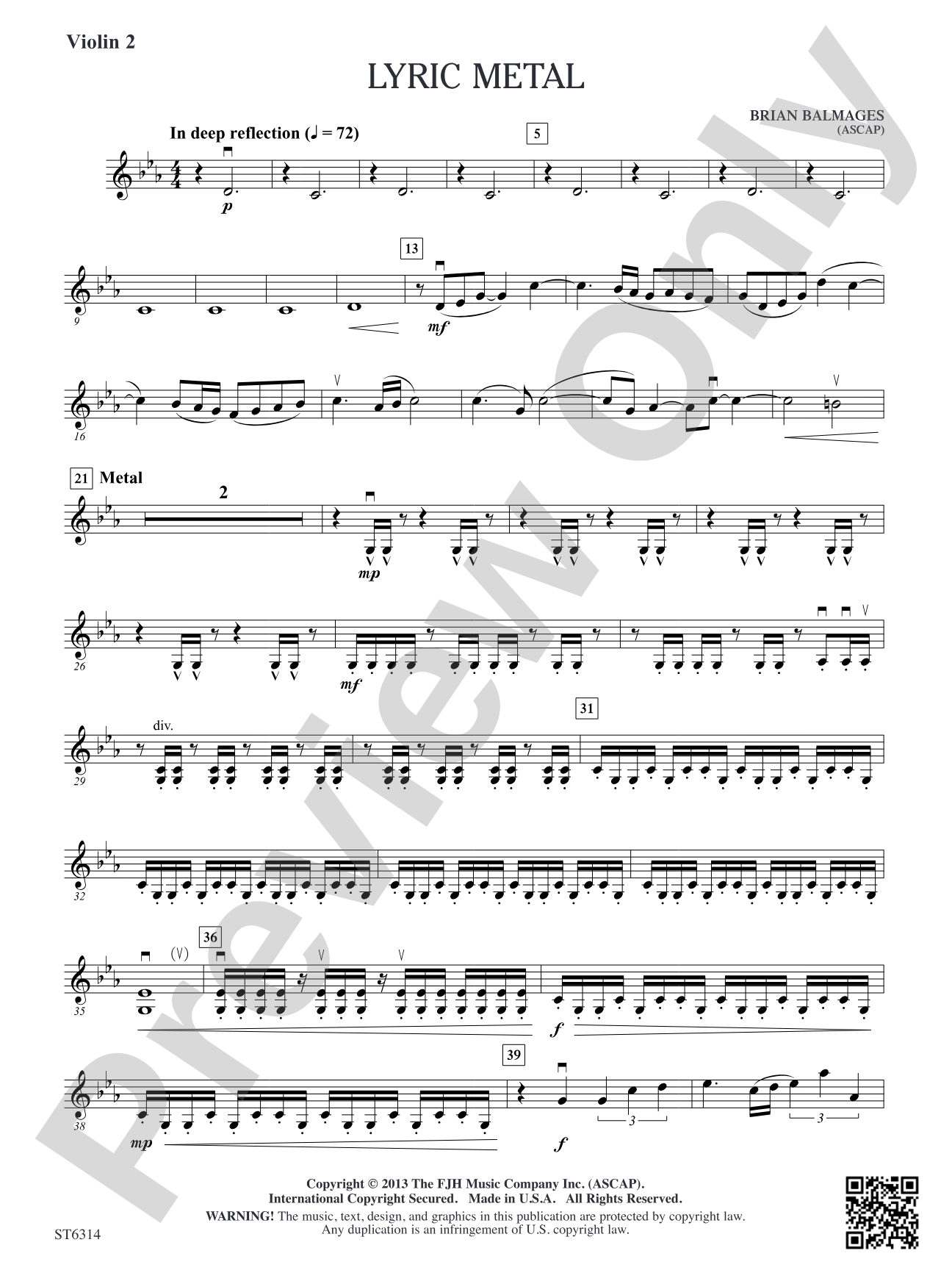

Lyric Metal: Violin 2
By Brian Balmages
Grade: 5
Item: 98-PC-DST6314_VN2
$7.00
Pickup currently not available
Description
Dark and passionate melodies are overcome with heavy metal inflection in this incredibly innovative and unique work for strings. The cello section imitates the sound of distorted guitars as the work unfolds, while upper strings soar over pulsating rhythms. Yes - heavy metal works for string orchestra. In fact, it works incredibly well! Wow!


Don't just read it, hear it, play along with it, and watch your students grow with it. In MakeMusic Cloud, Lyric Metal: Violin 2 comes alive with professional accompaniment, adjustable tempo, and built-in practice tools that turn solo practice into real progress.
Open in the Player
Jump straight in and assign it today.
Start Your Free Trial
Open this title and explore the full library in minutes.
Sample Audio
1
Audio File
--:--
0:00
0:00
Sample Video
No sample videos found.
Additional Details
Series:
FJH String Orchestra
Publisher:
The FJH Music Company, Inc.
SKU:
98-PC-DST6314_VN2
More about this title
About the Composer: Brian Balmages

Brian Balmages has established himself as a composer and conductor working fluidly across orchestral, band, and chamber repertoires. His works have been performed by ensembles spanning from professional symphony orchestras to elementary school groups in prestigious venues including Carnegie Hall, the Kennedy Center, Sydney Opera House, and Toronto Centre for the Arts. He is a recipient of the A. Austin Harding Award from the American School Band Directors Association and won the 2020 NBA William D. Revelli Composition Contest for Love and Light. He holds membership in the American Bandmasters Association and has received the James Madison University Distinguished Alumni Award from the School of Visual and Performing Arts.
Balmages maintains an active conducting schedule with all-state, regional, university, and professional ensembles worldwide, with notable guest appearances at the Midwest Clinic, Western International Band Clinic, and numerous state ASTA conferences. His music was performed at the 2013 Presidential Inaugural Prayer Service attended by President Obama and Vice President Biden. He was commissioned by the University of Miami to compose music for the inauguration of the institution's 6th president. Currently, he serves as Director of MakeMusic Publications and Digital Education for Alfred and MakeMusic.
Why we love this
Balmages brings serious compositional craft to an audacious concept: a metal-inflected string work that actually delivers on its premise rather than winking at it. The cello writing that mimics distorted guitars transforms a novelty concept into genuine orchestral innovation, and the juxtaposition of virtuosic upper string lines against heavy rhythmic drive creates the kind of distinctive sound that contest adjudicators and audiences remember.
What to expect
A collision of classical string writing and rock music intensity. The lower strings churn with the weight and distortion of amplified guitars while upper voices cut through with urgent, soaring lines over driving rhythms. There's a darkly theatrical quality, the kind of dramatic juxtaposition that makes audiences sit forward and reminds them that orchestral music doesn't have boundaries.
Who it's for
String orchestra directors at the Grade 5 level seeking repertoire that engages student musicians with contemporary musical language and appeals to modern audiences. This work suits ensembles comfortable with expressive playing, rhythmic precision, and bold tonal choices. It works equally well for festival programming, concert variety, or as a conversation starter about what orchestral music can be.
How to get the most out of it
- Give the cello section space to define the distorted guitar texture; their tone should be bold and unrefined, almost aggressively present in the mix rather than blended.
- Lock the rhythmic foundation early in rehearsals so that pulsating accompaniment figures become rock-solid before layering the soaring melodic material on top.
- Shape the dynamic contrasts decisively; the weight of heavy metal lives in stark shifts between sections, not gradual crescendos.
- Work dynamics and articulation across all string sections simultaneously so the metal aesthetic feels unified rather than a violin line sitting over a cello riff.
How to use it
Program this as a contemporary anchor that energizes a concert and showcases your ensemble's versatility. It pairs well with traditional repertoire on the same concert, offering a sharp tonal and stylistic contrast that keeps audiences engaged. The novelty factor also makes it memorable for festival competitions where distinctive programming stands out.
Skills your students will build
- Producing bold, focused tone with weight and projection rather than classical blend
- Executing sharp rhythmic precision in driving accompaniment figures while maintaining ensemble cohesion
- Balancing independent melodic lines against textural layers without losing collective sound
- Interpreting and executing metal-influenced articulation and dynamics with musical intent
- Reading and performing contemporary string orchestration techniques