
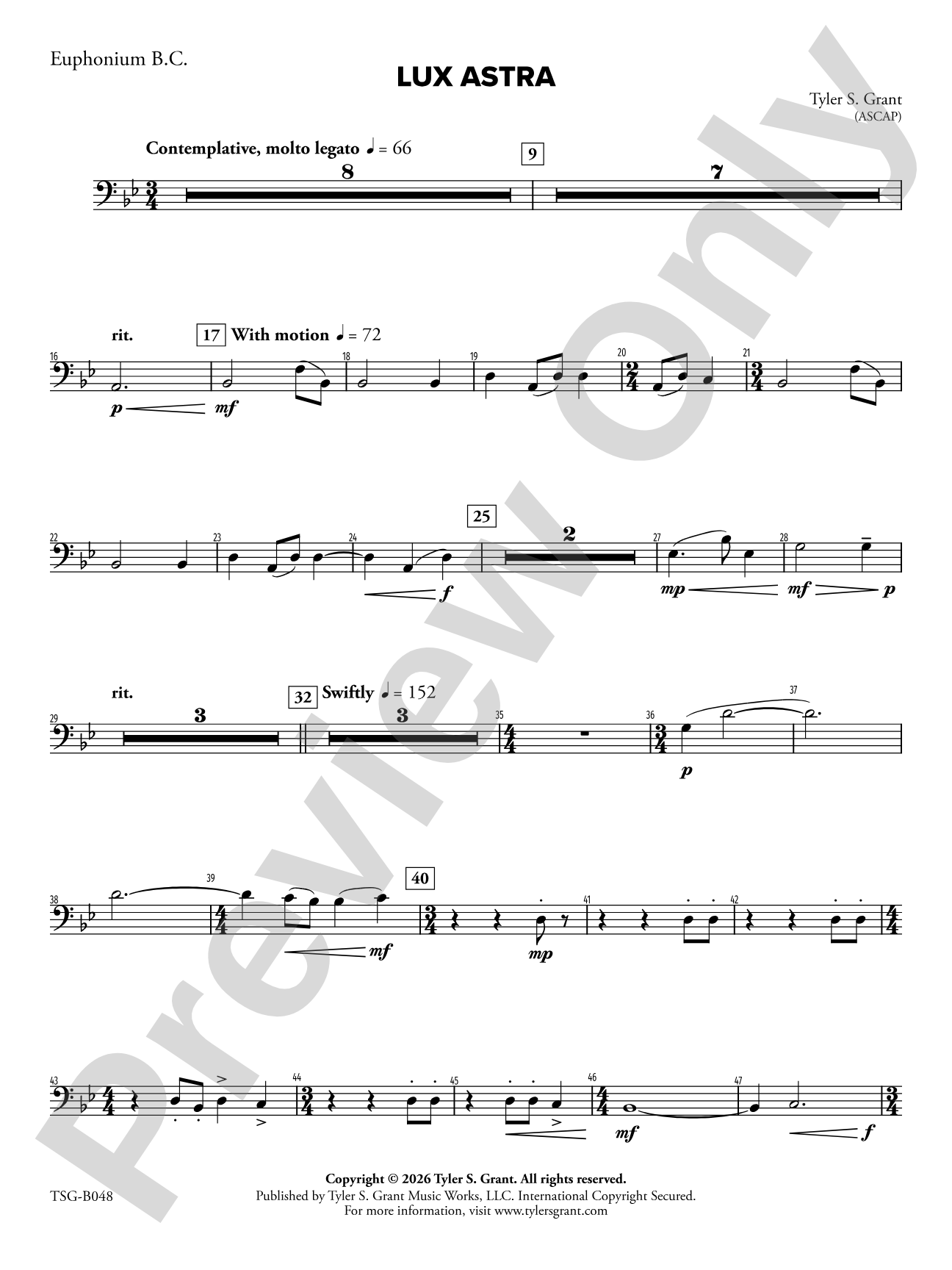

Lux Astra: Baritone B.C.
Tyler S. Grant
Item: 98-PC-0000073_BBC1
$3.00
Pickup currently not available
Description
A cosmic journey inspired by the radiant light of the stars, this work will transport your concert to unknown corners of the universe. Innovative instrumental color paired with contemporary harmonies provide a unique soundscape that will be memorable for students and audiences alike. A thrilling programmatic work with unlimited opportunities!


Discover MakeMusic Cloud: thousands of interactive titles your students can play along with today.
Sample Audio
1
Audio File
--:--
0:00
0:00
Sample Video
Additional Details
Publisher:
Tyler S. Grant Music Works
SKU:
98-PC-0000073_BBC1
Instrumentation:
Concert Band
More about this title
About the Composer: Tyler S. Grant

Tyler S. Grant has built a reputation as a sought-after composer and clinician whose works appear regularly on honor ensemble programs and curated repertoire lists across North America and beyond. His commissions have been performed at prestigious venues including Carnegie Hall, The Midwest Clinic, and the Macy's Thanksgiving Day Parade, and his composition Panoramic Fanfare won the Dallas Wind Symphony's 2014 Call for Fanfares Competition.
Beyond the composer's desk, Grant maintains an active conducting and teaching calendar, having worked clinically with over 100 school programs across 15 states and led all-state ensembles in multiple regions. A University of Alabama graduate, he studied conducting with Randall Coleman and credits mentor Brian Balmages as fundamental to his development. Grant also contributed to Alfred Music's Sound Innovations: Ensemble Development series and regularly shares insights through podcasts and publications including School Band & Orchestra Magazine.
Why we love this
Lux Astra reads as a concert work that respects your students' intelligence while rewarding their technical growth. Grant's orchestration choices feel deliberate rather than decorative, and the programmatic anchor gives your ensemble something concrete to rehearse toward rather than abstract gestures alone.
What to expect
A journey through unfamiliar harmonic terrain painted with instrumental colors that feel both modern and organic. The music evokes vast space without resorting to ambient wallpaper; instead it builds tension, shifts perspective, and delivers moments of radiance that stick with listeners long after the final chord.
Who it's for
Ambitious high school and college concert bands ready to program contemporary work with genuine substance. Festival and contest circuits will recognize Grant's craftsmanship immediately, though this piece works just as powerfully in concert settings where audiences value orchestral color and imaginative writing.
How to get the most out of it
- Build the dynamic arc gradually across sections. The cosmic imagery invites sustained tension, so resist the urge to peak early; save your brightest colors for moments Grant has clearly marked for them.
- Listen across the ensemble for balance in the high register, where contemporary harmonies can blur if any section runs away. Sectional balance matters as much as intonation here.
- Establish a clear pulse in rehearsal before diving into color work. Once the rhythm section has a unified foundation, the innovative instrumental writing lands much more effectively.
- Record a rehearsal and listen back specifically for phrase shape in the sustained passages. Visual score study helps, but your ear will catch balance issues the page won't show.
How to use it
Open a concert or festival program with this work to set an adventurous tone and signal to your audience that they're hearing a composer working at the current edge of the idiom. Pair it with contrasting programmatic or narrative pieces from different periods to create a thematic concert around storytelling in instrumental music.
Skills your students will build
- Sustaining tone color across long phrases in extended technique passages
- Reading and executing contemporary harmonic language and chromatic voice-leading
- Balancing transparent orchestration across the full ensemble
- Understanding and performing programmatic musical narrative without literal text
- Intonation precision in non-traditional harmonic contexts