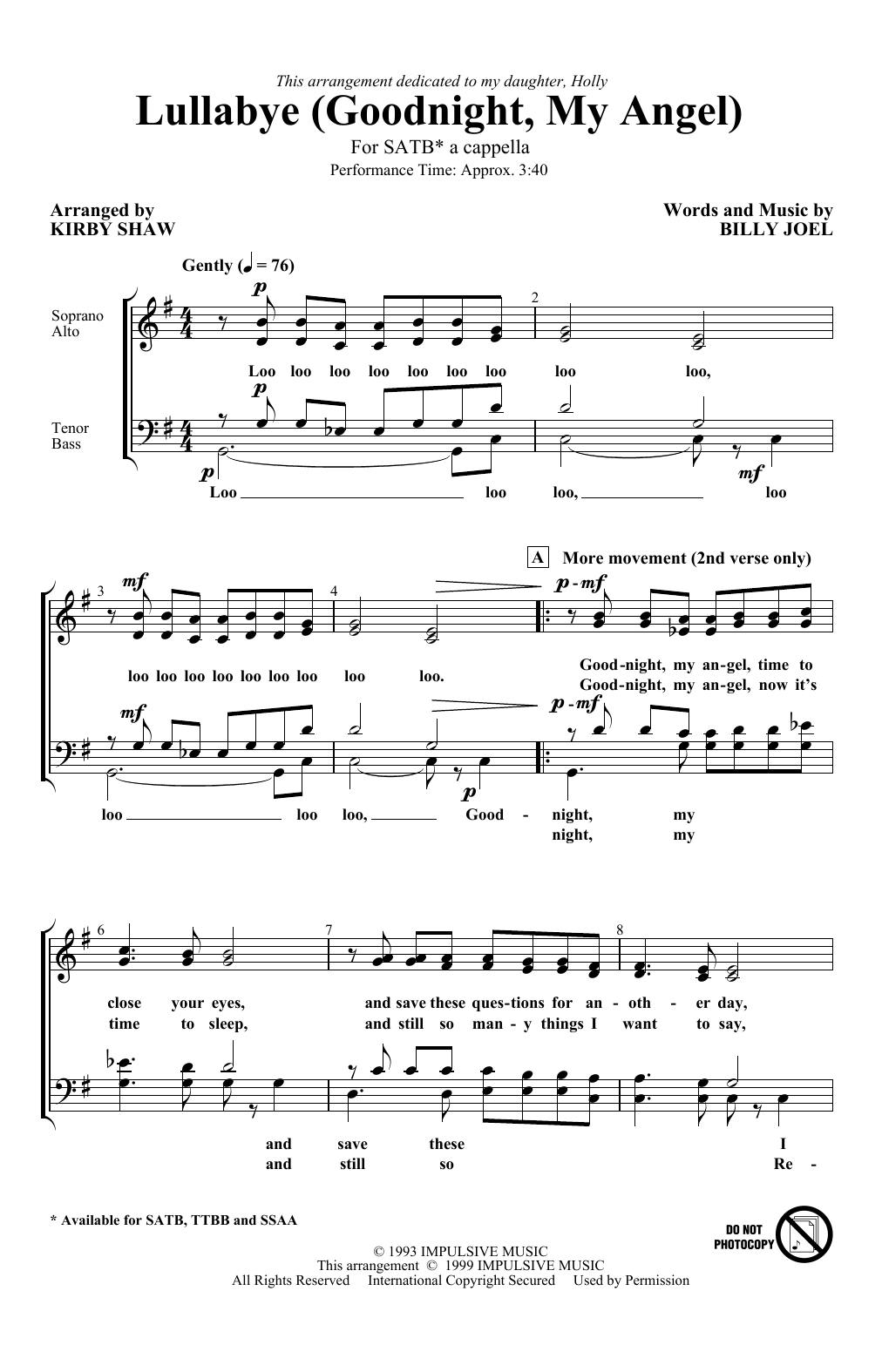
Lullabye (Goodnight, My Angel) (arr. Kirby Shaw) Sheet Music Preview

Lullabye (Goodnight, My Angel) (arr. Kirby Shaw): SATB Choral Octavo

As performed by Billy Joel / Arranged by Kirby Shaw

Grade: 3

Item: 35-DS00465652

Digital Download
$2.99
Description

Lullabye (Goodnight, My Angel) (arr. Kirby Shaw): SATB Choral Octavo isn't in MakeMusic Cloud just yet...but it could be. Let us know you'd like to see it, and you'll help shape what comes next. In the meantime, start a free trial and dive into thousands of interactive titles your students can play along with today.

Sample Audio
No sample audio found.
Sample Video
Additional Details
Publisher: Hal Leonard
Page Count: 5
SKU: 35-DS00465652

More about this title

About the Artist: Billy Joel

Billy Joel is a singer-songwriter whose catalog spans five decades of popular music, from classical training roots to arena rock and balladry. His ability to craft memorable melodies paired with emotionally direct lyrics has made his work a staple in both popular culture and music education settings.

Why we love this

Kirby Shaw's arrangement preserves the tenderness that makes this lullaby work while giving SATB ensembles a manageable, five-page package that doesn't oversimplify the emotional arc. Singers connect immediately to material they actually know, which builds ensemble confidence and allows you to focus on phrasing and balance rather than decoding unfamiliar harmonic language.

What to expect

Intimate and protective, like leaning close to someone you care for. The arrangement creates space for vulnerability without feeling sparse, allowing the melody to remain front and center while harmony quietly supports every phrase.

Who it's for

High school and collegiate choirs looking for repertoire that connects to students' lived musical experience. Works equally well in concert settings or as a thoughtful program closer that doesn't require additional accompaniment.

How to get the most out of it

  • Treat the dynamic contour as a journey, not a series of isolated moments. Map where the texture opens and closes across the full arc so the ending lands with genuine resolution rather than just fading out.
  • Layer your rehearsal by learning melodic lines first, then adding harmonic voices one part at a time. This piece's effectiveness depends on blend, and that blend emerges from singers who know exactly what they're supporting.
  • Let the a cappella texture breathe. Without instrumental support, every breath, every vowel shape, every tiny dynamic shift will register. Use that sensitivity as a feature, not a liability.

How to use it

Program this at the end of a concert where you want the audience to leave with a quiet, reflective moment. It pairs naturally with other contemporary pop arrangements or can stand alone as a palate cleanser before an energetic final piece.

Skills your students will build

  • Blending vowels across sustained harmonic passages
  • Maintaining ensemble tuning in a cappella texture
  • Shaping phrases through dynamic and textural contrast
  • Balancing accessibility with musical maturity

You May Also Like