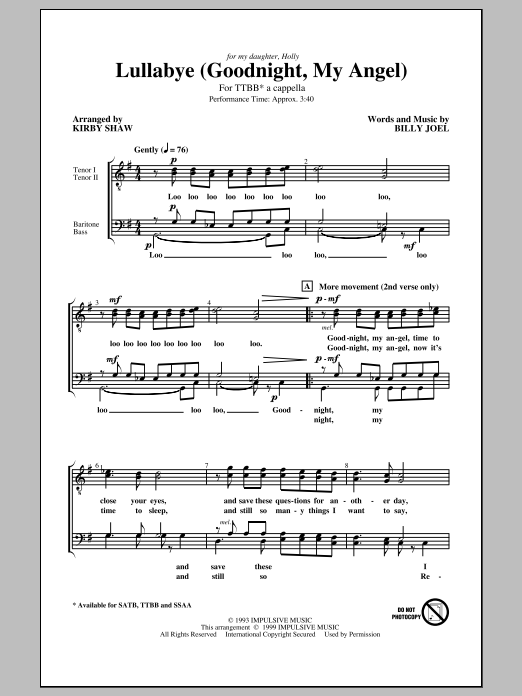
Lullabye (Goodnight, My Angel) (arr. Kirby Shaw) Sheet Music Preview

Lullabye (Goodnight, My Angel) (arr. Kirby Shaw): TTBB Choral Octavo

As performed by Billy Joel / Arranged by Kirby Shaw

Grade: 3

Item: 35-DS00297508

Digital Download
$2.99
Description

Lullabye (Goodnight, My Angel) (arr. Kirby Shaw): TTBB Choral Octavo isn't in MakeMusic Cloud just yet...but it could be. Let us know you'd like to see it, and you'll help shape what comes next. In the meantime, start a free trial and dive into thousands of interactive titles your students can play along with today.

Sample Audio
No sample audio found.
Sample Video
Additional Details
Publisher: Hal Leonard
Page Count: 5
SKU: 35-DS00297508

More about this title

About the Artist: Billy Joel

Billy Joel stands as one of the most significant songwriters of the late 20th century, bringing classical training and pop sensibility to a catalog that spans decades. His gift for melody and emotional directness makes his work particularly valuable in choral settings, where accessibility and genuine feeling matter equally.

Why we love this

Kirby Shaw's arrangement captures the tenderness of Joel's original without sacrificing the sophistication your singers need. A Grade 3 piece that genuinely moves audiences is rare; this one does both, making it ideal when you want emotional impact without overextending your ensemble's range or technical abilities.

What to expect

Gentle and protective, the way this arrangement unfolds feels like someone tucking in a child. There's vulnerability in the vocal writing that asks singers to find genuine softness and sustained lyricism within their range.

Who it's for

Male choirs seeking repertoire that feels contemporary without sounding trendy, and programs wanting a standout moment that doesn't require soloists or special staging. It works equally well for groups tackling a cappella for the first time.

How to get the most out of it

  • Balance the melody between the tenor parts; too much lead weight in the first tenor makes the second part disappear entirely.
  • Keep the bass line singing through sustained notes rather than letting it become a rhythmic afterthought.
  • Shape the phrase endings with slight breath releases rather than hard cutoffs; the lullaby's intimacy depends on it.
  • Record a run-through without the accompaniment once your singers are secure, then add it back. A cappella work first builds independence and ownership.

How to use it

Place this late in a concert where it can stand as a full moment rather than transition between louder numbers. The emotional geography makes it ideal as the closing piece of a set or as a bridge from more energetic repertoire into a reflective final section.

Skills your students will build

  • Sustaining warm, open vowels across extended phrase lengths
  • Balancing melody against sustained harmonic voices
  • Reading and executing a cappella rhythmic independence across four parts
  • Shaping dynamics through breath control rather than chest tension
  • Interpreting contemporary pop melody through choral voice leading

You May Also Like