Lullabye (Goodnight, My Angel) Sheet Music Preview

Lullabye (Goodnight, My Angel): SSA Choral Octavo

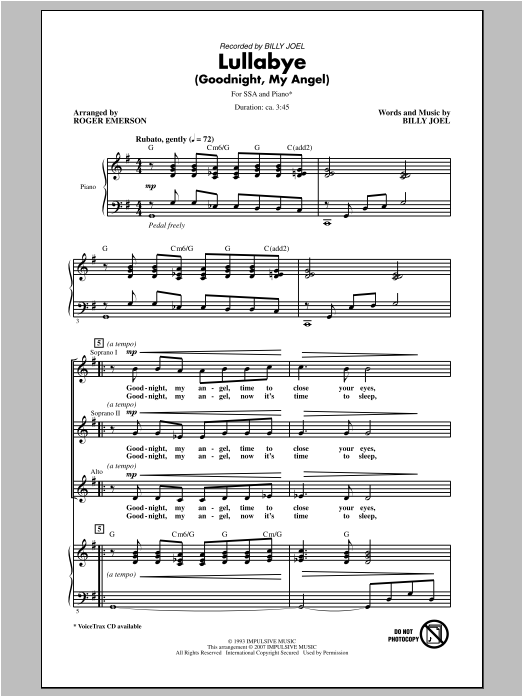
As performed by Billy Joel / Arranged by Roger Emerson

Item: 35-DS00254098

Digital Download
$2.50
Description

Lullabye (Goodnight, My Angel): SSA Choral Octavo isn't in MakeMusic Cloud just yet...but it could be. Let us know you'd like to see it, and you'll help shape what comes next. In the meantime, start a free trial and dive into thousands of interactive titles your students can play along with today.

Sample Audio
No sample audio found.
Sample Video
Additional Details
Publisher: Hal Leonard
Page Count: 12
SKU: 35-DS00254098

More about this title

About the Artist: Billy Joel

Billy Joel stands as one of the most commercially successful singer-songwriters in popular music history, with a catalog spanning five decades and countless platinum certifications. His gift for melody and his ability to craft songs that resonate across generations have made his work a natural fit for choral arrangers seeking material with emotional authenticity and broad appeal.

Why we love this

Roger Emerson's arrangement preserves the tender intimacy of Joel's original while creating space for three-part voices to bloom naturally. The SSA voicing allows you to program this lullaby in the second half of a concert, where its quiet vulnerability will land hardest with an audience.

What to expect

This arrangement captures the warmth of a parent singing a child to sleep. The harmonies settle gently beneath a floating melodic line, creating moments of luminous simplicity punctuated by subtle harmonic shifts that deepen the song's tenderness without interrupting its peaceful spell.

Who it's for

High school and adult choirs looking for repertoire that connects singers emotionally without demanding extensive vocal range or technical complexity. The arrangement welcomes singers new to three-part voicing while offering enough harmonic sophistication to engage experienced musicians.

How to get the most out of it

  • Resist the urge to add vibrato in the opening phrases; straight tone through the first verse keeps the song's storytelling front and center.
  • Balance the alto line carefully when it carries harmonic interest beneath the melody; the song requires blend, not blend-through-balance.
  • Shape phrases around the lyrical content rather than harmonic cadences, letting the text dictate your breath points and dynamic contours.

How to use it

Place this near the end of a concert set, either as your final selection or immediately before a single contrasting piece. Its contemplative character makes it especially effective in spring or winter programs, and it works particularly well when paired with other contemporary song arrangements.

Skills your students will build

  • Sustaining long vocal lines with consistent tone quality
  • Blending three-part harmony in close voicing
  • Shaping phrases based on lyrical and emotional content rather than harmonic structure
  • Balancing melody and harmony when they occupy similar registers

You May Also Like