
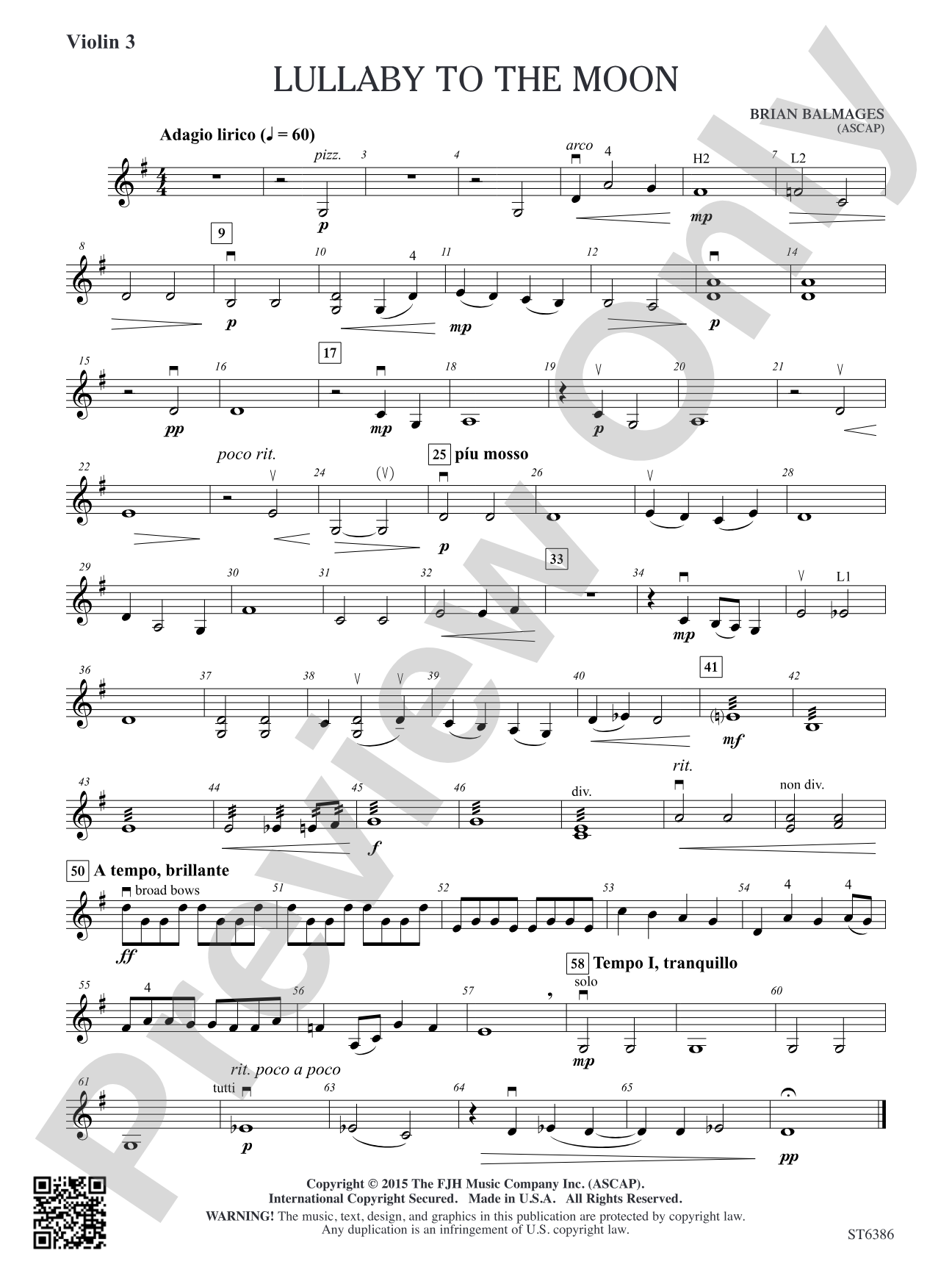

Lullaby to the Moon: Violin 3 (Viola T.C.)
By Brian Balmages
Grade: 2
Item: 98-PC-DST6386_VN3
$7.00
Pickup currently not available
Description
Many fictional works portray the moon as a living being, alone in space looking at the Earth. This lullaby honors this "living moon," portraying various emotions including the loneliness of seeing us from space. It also includes moments of comfort as the moon proudly watches over us, much as a parent watches over a child. Simply stunning, whether you have a grade 2 or a grade 6 ensemble. (4:15)


Don't just read it, hear it, play along with it, and watch your students grow with it. In MakeMusic Cloud, Lullaby to the Moon: Violin 3 (Viola T.C.) comes alive with professional accompaniment, adjustable tempo, and built-in practice tools that turn solo practice into real progress.
Open in the Player
Jump straight in and assign it today.
Start Your Free Trial
Open this title and explore the full library in minutes.
Sample Audio
1
Audio File
--:--
0:00
0:00
Sample Video
No sample videos found.
Additional Details
Series:
FJH Developing Strings
Publisher:
The FJH Music Company, Inc.
SKU:
98-PC-DST6386_VN3
More about this title
About the Composer: Brian Balmages

Brian Balmages has built an international reputation as a composer and conductor working across orchestral, band, and chamber idioms. His works have been performed by ensembles ranging from professional symphonies to school orchestras in landmark venues including Carnegie Hall, the Kennedy Center, and the Sydney Opera House. He earned the A. Austin Harding Award from the American School Band Directors Association and won the 2020 NBA William D. Revelli Composition Contest. An elected member of the American Bandmasters Association, Balmages received the inaugural James Madison University Distinguished Alumni Award and was commissioned by the University of Miami to compose for the inauguration of its sixth president.
As a conductor, Balmages maintains regular guest engagements with all-state ensembles, university orchestras, and professional groups worldwide. His conducting appearances have included the Midwest Clinic, Western International Band Clinic, and numerous state ASTA conferences. He currently serves as Director of MakeMusic Publications and Digital Education for Alfred and MakeMusic.
Why we love this
Balmages achieves something rare at grade 2: genuine emotional storytelling without oversimplifying the orchestration. The piece works beautifully with developing ensembles while offering enough musical sophistication to reward careful rehearsal. The programmatic concept engages students immediately, making the work both accessible and memorable.
What to expect
The music evokes a vast, quiet solitude from which tenderness emerges. There is yearning and beauty in the lullaby itself, punctuated by moments where the moon's protective vigil becomes almost parental in its warmth. The orchestration breathes with space, allowing listeners to inhabit the emotional journey of watching over a distant world.
Who it's for
This score and parts set is designed for string orchestras at the grade 2 level, though the composition scales successfully to more advanced ensembles. Conductors leading developing orchestras will find a piece that combines technical accessibility with genuine musicality, making it ideal for building both fundamentals and interpretive skills.
How to get the most out of it
- Shape each phrase with awareness of the moon's perspective. The lullaby quality asks for legato playing and careful attention to phrase endings, resisting the impulse to rush.
- Balance solo lines that emerge in different sections. Depending on your string distribution, you may need to bring out a single violin or viola voice while keeping the accompaniment warm and supportive.
- Explore dynamic contrast between the lonely passages and the protective moments. Letting these emotional shifts breathe will make the programmatic arc clear to your audience.
- Use the full four-minute duration to settle into the piece's atmosphere. Avoid rushing the slower sections; patience allows the poetic imagery to land.
How to use it
Program this as a lyrical centerpiece in a concert dominated by lighter fare, or use it as a thoughtful opener that establishes an introspective tone. Its contest and festival credentials make it equally at home in a competition setting, where its emotional depth and clear structure will stand out among other grade 2 selections.
Skills your students will build
- Phrasing and legato playing in extended melodic lines
- Dynamic contrast and expressive control within a limited range
- Listening for balance between principal voices and accompaniment
- Musical storytelling through programmatic thinking
- Intonation stability in sustained harmonic passages