Lullaby of Broadway (from "Golddiggers of 1935") Sheet Music Preview

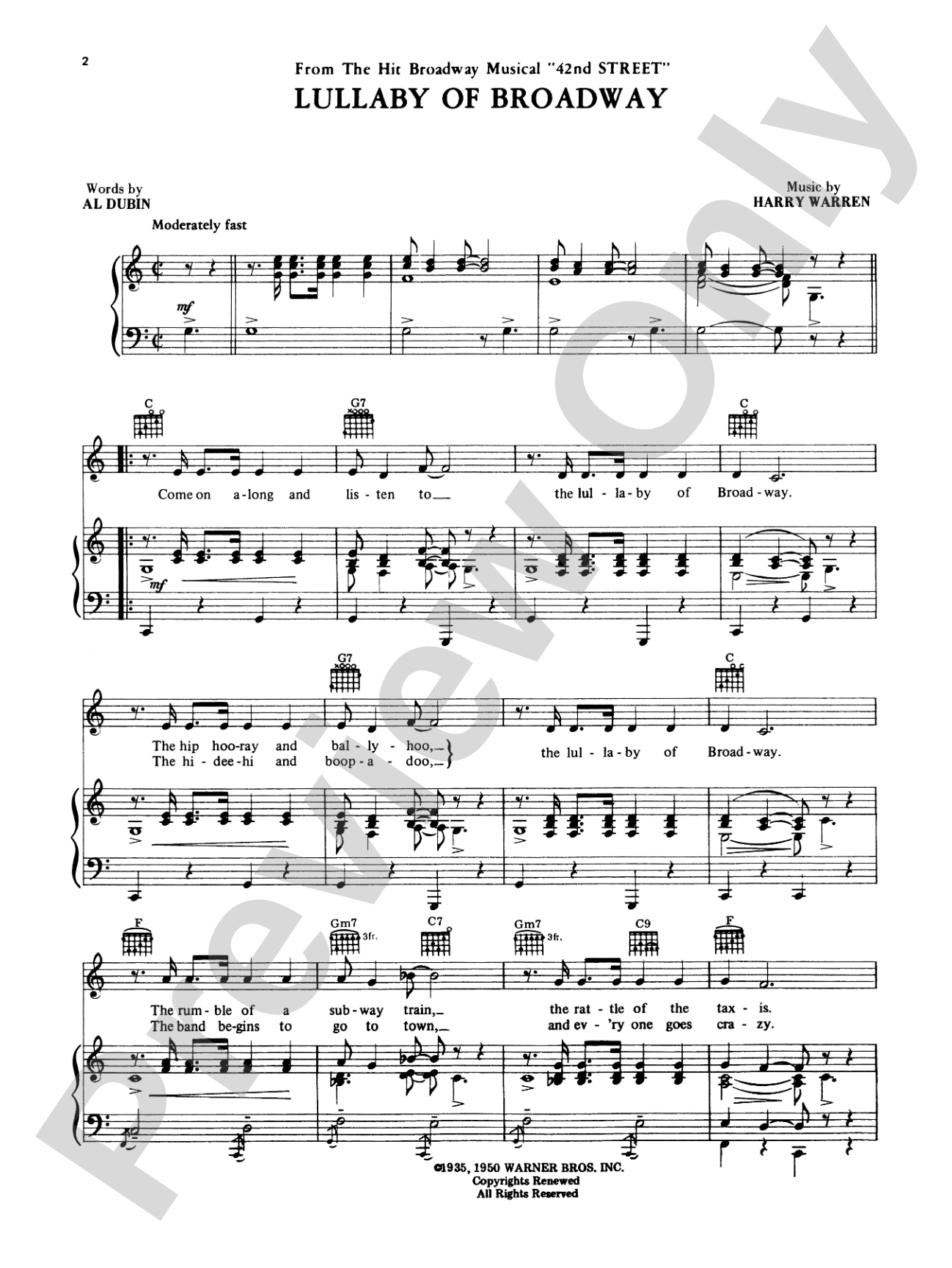
Lullaby of Broadway (from "Golddiggers of 1935"): Piano/Vocal/Chords

Words by Al Dubin, music by Harry Warren

Item: 00-PIP-000106

Digital Download
$3.99

One moment…

Description

Lullaby of Broadway (from "Golddiggers of 1935"): Piano/Vocal/Chords isn't in MakeMusic Cloud just yet...but it could be. Let us know you'd like to see it, and you'll help shape what comes next. In the meantime, start a free trial and dive into thousands of interactive titles your students can play along with today.

Sample Audio
No sample audio found.
Sample Video
Additional Details
Publisher: Alfred Music
Page Count: 4
SKU: 00-PIP-000106

More about this title

About the Composer: Harry Warren

Harry Warren (1893-1981) composed some of the most durable songs of the Great American Songbook, writing for Broadway and Hollywood throughout a career spanning five decades. He understood how to craft melodies that lodge in memory while supporting them with harmonies sophisticated enough for serious musicians, a combination that made his work endure long after the shows closed.

Why we love this

This arrangement captures the energy and theatrical charm of a Depression-era production number while remaining playable in intimate settings. The piano part is muscular enough to carry the song on its own, yet the vocal line sings beautifully with minimal accompaniment, giving singers room to interpret the text with personality and style.

What to expect

Broadway at its most seductive: the song has the lilt of a street serenade, the harmony of a savvy songwriter, and the theatrical wink of a number that knows how to charm an audience. There's sophistication in the simplicity here, with familiar progressions handled in ways that feel fresh rather than tired.

Who it's for

Pianists and singers preparing material for recitals, auditions, or casual performance settings will find this accessible yet musically substantive. Jazz and musical theatre students can study how a master melodist shaped singable lines that work across multiple styles and interpretations.

How to get the most out of it

  • Keep the rhythm bouncy and light despite the song's late-night setting; "Lullaby" here means something closer to a jazzy serenade than a gentle cradle song.
  • Shape the melody with the natural rise and fall of speech rhythms rather than dividing phrases into rigid four-bar units; let the lyrics guide your phrasing.
  • Use the chord symbols to explore jazz voicings and comping styles that suit your ensemble's sound, whether swinging the eighths or playing them straight.

How to use it

Include this in a standards-based recital or as a bridge between classical and musical theatre programming. It pairs well with other Golden Age songs in a cabaret-style concert, or stands alone as an encore that audiences recognize and enjoy.

Skills your students will build

  • Reading lead sheet notation and chord symbols with fluency
  • Interpreting jazz and swing rhythms in a popular song context
  • Balancing melodic singing with the independence of a pianist's part
  • Understanding harmonic language of the Great American Songbook

You May Also Like