
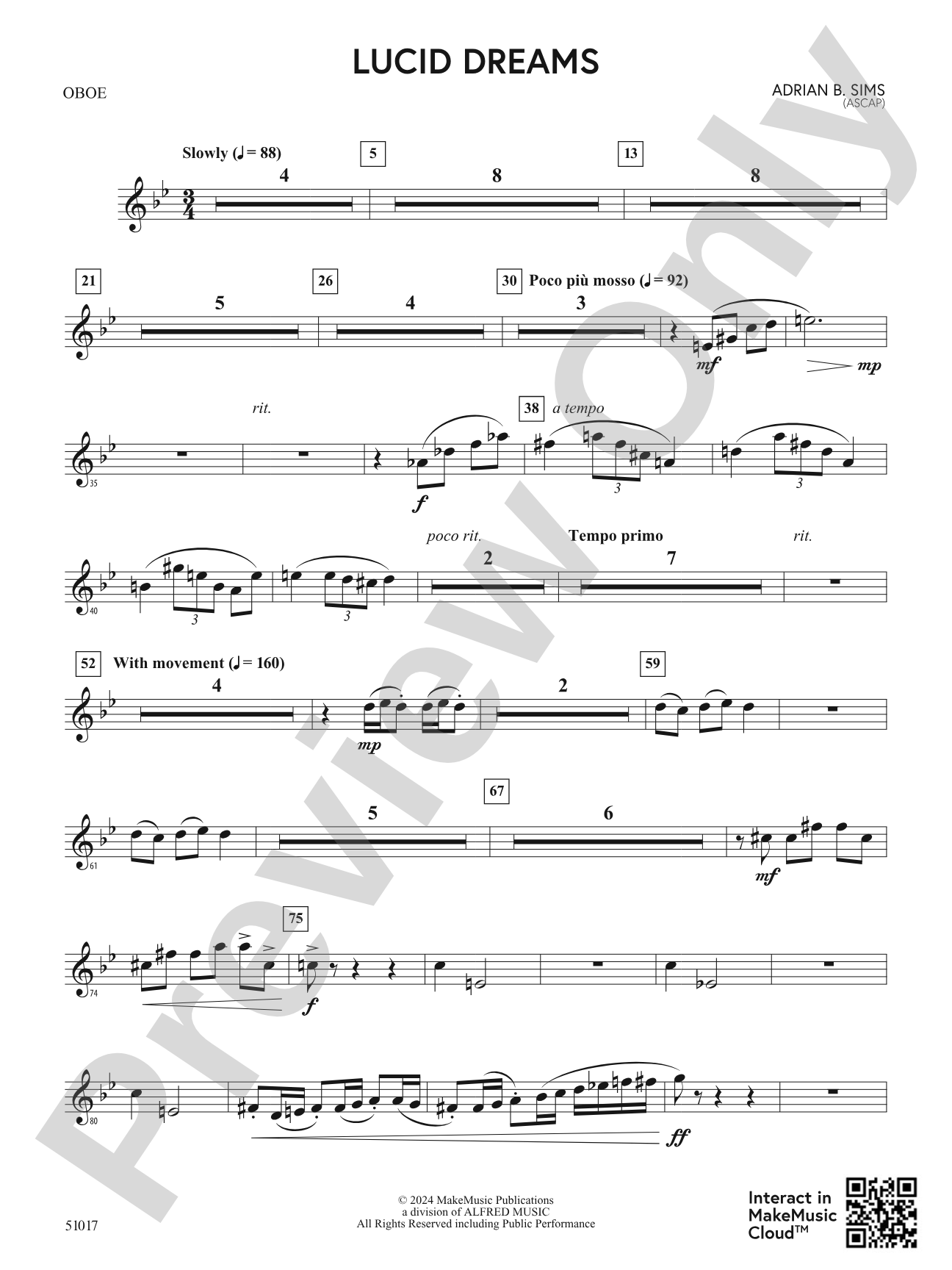

Lucid Dreams: Oboe
By Adrian B. Sims
Grade: 4.5
Item: 00-PC-0019229_O1
$3.00
Pickup currently not available
Description
Travel to the unknown in Lucid Dreams, an exciting work based on a five-note melodic idea that can't quite make up its harmonic mind. Adrian B. Sims takes the listener through musical hallucinations, both haunting and breathtaking, concluding with chords so glorious people may quite literally think they are dreaming! (4:40)


Don't just read it, hear it, play along with it, and watch your students grow with it. In MakeMusic Cloud, Lucid Dreams: Oboe comes alive with professional accompaniment, adjustable tempo, and built-in practice tools that turn solo practice into real progress.
Open in the Player
Jump straight in and assign it today.
Start Your Free Trial
Open this title and explore the full library in minutes.
Sample Audio
1
Audio File
--:--
0:00
0:00
Sample Video
Additional Details
Series:
MakeMusic Symphonic Band
Publisher:
MakeMusic Publications
SKU:
00-PC-0019229_O1
More about this title
About the Composer: Adrian B. Sims

Adrian B. Sims (born 2000) grew up in Seattle, Washington, and earned recognition early as a young composer. His works have appeared at The Midwest Band and Orchestra Clinic and placed on the Bandworld Top 100 List. He has won composition competitions through the Maryland Music Educators Association Young Composers Project and the Make Music Young Composers Contest, with performances across Maryland schools.
As both conductor and trombonist, Sims brings performer's insight to his writing. He participated in Maryland All-State Band and performed alongside the Baltimore Symphony Orchestra during high school. He currently studies music education and composition at the University of Maryland, where he works with composer Brian Balmages and studies trombone with Matthew Guilford, solo bass trombonist with the National Symphony Orchestra.
Why we love this
Sims creates a genuinely compelling soundworld from a single five-note cell, letting it drift through different harmonic contexts rather than forcing obvious resolutions. The progression from unsettling, dreamlike passages to those final radiant chords gives bands a satisfying arc that engages students and audiences alike. At Grade 4.5, the writing is sophisticated enough to reward careful rehearsal without overwhelming developing ensembles.
What to expect
Lucid Dreams inhabits a space between unease and wonder. The five-note idea surfaces repeatedly, sometimes ethereal, sometimes haunting, while the harmony shifts in ways that keep the listener slightly off balance. The journey concludes in breathtaking resolution, as if waking from a vivid dream into certainty.
Who it's for
Conductors seeking a Grade 4.5 work that challenges students musically and harmonically without excessive technical demands. Bands that are ready to work with programmatic music built on compositional sophistication rather than obvious theatrical effects will find rich material here.
How to get the most out of it
- Shape the five-note idea as a continuous thought across sections rather than a rhythmic pattern. This melodic consistency will help audiences hear the work's conceptual unity even as harmonies shift around it.
- Emphasize dynamic contrast between the haunting middle sections and the climactic moments. These shifts create the dream-logic progression that defines the piece.
- Balance clarity in inner voices; harmonic ambiguity only works when students articulate each voice distinctly, especially in passages where the melodic idea passes between sections.
- Let the final chord resonate fully. Sims writes toward this moment intentionally, so give it weight and allow it to land with the full, glorious impact he envisions.
How to use it
Program this as a centerpiece for a festival or concert featuring contemporary band works. Its four-minute-forty-second length and dramatic arc make it ideal for a concert that balances traditional and modern repertoire, or as a striking opening number that sets an artistic tone for the entire program.
Skills your students will build
- Following a recurring melodic motif across changing harmonic contexts
- Dynamic shaping to reflect programmatic intent and emotional arc
- Precision in voicing and balance when harmonic function is ambiguous
- Sectional independence and listening while maintaining ensemble cohesion