
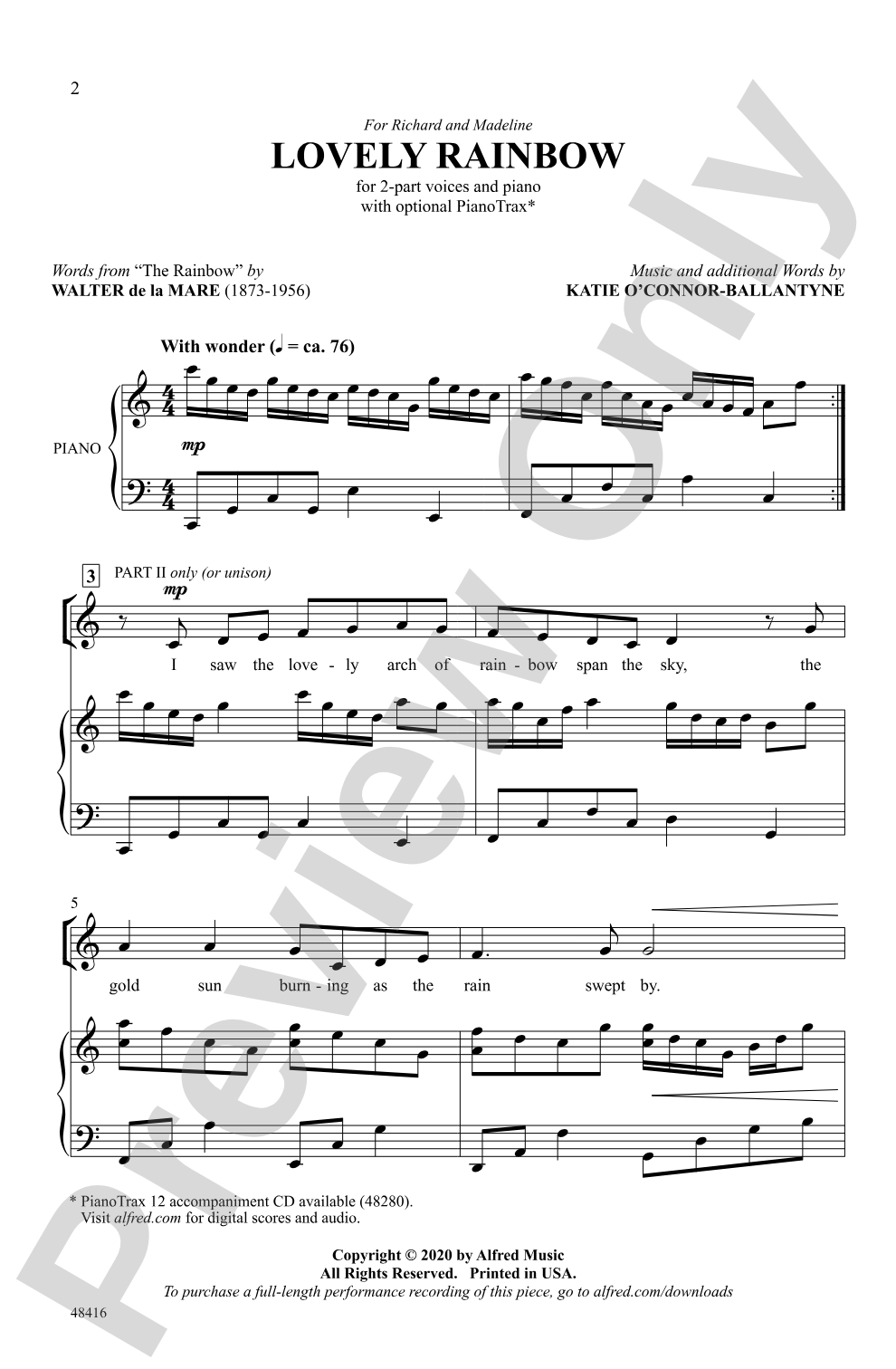

Lovely Rainbow: 2-Part Choral Octavo
Words by Walter de la Mare, music by Katie O'Connor-Ballantyne
Item: 00-PO-0006358
$2.05
Minimum order quantity: 20 copies
Pickup currently not available
Description
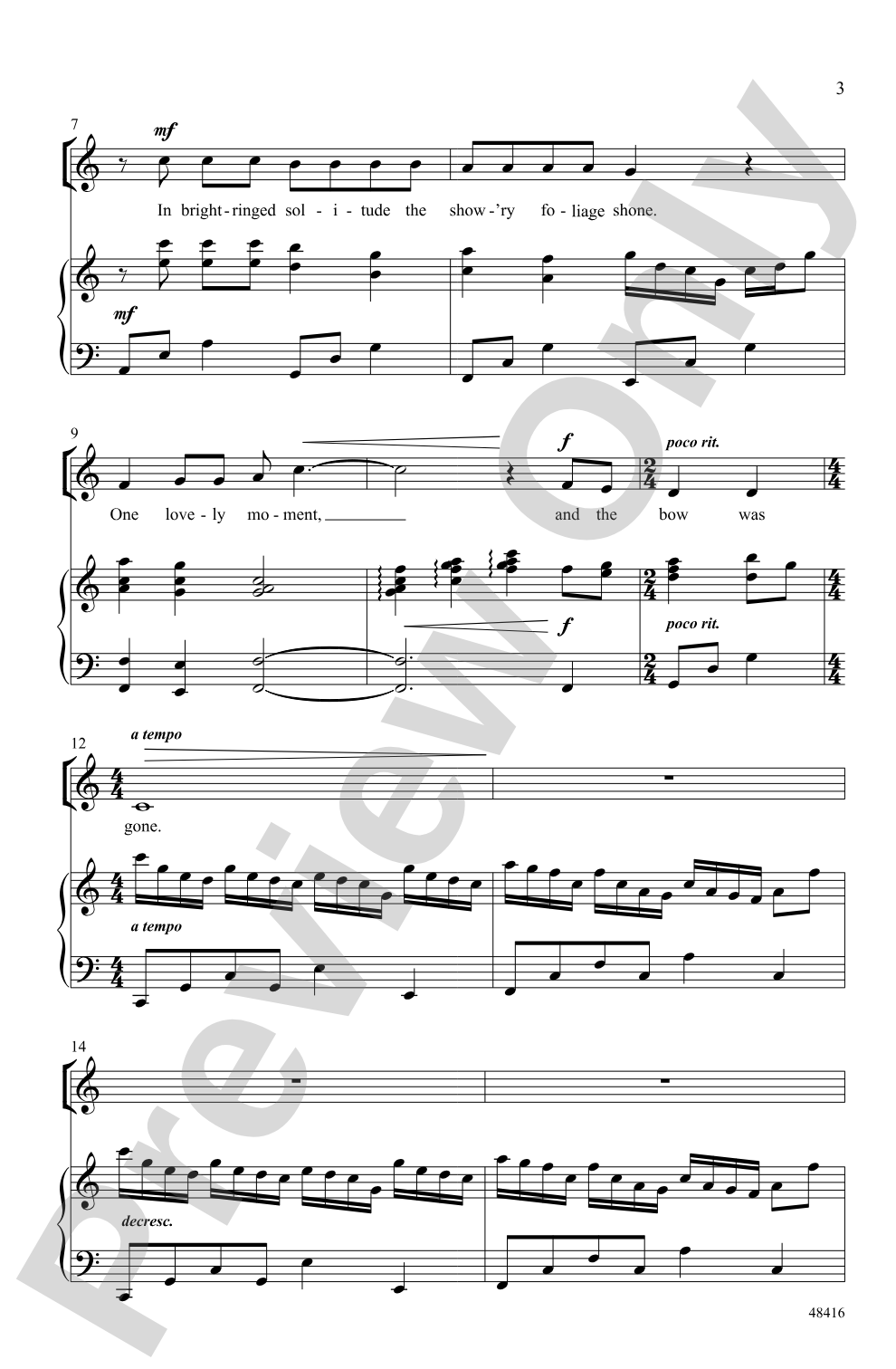
Written with developing voices and ears in mind, this partner song setting of the colorful poem "The Rainbow" is just right for choirs seeking to build harmony-singing skills. Independent yet complementary melodic lines encourage singers to retain their individual parts, while the cascading piano accompaniment subtly reinforces key notes and entrances. A great piece to grow on!


Lovely Rainbow: 2-Part Choral Octavo isn't in MakeMusic Cloud just yet...but it could be. Let us know you'd like to see it, and you'll help shape what comes next. In the meantime, start a free trial and dive into thousands of interactive titles your students can play along with today.
Request This Title
Tell us you want it.
Start Your Free Trial
Explore everything that's ready to play right now.
Sample Audio
1
Audio File
--:--
0:00
0:00
Sample Video
Additional Details
Series:
Alfred Choral Designs
Publisher:
Alfred Music
Page Count:
8
SKU:
00-PO-0006358
More about this title
About the Composer: Katie O'Connor Ballantyne

Katie O'Connor Ballantyne brings classroom experience across the full spectrum of music education to her compositional work. She has taught general music and piano to elementary students, directed choirs at the middle and high school levels, and worked with undergraduate musicians in aural skills and theory. Her teaching positions have included adjunct faculty work at Ithaca College's School of Music and artistic direction of the Ithaca Children and Youth Chorus.
Beyond composition, O'Connor Ballantyne has authored instructional texts including Harmony Handbook and Finding Your Teacher Voice, and serves actively as a guest conductor, festival adjudicator, and presenter at music education conferences nationwide. She holds degrees from Ithaca College (BM in Music Education and Vocal Performance) and the University of Limerick (MA in Chant and Ritual Song).
Why we love this
O'Connor Ballantyne designed this piece specifically for singers still building their part-singing independence. The two lines feel genuinely complementary rather than competitive, and the piano accompaniment listens to your singers, supporting entries and reinforcing their harmonic function without overwhelming the texture. Repertoire this thoughtfully crafted makes ensemble conductors' jobs easier.
What to expect
The imagery of a rainbow gives the music a sense of wonder and gentle movement. The two melodic lines wind around each other like the spectrum itself, creating moments of consonance and shimmer without ever feeling angular or difficult.
Who it's for
This octavo suits developing choirs in middle school and early high school, or any ensemble taking its first serious steps toward two-part harmony. Singers need enough individual confidence in their own line before they can truly listen to another part; this piece is calibrated for exactly that readiness level.
How to get the most out of it
- Have singers learn their parts separately first, then bring them together only after each line feels secure and confident.
- Use the cascading piano figures as a learning tool during rehearsal; they mark phrase boundaries and reinforce tonal centers that young singers need to hear.
- Encourage singers to listen horizontally through their own melodic line rather than vertically to the other part; this builds sustained line and reduces the impulse to drift toward the harmony.
How to use it
Program this alongside other accessible two-part repertoire in a concert celebrating spring or seasonal themes, or use it in a festival or adjudicated competition as a confidence-builder for singers still developing their ears. It also works well in a rehearsal sequence where directors want to demonstrate how independent parts can create richer harmony without losing clarity.
Skills your students will build
- Retaining an independent melodic line while singing concurrently with another part
- Hearing and maintaining harmonic function within a two-part texture
- Responding to piano accompaniment cues for entrances and phrase shaping
- Building confidence in unison and two-part blend