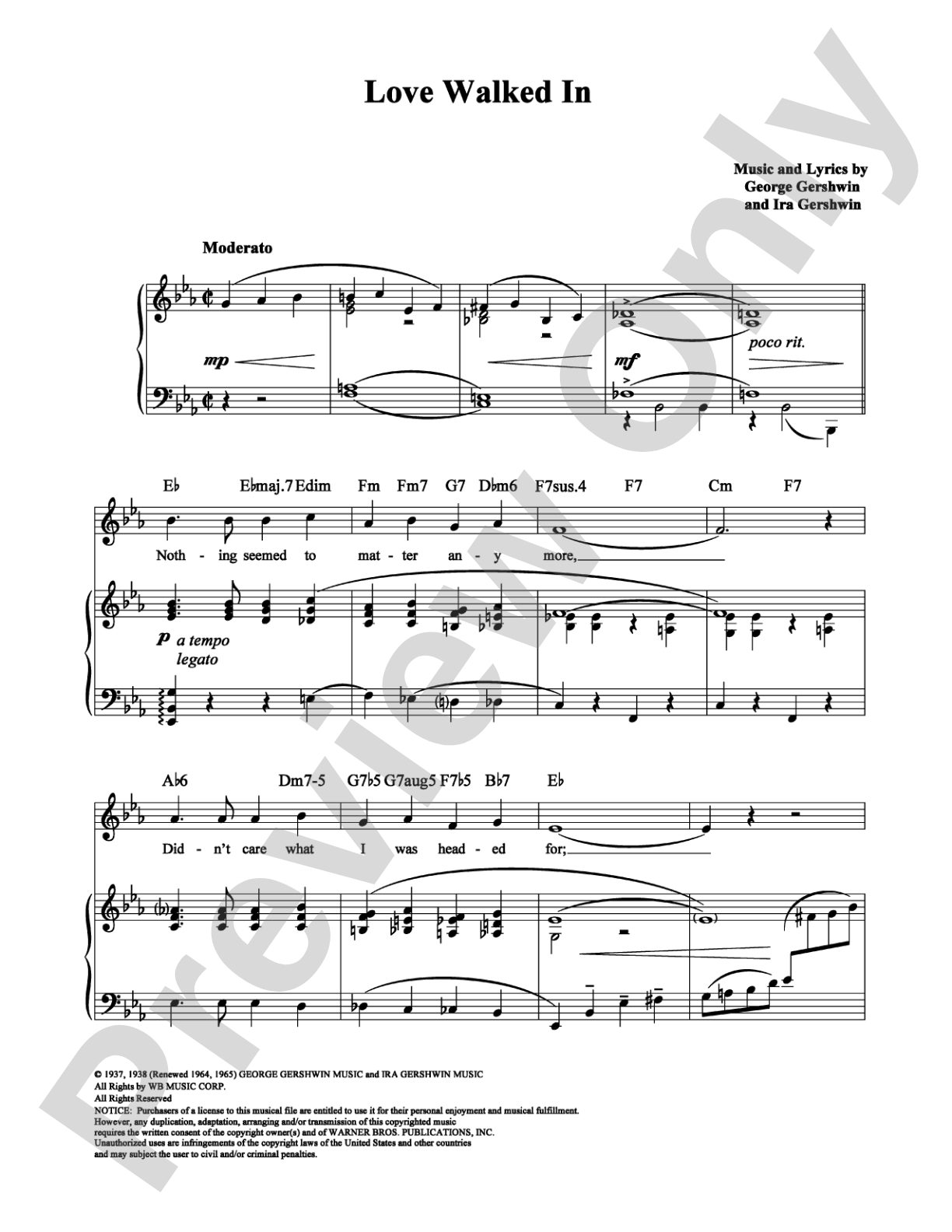
Love Walked In: Piano/Vocal/Chords Digital Sheet Music

Love Walked In: Piano/Vocal/Chords Digital Sheet Music

George Gershwin, Louis Armstrong, Sammy Kaye, Kenny Baker

Item: 00-PS-0004548

Digital Download
$3.99
Description

Love Walked In: Piano/Vocal/Chords Digital Sheet Music isn't in MakeMusic Cloud just yet...but it could be. Let us know you'd like to see it, and you'll help shape what comes next. In the meantime, start a free trial and dive into thousands of interactive titles your students can play along with today.

Sample Audio
No sample audio found.
Sample Video
Additional Details
SKU: 00-PS-0004548

More about this title

About the Artist: Louis Armstrong

Louis Armstrong (1901-1971) fundamentally shaped American music through his revolutionary approach to jazz improvisation and his warm, instantly recognizable voice. His influence extends far beyond jazz into popular song, where his interpretations of standards became the benchmark for generations of singers and musicians. Armstrong's ability to swing a melody while maintaining emotional directness made him one of the most recorded artists of the twentieth century.

Why we love this

This standard sits at the intersection of jazz sophistication and popular accessibility, making it ideal for singers who want to explore swing phrasing within a familiar harmonic framework. The chord changes reward players who understand voice leading while remaining approachable for intermediate pianists accompanying vocalists.

What to expect

Warm and inviting, with a gentle swagger underneath. The melody unfolds conversationally over changes that shimmer with chromatic color, evoking that moment when affection arrives unexpectedly.

Who it's for

Vocalists building a repertoire of jazz standards and pianists seeking experience accompanying singers through changes with harmonic depth. This work serves singers preparing for recitals, auditions, or performance in jazz and musical theatre contexts.

How to get the most out of it

  • Treat the rhythm section feel as a priority; the piano should lay back slightly on the beat rather than landing squarely on it, mimicking the swing conventions Armstrong brought to this tune.
  • Let the vocal line breathe naturally over the changes rather than observing strict time; this flexibility between voice and piano creates the conversational quality the song demands.
  • Explore the chromatic movement in the harmony and allow minor chord substitutions to color individual phrases without overshadowing the melody's simplicity.
  • Balance the accompaniment texture to support without overwhelming the vocalist; comping strategically during vocal passages leaves space for the lyric to land clearly.

How to use it

Program this alongside other standards from the 1930s-40s era to create a set exploring American popular song, or feature it in a jazz recital alongside more uptempo numbers for contrast. It works equally well in a cabaret-style program or as a solo performance showcasing vocalist-pianist collaboration.

Skills your students will build

  • Swing rhythm and articulation in melody and accompaniment
  • Reading and executing jazz chord changes and reharmonization
  • Balance and texture when accompanying a vocalist
  • Phrasing over bar lines in a conversational melodic style
  • Chromatic voice leading in jazz harmony

You May Also Like