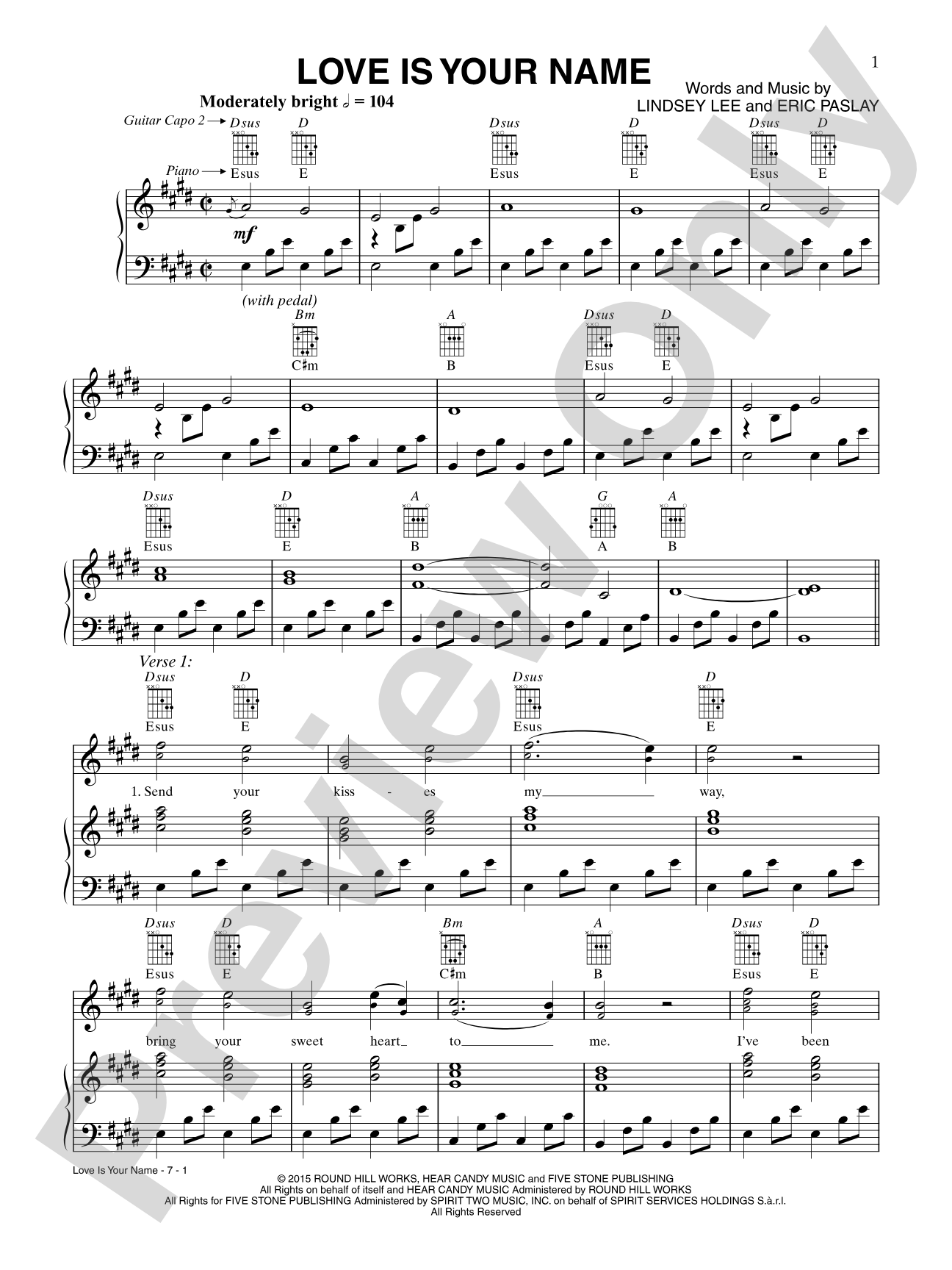
Love Is Your Name: Piano/Vocal/Guitar Digital Sheet Music

Love Is Your Name: Piano/Vocal/Guitar Digital Sheet Music

Eric Paslay, Lindsey Lee

Item: 00-PS-0015997

Digital Download
$3.99
Description

Love Is Your Name: Piano/Vocal/Guitar Digital Sheet Music isn't in MakeMusic Cloud just yet...but it could be. Let us know you'd like to see it, and you'll help shape what comes next. In the meantime, start a free trial and dive into thousands of interactive titles your students can play along with today.

Sample Audio
No sample audio found.
Sample Video
Additional Details
SKU: 00-PS-0015997

More about this title

Why we love this

The three-part layout gives guitarists real flexibility: follow your own part while tracking the vocal melody and harmonic structure, or use it as a springboard for reharmonization and improvisation. Pop rock guitar parts demand both rhythmic precision and interpretive choice, and this format supports both without forcing you into a predetermined arrangement.

What to expect

A contemporary pop rock song built on the assertion that love defines identity. The energy is uplifting and declarative, with the guitar likely serving as both rhythmic anchor and melodic support depending on the arrangement style.

Who it's for

Guitarists who sing or perform alongside vocalists in pop rock contexts, as well as music directors preparing arrangements for small ensembles or contemporary worship settings. This format also suits self-teaching musicians who want to understand how melody, harmony, and groove work together in modern songwriting.

How to get the most out of it

  • Anchor your rhythmic pocket by locking into the kick drum and bass line before thinking about fills; the vocal melody will sit naturally once the foundation is solid.
  • Experiment with dynamics across the form. Strip back to bare strumming during verses to let the vocal breathe, then layer in arpeggios or partial chords during the chorus.
  • Use the piano voicings as a harmonic reference, not a blueprint. Translate those shapes into idiomatic guitar voicings that sit in your register and complement the vocal line.
  • If you're playing with a full band, carve out space by avoiding the exact rhythmic figures the keys are playing; counterpoint creates texture.

How to use it

Slot this into a concert or service where you need a modern, accessible piece with singable melody and straightforward harmonic language. It works well paired with instrumental arrangements or as a stepping stone for students learning to comp and accompany simultaneously.

Skills your students will build

  • Reading and playing from a three-part score (melody, vocal line, chord chart)
  • Translating piano voicings to guitar shapes
  • Playing rhythmic accompaniment while tracking a vocal line
  • Pop rock rhythmic phrasing and dynamic control
  • Improvising fills and reharmonizations within a contemporary song structure

You May Also Like