
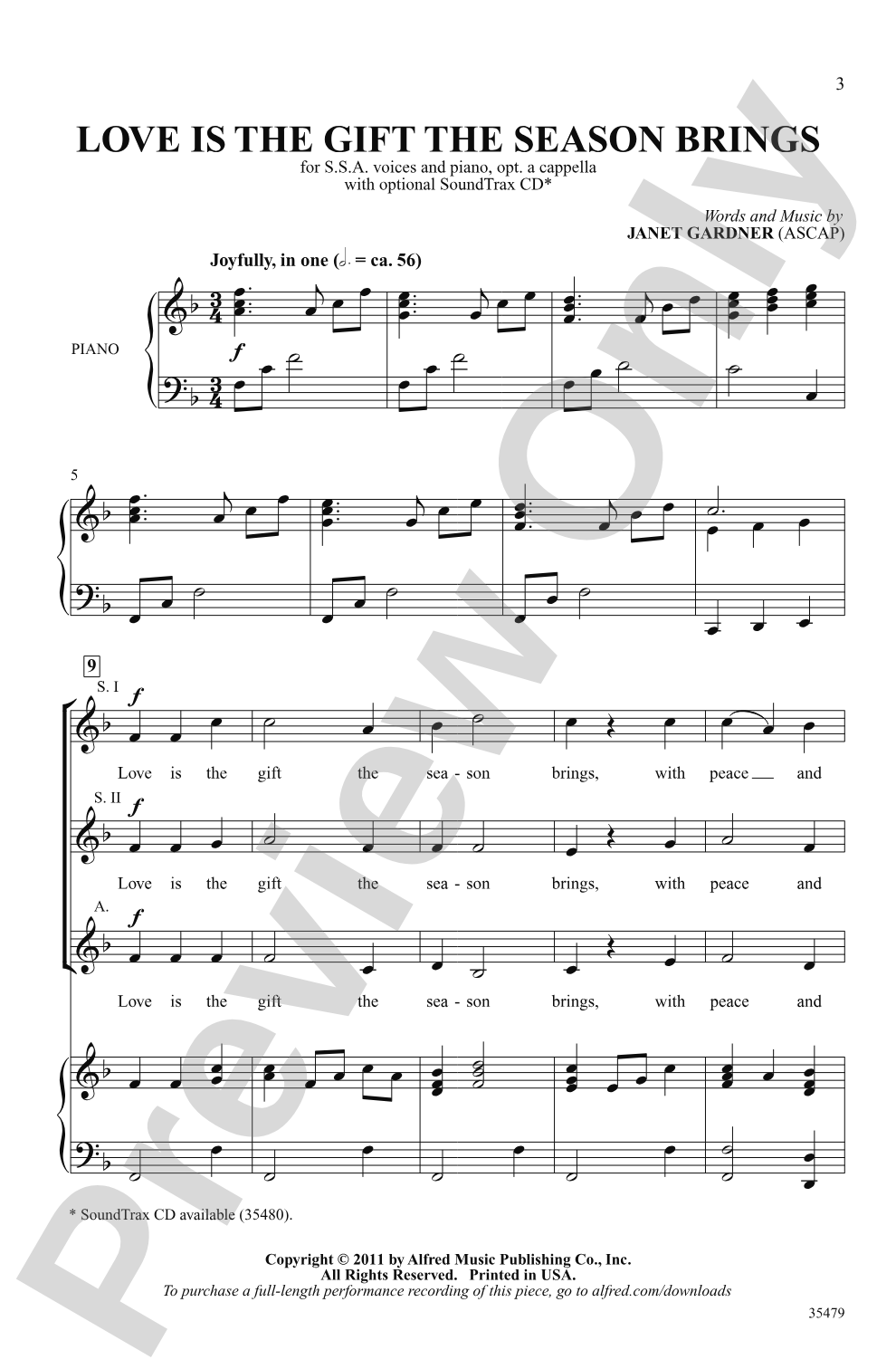
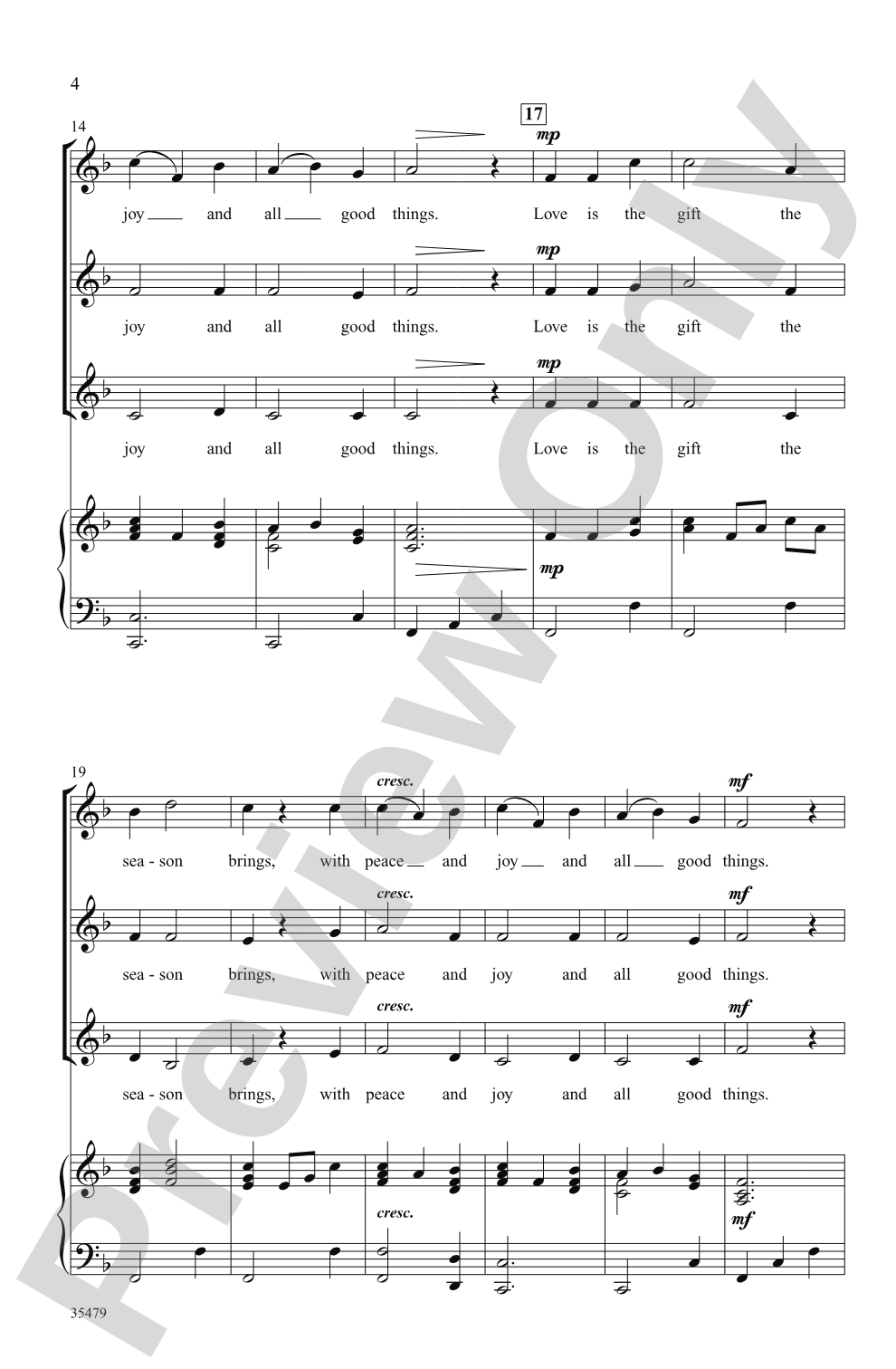

Love Is the Gift the Season Brings: SSA Choral Octavo
Words and music by Janet Gardner
Item: 00-PO-0000890
$1.80
Minimum order quantity: 20 copies
Pickup currently not available
Description
Here's a modern day madrigal for SSA choirs that may be performed a cappella or with the lilting "in one" accompaniment. Program this joyful song for holiday concerts or any time you want to celebrate "love . . . with peace and joy and all good things."


Love Is the Gift the Season Brings: SSA Choral Octavo isn't in MakeMusic Cloud just yet...but it could be. Let us know you'd like to see it, and you'll help shape what comes next. In the meantime, start a free trial and dive into thousands of interactive titles your students can play along with today.
Request This Title
Tell us you want it.
Start Your Free Trial
Explore everything that's ready to play right now.
Sample Audio
1
Audio File
--:--
0:00
0:00
Sample Video
No sample videos found.
Additional Details
Series:
Alfred Choral Designs
Publisher:
Alfred Music
Page Count:
12
SKU:
00-PO-0000890
More about this title
About the Composer: Janet Gardner

Janet Gardner studied music education at Concordia College in Moorhead, Minnesota, and spent 33 years teaching elementary general music in Montevideo, Minnesota. Throughout her career, she led workshops at state universities, presented at state music conventions as a clinician, and was recognized as the 1995 Minnesota Music Classroom Teacher of the Year. She chaired the Minnesota Elementary Composition Contest for six years and was a featured composer and clinician at music festivals across the United States and Canada.
Gardner has published numerous musicals with Alfred Music, including Bones!, Broadway Santa, The Granny Awards, and The Phantom of the Music Room, alongside choral works such as Godfrey Gordon Gustavus Gore and The Tide Rises, The Tide Falls. Her compositions have earned annual ASCAP awards. Since retiring from classroom teaching in 2006, Gardner continues composing in Montevideo, where she serves as a church musician, directs an ecumenical contemporary music ensemble, and sits on the board of the Minnesota Valley Community Concert Association.
Why we love this
Gardner writes with genuine warmth and accessibility, crafting a piece that honors the madrigal tradition without demanding specialized vocal technique or complex part writing. The flexibility to perform a cappella or with accompaniment lets you adapt to your ensemble's strengths and your concert logistics, while the celebratory text about love, peace, and joy carries enough substance to resonate with audiences beyond the holiday season.
What to expect
This is music that feels like a good conversation among friends rather than a formal performance. The madrigal style gives it charm and intimacy, while the text about celebrating love, peace, and joy creates an infectious warmth that feels earned rather than imposed.
Who it's for
SSA choirs looking for a secular piece with genuine musicality and warmth, whether your ensemble is middle school, high school, community-based, or adult singers. The straightforward voice leading and optional accompaniment make it accessible while remaining musically engaging enough to satisfy accomplished singers.
How to get the most out of it
- Balance the three SSA lines by listening to how each voice part carries melody and countermelody throughout; avoid letting the sopranos dominate by default.
- If using the recorded accompaniment, do a full run-through without it first to establish independence and intonation; add it once the voices are secure.
- Shape the text naturally and conversationally, as you would in a madrigal; let the phrase endings breathe rather than holding through to the bar line.
- Experiment with tempi in rehearsal, keeping the "in one" feel light and lilting rather than sluggish, which will energize the celebratory message.
How to use it
Schedule this for holiday or winter concerts where you want something celebratory without the weight of a complex choral work, or place it on any spring or summer program as a joyful standalone piece that opens a program or provides a moment of lightness between heavier selections. It also works beautifully as a community service concert piece or a program opener at informal singing events.
Skills your students will build
- Madrigal-style phrasing and text expression in secular choral music
- Part independence and voice leading awareness in SSA voicing
- A cappella intonation and blend across multiple voice parts
- Flexibility between accompanied and unaccompanied performance contexts