
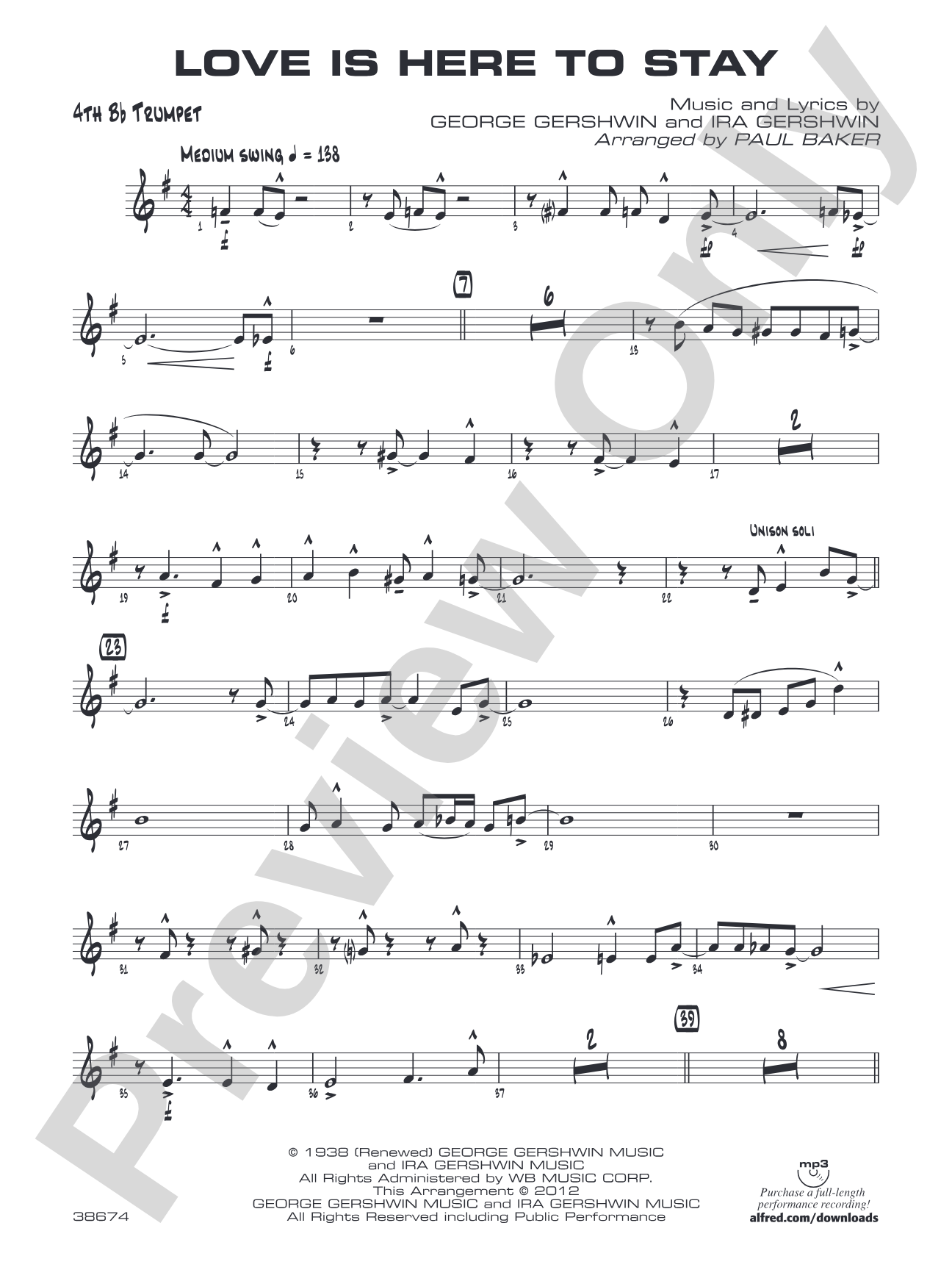

Love Is Here to Stay: 4th B-flat Trumpet
Music and lyrics by George and Ira Gershwin / arr. Paul Baker
Grade: 2 (Medium Easy)
Item: 00-PC-0017222_T4
$3.00
Pickup currently not available
Description
A swingin' version of this great standard in the Basie style. This chart features plenty of excellent sax solis, written-out solos for trumpet 2 and alto 1, a superb shout chorus, and the lead trumpet range up to written G on top of the staff. This title is available in MakeMusic Cloud.


Don't just read it, hear it, play along with it, and watch your students grow with it. In MakeMusic Cloud, Love Is Here to Stay: 4th B-flat Trumpet comes alive with professional accompaniment, adjustable tempo, and built-in practice tools that turn solo practice into real progress.
Open in the Player
Jump straight in and assign it today.
Start Your Free Trial
Open this title and explore the full library in minutes.
Sample Audio
1
Audio File
--:--
0:00
0:00
Sample Video
No sample videos found.
Additional Details
Series:
Young Jazz Ensemble
Publisher:
Alfred Music
Page Count:
92
SKU:
00-PC-0017222_T4
More about this title
About the Composer: George Gershwin
George Gershwin (1898, 1937) bridged classical and popular music in ways few composers have managed. His rhythmic sophistication, harmonic innovation, and gift for melody made him essential to American concert music, yet he never lost touch with Broadway, jazz, and vernacular song. For music educators, Gershwin's output offers students a direct entry into twentieth-century compositional thinking without sacrificing accessibility or immediate musical reward.
Gershwin's standards remain teaching gold because they're built on clear harmonic structures and memorable material. Whether students encounter his work through jazz arrangements or concert pieces, they're engaging with a composer who understood how to write for performers of varying abilities while maintaining musical integrity.
Why we love this
Paul Baker's arrangement captures the swagger and punch of the Basie band sound without overcomplicating the ensemble's parts. The written-out solos for alto 1 and trumpet 2 give less experienced improvisers concrete material to learn from, while the shout chorus and those sax solis deliver the authentic small-group energy that makes this era of jazz so infectious. For a grade 2 group, this hits the sweet spot of sounding professional and fun to play.
What to expect
Propulsive and joyful, with that particular Basie-band lightness in the rhythm section and warmth in the horns. The melody sits right in the pocket, and the arrangement gives you space to breathe between the hits. It swings without strain.
Who it's for
This arrangement serves grade 2 jazz ensembles with strong readers but developing improvisers. Programs looking to build confidence in less experienced soloists will benefit from the written parts for trumpet 2 and alto 1, while stronger players anchor the section work and featured passages.
How to get the most out of it
- Shape the melody with clear articulation in the lead trumpet part. The top G demands confidence, not force; let the range feel natural by supporting it with steady air and solid fundamentals.
- Lock the written solos (alto 1 and trumpet 2) into the rhythm section's pocket. These aren't improvised; treat them as composition and nail the rhythmic precision and dynamic shaping.
- Find the push in the shout chorus. This section needs ensemble unity and a sense of building momentum. Mark your attacks and releases clearly in rehearsal so everyone feels the same pulse.
- Lift the sax solis with a conversational tone. They're asking and answering, so vary your approach across the different solos. One might be punchy; another might float. Let that personality come through.
How to use it
Pair this with other Gershwin-era standards to create a short suite that explores American songwriting and jazz arranging traditions. It works equally well as a festival piece or as part of a concert celebrating the Great American Songbook. The moderate difficulty and audience familiarity make it a solid closer or anchor in a jazz concert set.
Skills your students will build
- Articulation and phrasing in jazz idiom (swing feel, ghost notes, dynamic shaping)
- Reading and interpreting written solo lines with jazz vocabulary
- Ensemble balance and listening in Basie-style voicings
- Rhythmic precision in shout sections and tight ensemble figures
- Lead trumpet range extension to written G with secure intonation
- Section work with clear part independence and textural awareness