Love Grows (Where My Rosemary Goes) (arr. Roger Emerson) Sheet Music Preview

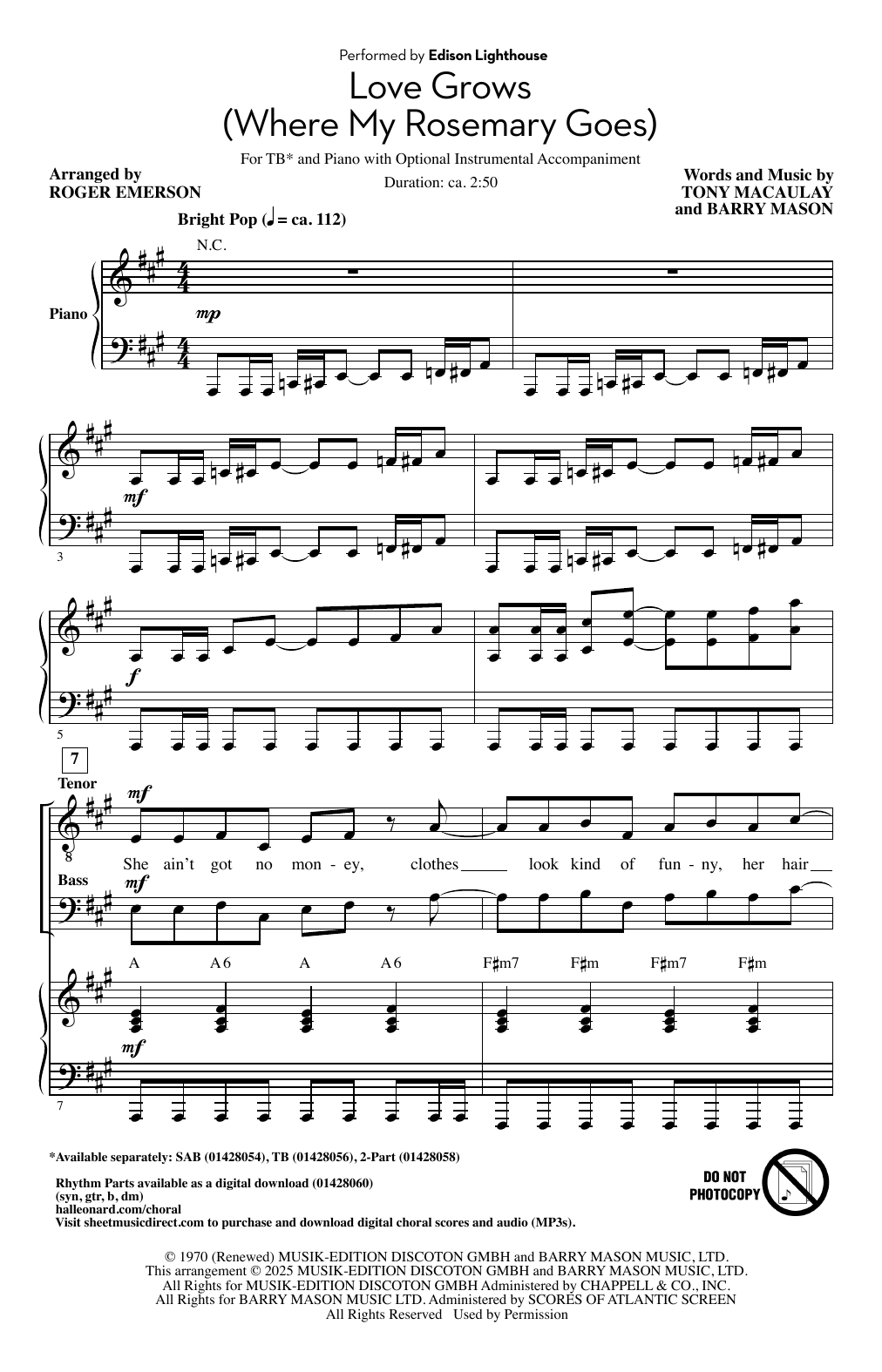
Love Grows (Where My Rosemary Goes) (arr. Roger Emerson): TB Choral Octavo

By Barry Mason / By Tony Macaulay / As performed by Edison Lighthouse / Arranged by Roger Emerson

Item: 35-DS01777567

Digital Download
$2.50
Description

Love Grows (Where My Rosemary Goes) (arr. Roger Emerson): TB Choral Octavo isn't in MakeMusic Cloud just yet...but it could be. Let us know you'd like to see it, and you'll help shape what comes next. In the meantime, start a free trial and dive into thousands of interactive titles your students can play along with today.

Sample Audio
No sample audio found.
Sample Video
Additional Details
Publisher: Hal Leonard
Page Count: 11
SKU: 35-DS01777567

More about this title

About the Composer: Barry Mason

Barry Mason wrote some of the most enduring pop songs of the 1960s and 1970s, often collaborating with fellow songwriter Tony Macaulay. Their partnership produced radio staples that crossed genres and generations, demonstrating a gift for melody and accessibility that made their work instantly memorable. Mason's compositional approach valued singability and emotional directness, qualities that have kept his songs relevant for educational ensembles.

Why we love this

Roger Emerson's arrangement transforms this 1970 pop hit into a piece that honors the original's warmth while giving it genuine choral weight. The voicing balances accessibility with musicianship, letting singers feel like they're performing something contemporary and fun rather than something retrofitted into choral form. Boys' choirs especially benefit from material that feels this confident and unfussy.

What to expect

Warm and unpretentious. The arrangement has a gentle swing to it, with the kind of easy charm that makes audiences relax into listening. There's real affection in the harmonic writing, which deepens what could have been a simple pop cover into something singers genuinely want to inhabit.

Who it's for

Boys' and men's choirs at intermediate to advanced levels, as well as mixed ensembles looking for repertoire that feels current without demanding vocal heroics. The piece works equally well for concert programming or festival performance, where its familiarity becomes an asset rather than a liability.

How to get the most out of it

  • Lean into the straightforward melody rather than over-interpreting it. The song's power comes from its directness, which means clean attacks and clear vowel formation serve the music better than expressive distortion.
  • Balance the harmonic movement carefully in the lower voices. Emerson's voicing gives the bass and baritone parts genuine interest; letting those lines breathe prevents the arrangement from collapsing into melody-plus-accompaniment.
  • Use the recorded accompaniment to establish the groove, but don't let it dictate your tempo. Find the pocket that feels natural for your ensemble's strengths.

How to use it

Pair this with other pop and folk arrangements to create a set that showcases your ensemble's range beyond traditional choral literature. It also works beautifully as a lighter moment in a concert built around heavier repertoire, giving audiences a chance to hear your singers in repertoire that requires different strengths. Consider programming it at community concerts or school assemblies where connection with the audience matters as much as technical display.

Skills your students will build

  • Sustaining clear diction across block chords
  • Balancing melody with harmonic parts in close voicing
  • Singing with a conversational tone rather than operatic weight
  • Holding tuning in unison and parallel thirds
  • Responding to rhythmic precision in a groove-based arrangement

You May Also Like