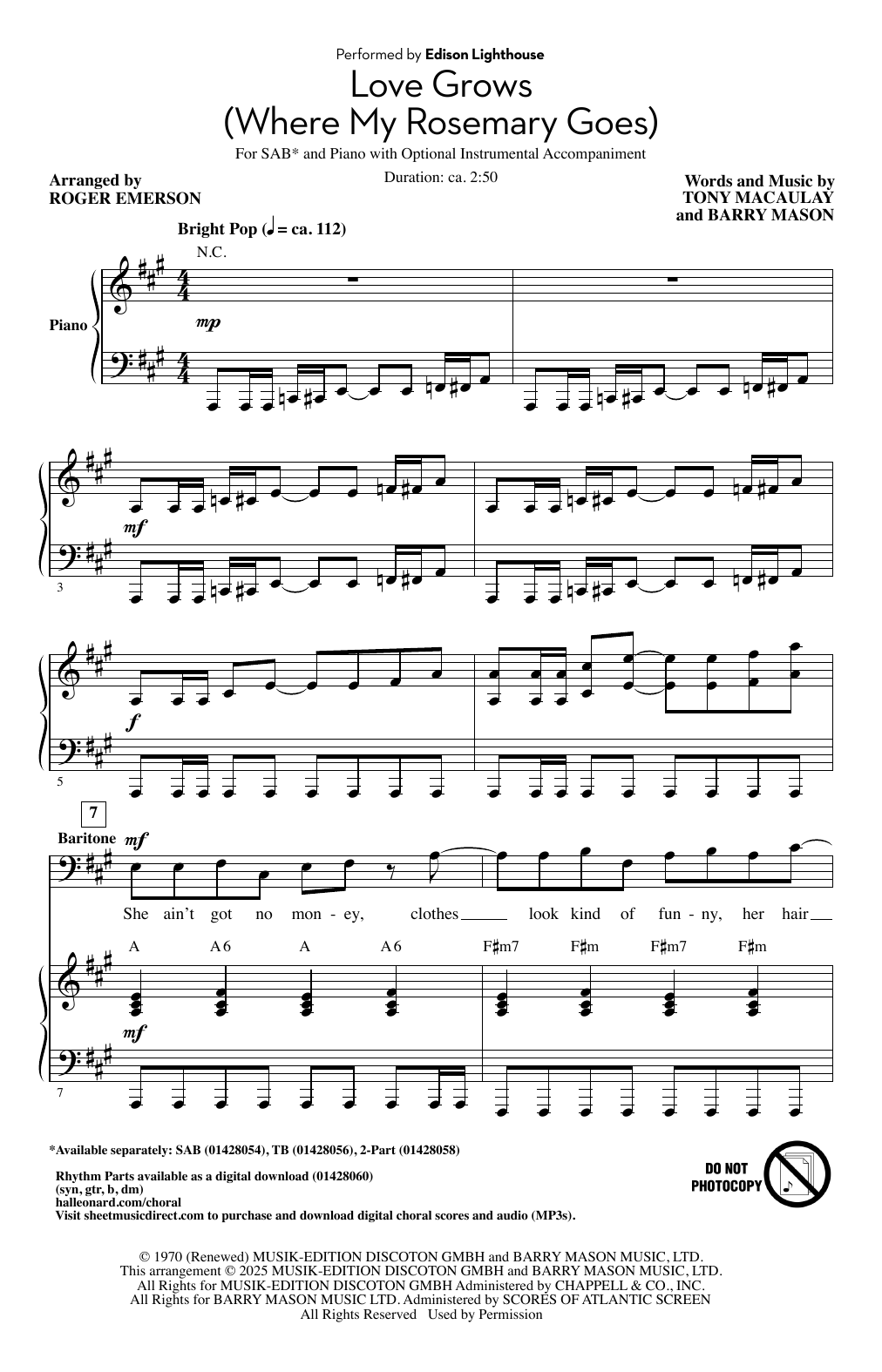
Love Grows (Where My Rosemary Goes) (arr. Roger Emerson) Sheet Music Preview

Love Grows (Where My Rosemary Goes) (arr. Roger Emerson): SAB Choral Octavo

By Barry Mason / By Tony Macaulay / As performed by Edison Lighthouse / Arranged by Roger Emerson

Item: 35-DS01777566

Digital Download
$2.65
Description

Love Grows (Where My Rosemary Goes) (arr. Roger Emerson): SAB Choral Octavo isn't in MakeMusic Cloud just yet...but it could be. Let us know you'd like to see it, and you'll help shape what comes next. In the meantime, start a free trial and dive into thousands of interactive titles your students can play along with today.

Sample Audio
No sample audio found.
Sample Video
Additional Details
Publisher: Hal Leonard
Page Count: 15
SKU: 35-DS01777566

More about this title

About the Composer: Barry Mason

Barry Mason is a legendary British songwriter whose gift for crafting infectious melodies and singable hooks made him a cornerstone of 1970s pop. His collaborations with Tony Macaulay produced some of the era's most enduring hits, songs that connected instantly with audiences and have only grown more charming with time. Mason's compositional approach prioritizes clarity and emotional directness, qualities that shine through in every arrangement.

Why we love this

Roger Emerson has captured the warmth and accessibility of this 1970s classic while writing for real choirs with mixed ranges. The arrangement sits comfortably for SAB voices without sacrificing the song's melodic charm, and it opens doors for singers who might not have encountered this tune before. It's the kind of piece that reminds students why they joined choir in the first place.

What to expect

Warmth and nostalgia blend with genuine musical craft. The arrangement feels intimate despite its familiar source material, inviting singers and listeners alike into a moment of reflection and gentle connection. There's a tender sincerity here that transcends its pop origins.

Who it's for

Choirs seeking repertoire that bridges classical technique with popular appeal will find this arrangement both accessible and musically worthwhile. It works particularly well for ensembles that include less experienced singers or those new to three-part mixed voicing. Directors programming informal concerts or community events will appreciate how naturally this piece engages audiences.

How to get the most out of it

  • Let the melody breathe in the soprano line; resist the urge to over-phrase. The tune's strength lies in its simplicity and forward motion.
  • Balance the alto and bass parts carefully in the verse sections so they support rather than compete with the top line.
  • Lean into the gentle rhythmic lilt that gives this song its folk-song character. Think 'natural storytelling' rather than rigid metric precision.
  • Record yourself as an ensemble during rehearsals. Hearing playback helps singers understand blend and intonation in ways that real-time feedback sometimes cannot.

How to use it

Pair this with other folk-influenced arrangements to create a themed concert set, or use it as a refreshing contrast between heavier classical selections. It's excellent programming for spring concerts or any event aimed at building community and accessibility around choir music. The piece also works beautifully as a confidence builder early in the rehearsal season.

Skills your students will build

  • Blending sustained vowels across three-part texture
  • Singing lyrical melodic lines without sacrificing diction clarity
  • Balancing part independence with harmonic awareness
  • Maintaining musical shape across longer phrase structures
  • Interpreting rubato and subtle rhythmic flexibility in folk-influenced material

You May Also Like