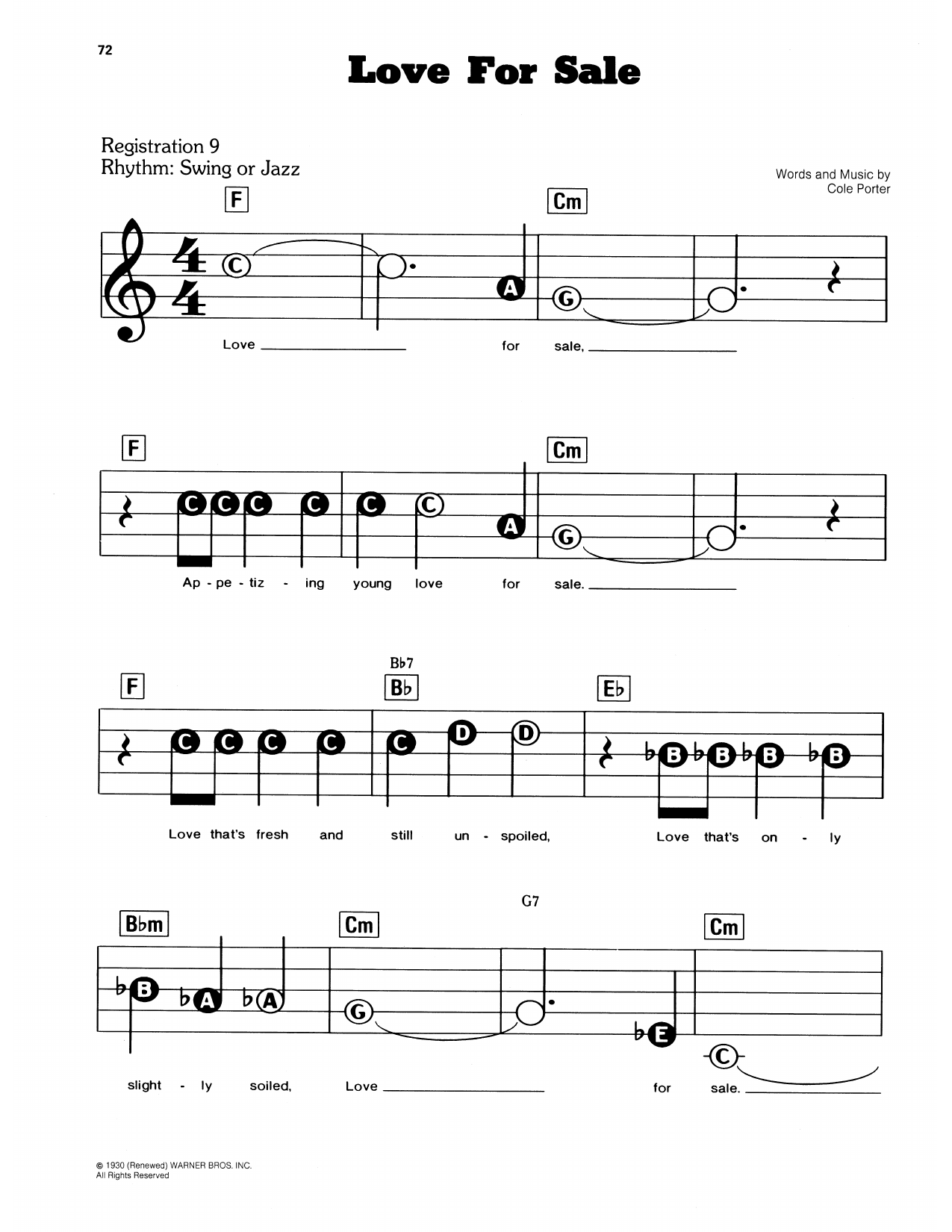
Cole Porter brought sophistication and wit to American musical theater like few composers before or after him. His songs combine elegant harmonic language with clever, urbane lyrics that made Broadway audiences laugh and think simultaneously. Porter's influence on jazz standards and popular music education remains substantial; his melodic gifts and harmonic inventiveness continue to challenge and delight musicians across all levels.
Why we love this
This E-Z Play arrangement strips "Love For Sale" down to its essential charm without sacrificing the song's sophisticated harmonic content. The compact four-page format makes it accessible for students still building their jazz vocabulary, while the Porter signature of lyrical elegance stays completely intact. It's a straight shot into understanding how standards work: melody, harmony, and a story that matters.
What to expect
Urbane and slightly melancholic, with an undercurrent of resignation that Porter conveys through both melody and harmony. The song carries the atmosphere of a 1930s nightclub where the world-weary but graceful acceptance of life's complexities becomes almost poetic. There's elegance in the simplicity of just presenting a beautiful melody over tasteful chords.
Who it's for
Piano students who are ready to engage with jazz standards and Broadway repertoire but benefit from simplified notation. Teachers looking for four-page material that introduces Porter's harmonic language without overwhelming students still developing their sight-reading in styles beyond classical.
How to get the most out of it
Shape the melodic line with subtle rubato; Porter's songs ask for conversational phrasing rather than metronomic exactness
Listen closely to the harmonic movement under the melody and let those chord changes breathe rather than rushing through them
Balance legato singing of the main tune with crisp articulation in any rhythmic accompaniment figures
Consider the lyrical content as you play; the song's emotional arc (a bit world-weary, ultimately accepting) should inform your dynamic choices
How to use it
Pair this with other Porter standards in a jazz standards concert, or slot it into a broader "American Songbook" showcase that charts the evolution of composed popular music. It works particularly well when you want to introduce students to the sophistication of standards without requiring them to navigate lead sheets or full fake books yet.
Skills your students will build
Reading jazz chord voicings and recognizing seventh chords in context
Interpreting rubato and expressive phrasing in a non-classical style
Understanding song form and harmonic progression in standards
Balancing melody and accompaniment in simplified piano arrangements
Recognizing and performing swing-influenced rhythmic feel
You May Also Like
Scan to Complete Your Purchase
Use your phone's camera to scan the code below
You'll log in on your phone and the order will be added to your account