
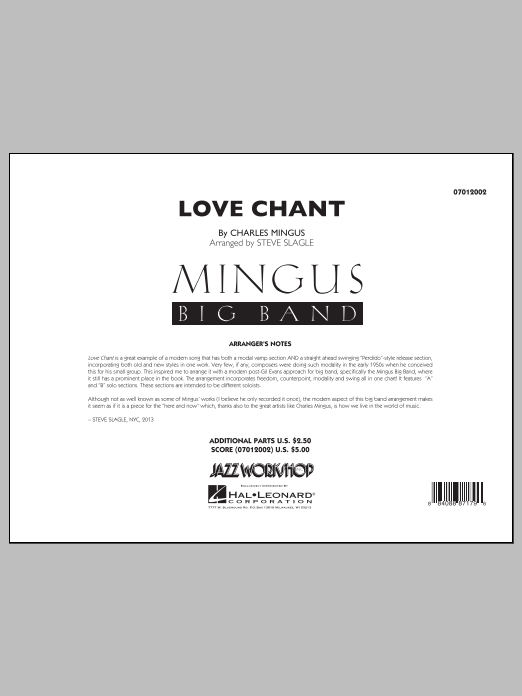

Love Chant: Jazz Ensemble Conductor Score & Parts
By Charles Mingus / Arranged by Steve Slagle
Grade: 5
Item: 35-PK00276625
$60.00
Pickup currently not available
Buy Extra Parts (Digital PDF Download)
| Product | Price | Quantity |
|---|---|---|
| Love Chant - Conductor Score (Full Score) | $6.00 | |
| Love Chant - Alto Sax 1 | $6.00 | |
| Love Chant - Alto Sax 2 | $6.00 | |
| Love Chant - Tenor Sax 1 | $6.00 | |
| Love Chant - Tenor Sax 2 | $6.00 | |
| Love Chant - Baritone Sax | $6.00 | |
| Love Chant - Trumpet 1 | $6.00 | |
| Love Chant - Trumpet 2 | $6.00 | |
| Love Chant - Trumpet 3 | $6.00 | |
| Love Chant - Trombone 1 | $6.00 | |
| Love Chant - Trombone 2 | $6.00 | |
| Love Chant - Trombone 3 | $6.00 | |
| Love Chant - Piano | $6.00 | |
| Love Chant - Bass | $6.00 | |
| Love Chant - Drums | $6.00 |
Parts Added to Cart!
Description
Recorded by the Mingus Big Band on the CD "Que Viva Mingus!", this stellar Steve Slagle arrangement takes the band through an extended modal format, while always swingin'! With a unique blend of group improvisation, full ensemble passages, and solo space for trombone, tenor sax and trumpet, this medium tempo chart is another standout from this iconic contemporary big band.


Love Chant: Jazz Ensemble Conductor Score & Parts isn't in MakeMusic Cloud just yet...but it could be. Let us know you'd like to see it, and you'll help shape what comes next. In the meantime, start a free trial and dive into thousands of interactive titles your students can play along with today.
Request This Title
Tell us you want it.
Start Your Free Trial
Explore everything that's ready to play right now.
Sample Audio
No sample audio found.
Sample Video
No sample videos found.
Additional Details
Publisher:
Hal Leonard
SKU:
35-PK00276625
More about this title
About the Composer: Charles Mingus
Charles Mingus (1922-1979) fundamentally reshaped big band writing by treating the ensemble as a flexible, responsive organism rather than a rigid hierarchy. His compositions challenged harmonic conventions and demanded that musicians listen intently to one another, creating spaces for spontaneous interaction within carefully crafted structures. Mingus remains essential listening for any program serious about understanding how jazz composition can balance composition and freedom.
As both bassist and bandleader, Mingus pushed his players to think beyond their parts and engage with the larger conversation happening in the room. His legacy continues to inspire arrangers and conductors who want their bands to swing with both precision and spirit.
Why we love this
Steve Slagle's arrangement captures what makes Mingus essential for upper-level ensembles: the modal harmonic terrain creates real improvisation opportunities rather than just blowing changes, while the written ensemble sections are orchestrated with enough detail to feel composed without becoming restrictive. Your soloists will actually have room to breathe and respond to what's happening around them, and the rhythm section locks into a groove that feels contemporary and swinging at once.
What to expect
Hypnotic and forward-moving despite the modal simplicity. The piece settles into a deep pocket where individual voices emerge clearly against a unified ensemble backdrop, creating the feeling of a conversation among friends rather than a performance for an audience. There's warmth in the writing and space for genuine musical personality to show through.
Who it's for
Grade 5 ensembles with solid fundamentals and at least one strong soloist in each of the featured chairs. Your rhythm section needs to be comfortable with modal vamps and sustaining a groove without harmonic movement to push them forward. Directors programming contemporary big band music with educational substance will find this both accessible and artistically rewarding.
How to get the most out of it
- Establish the modal center early in rehearsal so your soloists understand the harmonic landscape. This isn't a bebop head waiting for soloists to navigate changes; spend time letting the group feel the tonal gravity of the format before any solo takes place.
- Balance the written tutti passages with attention to blend and articulation. Mingus arrangements thrive when the ensemble plays as one voice, which means careful listening from every section during those full-band moments.
- Give your trombone, tenor, and trumpet soloists permission to stretch their solo space. These three chairs carry the improvisational weight, and the arrangement works best when they sound confident and unhurried in their statements.
How to use it
Program this alongside other Mingus arrangements or compositions if you're building a set around his influence on contemporary big band writing. It works equally well as a concert closer where you want to leave the audience with something spacious and swinging, or as the centerpiece of a program focused on improvisation and ensemble listening. Medium tempo and accessible harmony make this an excellent pairing with both harder-swinging charts and more progressive material.
Skills your students will build
- Playing in extended modal contexts without chord changes
- Group improvisation and ensemble listening during solo passages
- Balancing ensemble precision with swing feel
- Sustaining groove in the rhythm section over a static harmonic center
- Responding musically to other soloists while improvising