
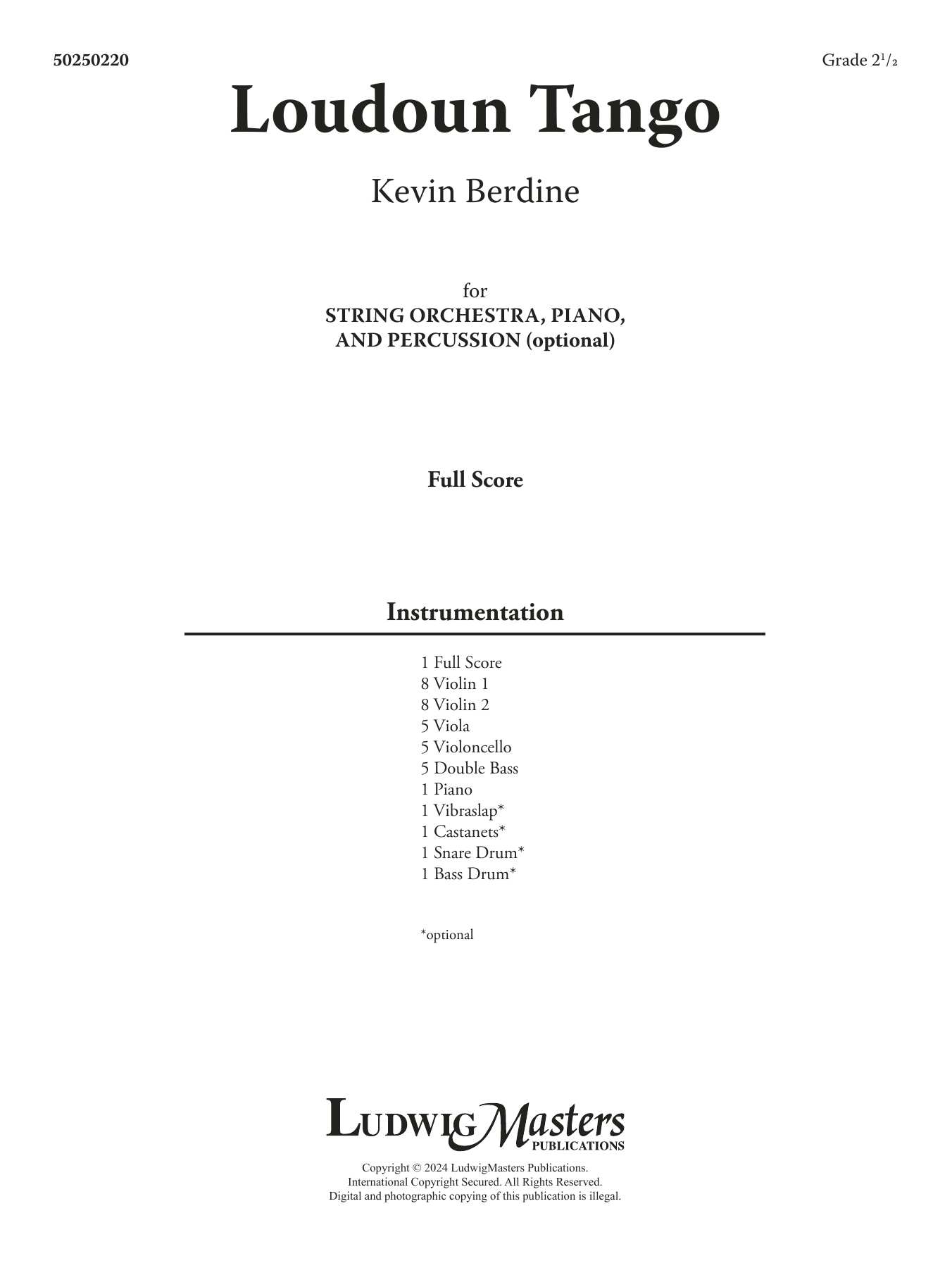

Loudoun Tango: String Orchestra Conductor Score & Parts
By Kevin Berdine
Item: 35-PK01498735
$55.00
Pickup currently not available
Buy Extra Parts (Digital PDF Download)
| Product | Price | Quantity |
|---|---|---|
| Loudoun Tango - Full Score | $6.00 | |
| Loudoun Tango - Violin 1 | $2.50 | |
| Loudoun Tango - Violin 2 | $2.50 | |
| Loudoun Tango - Viola | $2.50 | |
| Loudoun Tango - Violoncello | $2.50 | |
| Loudoun Tango - Double Bass | $2.50 | |
| Loudoun Tango - Piano | $2.50 | |
| Loudoun Tango - Vibra-Slap | $2.50 | |
| Loudoun Tango - Castanets | $2.50 | |
| Loudoun Tango - Snare Drum | $2.50 | |
| Loudoun Tango - Bass Drum | $2.50 |
Parts Added to Cart!
Description
This piece was written to celebrate the Loudoun County Public Schools' orchestra's inaugural school year. Administration, staff, families, and students worked tirelessly to bring orchestral music to the schools. Tango was chosen by the students as dance music had been their favorite music to play. Written in the string friendly key of D minor, this lively tango includes interesting parts for all sections and an idiomatic percussion ensemble accompaniment.


Loudoun Tango: String Orchestra Conductor Score & Parts isn't in MakeMusic Cloud just yet...but it could be. Let us know you'd like to see it, and you'll help shape what comes next. In the meantime, start a free trial and dive into thousands of interactive titles your students can play along with today.
Request This Title
Tell us you want it.
Start Your Free Trial
Explore everything that's ready to play right now.
Sample Audio
No sample audio found.
Sample Video
No sample videos found.
Additional Details
Publisher:
Hal Leonard
SKU:
35-PK01498735
More about this title
Why we love this
A tango written specifically for a string orchestra's first year is inherently meaningful, but what makes this work genuinely rewarding to teach is how it honors student voice. Berdine gives every section something idiomatic to play while keeping the writing accessible, which means your students feel the difference between leading and supporting roles without struggling technically.
What to expect
Energetic without being frantic, with the rhythmic snap of tango paired against soaring string lines that keep the piece from becoming purely rhythmic. There's a celebratory warmth beneath the stylistic sophistication.
Who it's for
String orchestras at the secondary level, whether in their first year or any year where you want repertoire that acknowledges your students' collective effort and celebrates what dance music can offer as serious concert material. Works equally well for smaller ensembles and full orchestras.
How to get the most out of it
- Shape the melodic lines with a clear sense of forward motion characteristic of tango rhythm, but resist rushing; the genre's appeal comes from control and precision.
- Balance the percussion ensemble so it sits behind the strings rather than dominating. These players are part of the texture, not the engine.
- Approach D minor not as dark but as warm and grounded. This key choice makes the piece sit beautifully under student hands.
How to use it
Program this as an opener or closer on a concert where you want to establish ensemble identity and joy. It lands particularly well when paired with a classical concerto or a more austere contemporary piece, creating programming contrast while staying rooted in student repertoire.
Skills your students will build
- Tango rhythm patterns and articulation style
- Ensemble balance between melodic and accompaniment voices
- Intonation in D minor through various string positions
- Coordinate rhythmic precision across multiple percussion voices
- Sectional independence and listening skills