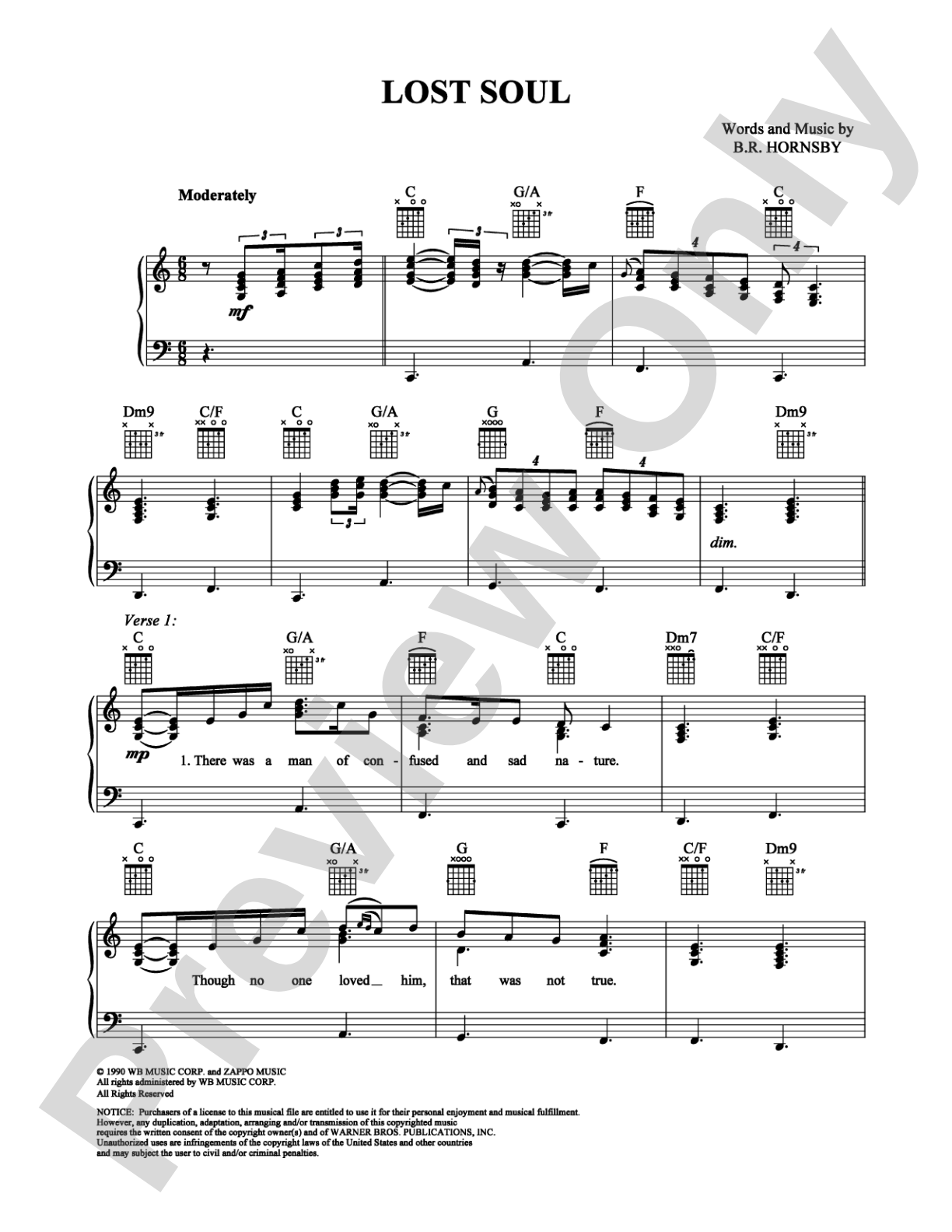
Lost Soul: Piano/Vocal/Chords Digital Sheet Music

Lost Soul: Piano/Vocal/Chords Digital Sheet Music

Bruce Hornsby

Item: 00-PS-0006006

Digital Download
$3.99
Description

Lost Soul: Piano/Vocal/Chords Digital Sheet Music isn't in MakeMusic Cloud just yet...but it could be. Let us know you'd like to see it, and you'll help shape what comes next. In the meantime, start a free trial and dive into thousands of interactive titles your students can play along with today.

Sample Audio
No sample audio found.
Sample Video
Additional Details
SKU: 00-PS-0006006

More about this title

About the Artist: Bruce Hornsby

Bruce Hornsby emerged in the 1980s as a pianist and singer-songwriter who bridged pop accessibility with sophisticated harmonic language and introspective lyrics. His work across multiple decades demonstrates a commitment to melodic storytelling and instrumental craft, earning him recognition as both a solo artist and collaborator in diverse musical settings.

Why we love this

Hornsby's harmonic sensibility gives pianists real substance to explore; this arrangement captures his signature blend of conversational melody and jazz-inflected chords that reward careful listening. The piece works beautifully in programs pairing contemporary singer-songwriters with art song or in recitals showcasing pop repertoire written by serious musicians.

What to expect

The piece carries the introspective quality characteristic of Hornsby's work: a sense of quiet searching set against warm, intelligent chords. There's intimacy in the arrangement, a sense of conversation between voice and piano rather than display.

Who it's for

Vocalist-pianists preparing contemporary music repertoire will find this accessible yet musically substantive. It suits recital programs, cabaret settings, or classroom exploration of modern American songwriting that values both melodic clarity and harmonic sophistication.

How to get the most out of it

  • Balance the vocal line with chord voicings that support without overwhelming; Hornsby's arrangements often sit the melody gently above the harmonic texture rather than anchoring it.
  • Pay attention to rhythmic elasticity in the piano part. These arrangements breathe naturally, so lock into the vocal phrasing rather than mechanically subdividing the beat.
  • Explore the color in the chord extensions and substitutions. Hornsby frequently uses ninths, elevenths, and altered dominants; let these voicings ring slightly to reveal their harmonic richness.
  • Consider the emotional arc of the lyric when shaping dynamics and tempo. The piano part should respond to the narrative, not simply mark time.

How to use it

Slot this into a vocalist's recital to represent contemporary singer-songwriters or pair it with standards and art songs to show the continuum of American songwriting. It also works in ensemble settings pairing popular music with classical art song, highlighting how sophisticated harmonic thinking crosses genre boundaries.

Skills your students will build

  • Reading chord symbols and jazz-influenced voicings on lead sheets
  • Balancing vocal accompaniment with harmonic texture
  • Interpreting rhythmic flexibility and phrasing in contemporary arrangements
  • Connecting harmonic analysis to expressive performance choices

You May Also Like