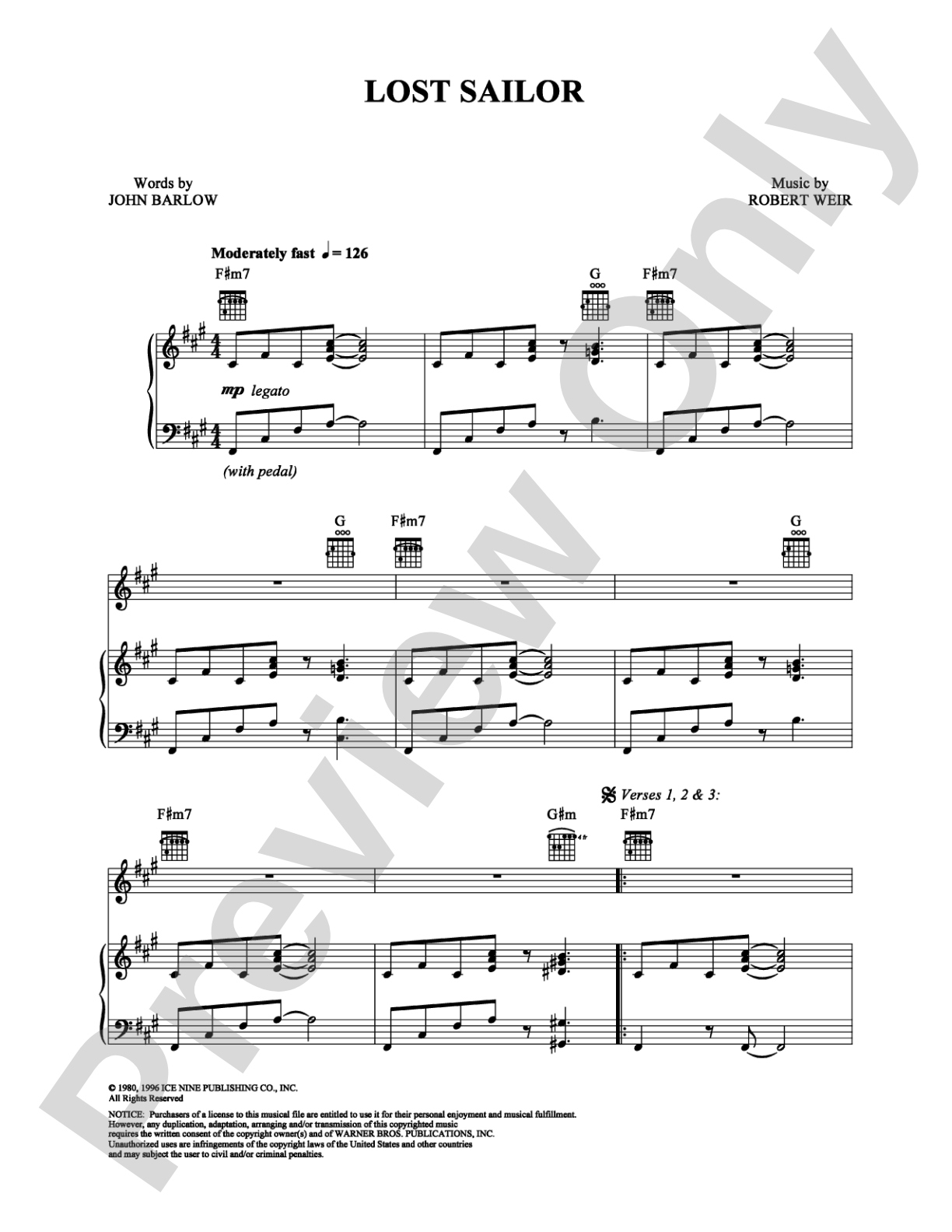
Lost Sailor: Piano/Vocal/Chords Digital Sheet Music

Lost Sailor: Piano/Vocal/Chords Digital Sheet Music

Grateful Dead, Bob Weir

Item: 00-PS-0002438

Digital Download
$2.95
Description

Lost Sailor: Piano/Vocal/Chords Digital Sheet Music isn't in MakeMusic Cloud just yet...but it could be. Let us know you'd like to see it, and you'll help shape what comes next. In the meantime, start a free trial and dive into thousands of interactive titles your students can play along with today.

Sample Audio
No sample audio found.
Sample Video
Additional Details
SKU: 00-PS-0002438

More about this title

About the Artist: Grateful Dead

The Grateful Dead emerged from the San Francisco Bay Area in the mid-1960s as pioneers of improvisational rock and jam band culture. Their decades-long career produced some of the most beloved and durable songs in American popular music, many of which have become standards in both rock and folk contexts. The band's emphasis on musical exploration and community created a legacy that continues to influence musicians across multiple genres.

Why we love this

"Lost Sailor" captures the narrative-driven songwriting and melodic accessibility that made the Grateful Dead's catalog so teachable in music education settings. The piano/vocal/chords arrangement opens this tune to singers and pianists who want to explore classic rock material with authentic harmonic language. It's substantial enough to develop musicianship without requiring extensive ensemble forces.

What to expect

The piece carries a maritime wistfulness, with chord progressions that drift and resolve in ways that suggest journey and contemplation. Piano textures can range from sparse and suggestive to fuller and more driving depending on interpretation, creating space for the narrative voice to emerge and hold attention.

Who it's for

Solo pianists and singers developing their ability to interpret rock material with harmonic sophistication will find valuable work here. This arrangement also suits student pianists accompanying singers in recital or singers accompanying themselves at the piano in performance settings.

How to get the most out of it

  • Pay attention to the harmonic changes in the verse; lock in the chord progression so improvisation feels anchored rather than adrift.
  • Listen to how the vocal melody sits against the chord changes, paying special attention to passing tones and approaches that create the tune's narrative arc.
  • Balance the piano accompaniment texture by varying dynamics and voicing density across sections, resisting the urge to fill every moment with sound.
  • Explore the relationship between piano rhythm and vocal phrasing; the arrangement will breathe differently depending on how strictly you interpret the notated rhythms.

How to use it

Include this in a recital program exploring American songwriting traditions or as part of a set of rock-era compositions that demonstrate sophisticated harmonic thinking. It pairs well with other singer-songwriter material and provides a bridge between classical song traditions and contemporary repertoire.

Skills your students will build

  • Reading and interpreting lead sheet notation (chords and melody)
  • Performing rock-era harmonies with contemporary harmonic language
  • Accompanying singing while maintaining instrumental independence
  • Interpreting rhythmic notation flexibly within a steady harmonic framework
  • Building narrative arc through phrasing and dynamic shaping

You May Also Like