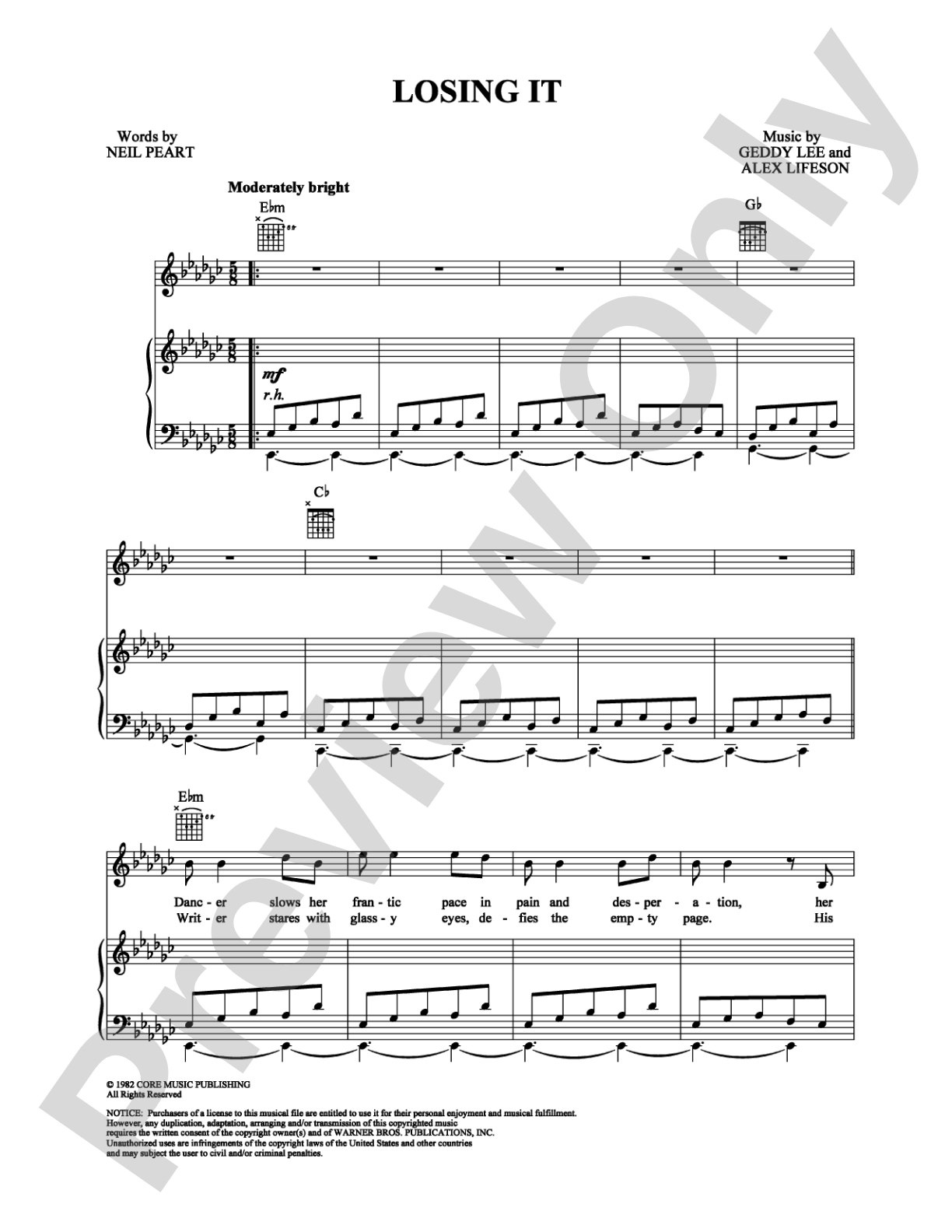
Losing It: Piano/Vocal/Chords Digital Sheet Music

Losing It: Piano/Vocal/Chords Digital Sheet Music

Rush, Geddy Lee, Alex Lifeson

Item: 00-PS-0004209

Digital Download
$3.99
Description

Losing It: Piano/Vocal/Chords Digital Sheet Music isn't in MakeMusic Cloud just yet...but it could be. Let us know you'd like to see it, and you'll help shape what comes next. In the meantime, start a free trial and dive into thousands of interactive titles your students can play along with today.

Sample Audio
No sample audio found.
Sample Video
Additional Details
SKU: 00-PS-0004209

More about this title

About the Artist: Rush

Rush formed in Toronto in 1968 and became one of progressive rock's most influential and technically demanding bands. The trio of Geddy Lee (vocals, keyboards, bass pedals), Alex Lifeson (guitar), and Neil Peart (drums, lyrics) built a four-decade career on intricate time signatures, virtuosic instrumental interplay, and philosophical lyricism that earned them a devoted following across multiple generations of musicians.

Why we love this

Arranging Rush for piano and voice opens up one of rock's most cerebral catalogs to singers and pianists working outside a full band context. The harmonic sophistication and rhythmic complexity that defined Rush's studio sound translate exceptionally well to voice and keyboard, letting students grapple with genuinely challenging material that respects their intelligence.

What to expect

Intellectually engaging and musically substantial. Rush's songwriting balances introspection with rhythmic propulsion, and this arrangement preserves that tension between intricate harmonic movement and forward momentum, creating a piece that feels both cerebral and emotionally resonant.

Who it's for

Singers and pianists comfortable with rhythmically intricate material and musicians drawn to progressive rock's technical and lyrical depth. This arrangement works well for advanced high school singers, college-level vocalists, and experienced amateur musicians performing in non-classical contexts.

How to get the most out of it

  • Pay close attention to the rhythmic notation; Rush's time signature changes and syncopation require precise counting and may benefit from practice with a metronome set to subdivisions rather than beats.
  • Balance the vocal line's narrative weight with the piano accompaniment by mapping where the melody needs to cut through and where the keyboard can carry harmonic color without overshadowing the singer.
  • Explore the dynamic range marked in the chart; Rush compositions rarely sit at one dynamic level, and tracing those shifts will deepen the emotional arc of the song.

How to use it

Feature this in a concert that celebrates rock songwriting with serious harmonic and rhythmic content, or pair it with other art-rock selections to show your singers' range beyond traditional musical theater. It works particularly well in recitals showcasing contemporary or non-classical repertoire.

Skills your students will build

  • Reading and performing non-standard time signatures and metric modulation
  • Balancing complex piano accompaniment with a sung melodic line
  • Interpreting dynamic and expressive markings in a rock context
  • Understanding harmonic progression in progressive rock idiom
  • Maintaining rhythmic precision through syncopated passages

You May Also Like