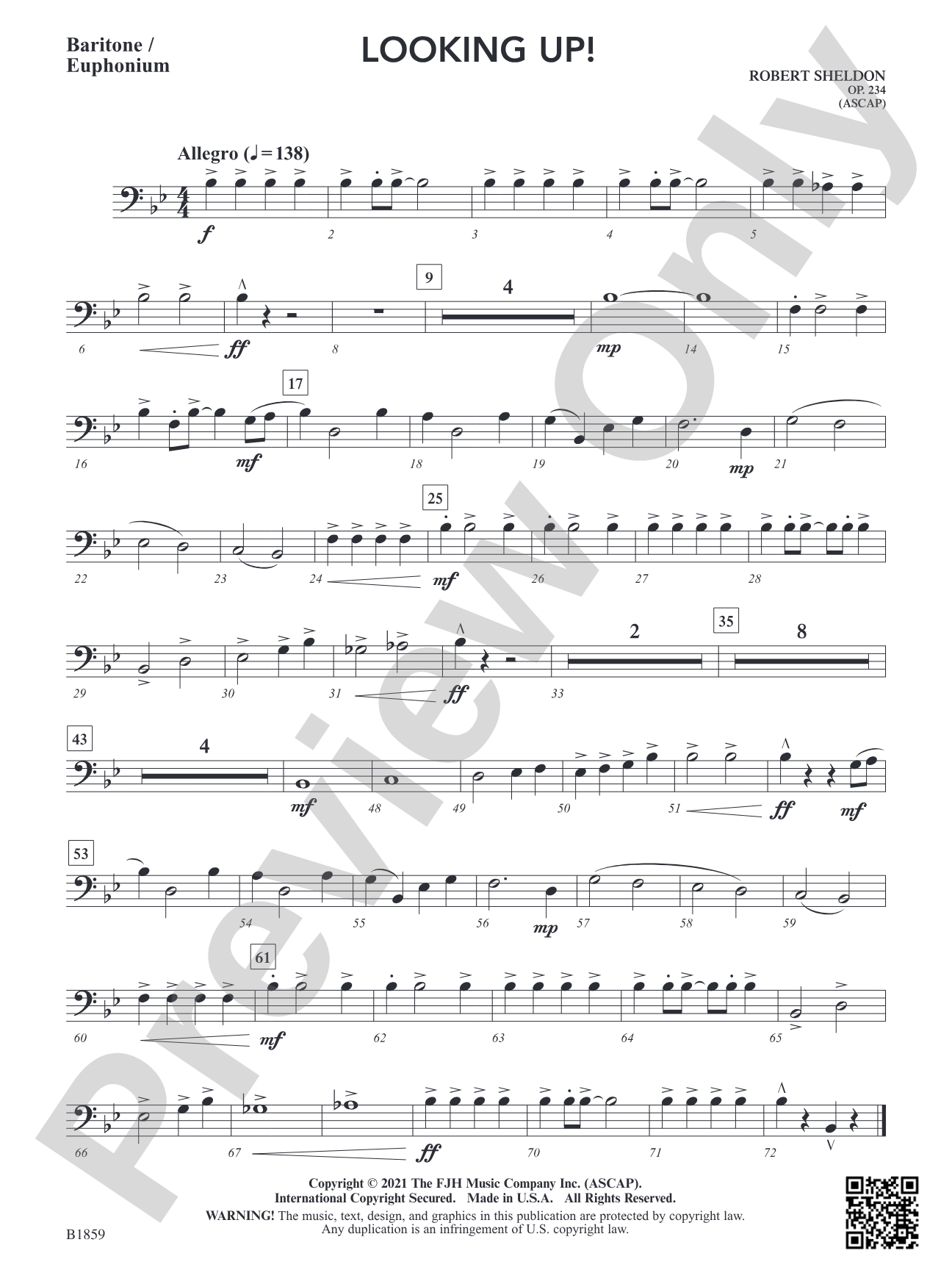
Looking Up!: Baritone / Euphonium Sheet Music Preview

Looking Up!: Baritone / Euphonium

By Robert Sheldon

Grade: 1.5

Item: 98-PC-DB1859_BBC1

Digital Download
$7.00
Description
This up-tempo piece delivers a happy and energetic mood! Fun parts are provided for everyone, and the percussion section has plenty to do. Perfect as a concert opener, the rhythmic drive and tuneful melody is sure to engage the audience, leaving them with toes tapping and smiles on their faces. (2:00)

Don't just read it, hear it, play along with it, and watch your students grow with it. In MakeMusic Cloud, Looking Up!: Baritone / Euphonium comes alive with professional accompaniment, adjustable tempo, and built-in practice tools that turn solo practice into real progress.

Sample Audio
0:00
0:00
Sample Video
Additional Details
Series: MOS Performance Series
Publisher: The FJH Music Company, Inc.
SKU: 98-PC-DB1859_BBC1

More about this title

About the Composer: Robert Sheldon

Robert Sheldon

Robert Sheldon's wind band works appear on festival and contest schedules worldwide, and his music has earned him recognition from the American School Band Director's Association, Phi Beta Mu, and the American Society of Composers, Authors and Publishers. Beyond composition, he shaped instrumental music education as lead author of Sound Innovations for Concert Band, a resource used by countless directors.

Sheldon regularly conducts All-State and Regional Honor Bands, presents clinics at universities and state music education conferences, and has guest conducted across the United States, Japan, Canada, Italy, Germany, Australia, and China. His works have been performed at Carnegie Hall, Orchestra Hall, Boston Symphony Hall, the Sydney Opera House, and the Kennedy Center. In 2020, VanderCook College of Music awarded him an honorary doctorate in recognition of his contributions to the field.

Why we love this

Sheldon writes for the ensemble he knows best, and this piece proves it. Every section gets something memorable to play, the percussion parts are genuinely engaging rather than decorative, and the driving rhythm propels audiences from the first measure. It's concert-smart programming: short enough to not overstay its welcome, energetic enough to reset the room, and tuneful enough that students want to rehearse it.

What to expect

From the downbeat, this piece radiates optimism. The melody dances forward on a bed of snappy rhythmic figures, and the percussion section keeps everything moving with infectious energy. There's no doubt what the audience is meant to feel: pure joy and forward momentum.

Who it's for

New bands and young ensemble musicians benefit most from this piece. The Grade 1.5 difficulty ensures every section finds rewarding parts without needing advanced technique, while the accessible harmony and rhythmic clarity make it ideal for building ensemble cohesion early in the school year or season.

How to get the most out of it

  • Emphasize the rhythmic precision in the accompaniment figures. Sheldon's energy comes from locked rhythmic accuracy across all parts, not from rushing or loosening the pulse.
  • Balance the melody so it sings above the rhythmic foundation. The tune should feel lifted and buoyant, not buried in the texture.
  • Let the percussion section drive the character. These players anchor the entire piece, so rehearse them with the same attention you'd give the woodwind section.
  • Find the sweet spot in tempo where the piece feels propulsive but not frantic. A well-controlled cut time or fast 4/4 allows the melody and rhythm to both land clearly.

How to use it

Use this as your opening piece. Two minutes of immediate gratification and audience engagement set the tone for everything that follows, whether you're planning a full concert, a festival appearance, or a contest performance. It works equally well as a warm-up to more substantial repertoire or as a standalone crowd-pleaser.

Skills your students will build

  • Maintaining rhythmic precision in syncopated figures
  • Balancing melody against accompanying parts
  • Reading and performing in cut time
  • Ensemble cohesion and synchronized articulation
  • Percussion section independence and clarity

You May Also Like