
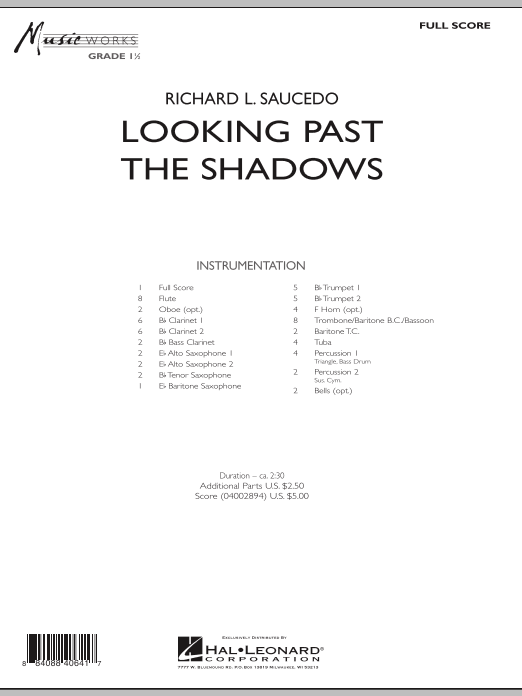

Looking Past the Shadows: Concert Band Conductor Score & Parts
By Richard L. Saucedo
Grade: 1.5
Item: 35-PK00126743
$45.00
Pickup currently not available
Buy Extra Parts (Digital PDF Download)
Parts Added to Cart!
Description
Featuring a flowing lyric style and beautiful harmonies, this composition for beginning groups allows you to teach phrasing and musicality in a rewarding setting. With easy rhythms and moderate ranges, this is very attainable for young players. Dur: 2:30 (Grade 1-1/2)


Looking Past the Shadows: Concert Band Conductor Score & Parts isn't in MakeMusic Cloud just yet...but it could be. Let us know you'd like to see it, and you'll help shape what comes next. In the meantime, start a free trial and dive into thousands of interactive titles your students can play along with today.
Request This Title
Tell us you want it.
Start Your Free Trial
Explore everything that's ready to play right now.
Sample Audio
No sample audio found.
Sample Video
No sample videos found.
Additional Details
Publisher:
Hal Leonard
SKU:
35-PK00126743
More about this title
About the Composer: Richard L. Saucedo

Richard L. Saucedo shaped Indiana's band program landscape during his 31 years as Director of Bands and Performing Arts Chairman at Carmel High School. His ensembles earned consistent recognition at state, regional, and national levels, including three appearances by the Wind Symphony I at the Music for All National Concert Band Festival and back-to-back Indiana State Champion titles. The Carmel Marching Greyhounds secured two BOA National Championships under his direction while maintaining a 17-year streak in the BOA Grand National Championship's top ten.
Recognized as Indiana's Bandmaster of the Year in 1998-99 and Outstanding Music Educator in 2010, Saucedo was inducted into the Music for All Hall of Fame in 2015 and the Drum Corps International Hall of Fame in 2022. Beyond his classroom legacy, he has contributed to five DCI world championships as brass arranger and composer for the Cavaliers and currently serves as music ensemble coordinator for the Blue Devils Drum and Bugle Corps. His compositional and arranging work spans marching bands, concert bands, choral groups, and orchestras, informed by decades of understanding what young musicians need to grow.
Why we love this
Saucedo writes with a conductor's understanding of what young bands can achieve when given music that feels genuinely musical, not simplified. The lyrical approach here invites your students to shape phrases and voice harmonies rather than simply execute notes, which deepens their engagement from day one. For groups working at 1.5 level, this strikes the rare balance of being immediately playable while offering real material worth caring about.
What to expect
Reflective and warm, with an underlying sense of hope. The flowing lyric style creates space for students to hear how their individual voices combine into something larger, and the moderate tessitura lets everyone contribute without strain.
Who it's for
Beginning concert bands ready to work on musicality without struggling with technical demands. Groups at the 1.5 level can focus entirely on phrasing, blend, and expressive playing because the rhythmic and range requirements won't distract them.
How to get the most out of it
- Shape each phrase by finding its natural arrival point rather than treating the score as a series of measures. Even young players respond when you identify where the line breathes.
- Balance the harmonic content carefully; the beauty depends on weaker voices staying audible. Check that your inner parts aren't covered by the melody.
- Take the recorded accompaniment as a guide for tempo and balance, then conduct it live. Your gesture matters more than matching a click track.
- Rehearse the transitions between sections to ensure they feel like one continuous thought. Avoid treating this like three separate pieces.
How to use it
Pair this with your concert-season programming when you want to showcase growth in expressive playing without relying on flashy technical displays. The 2:30 duration makes it useful either as a standalone showcase piece or as part of a thematic concert exploring melody and harmony.
Skills your students will build
- Phrasing at the beginning level; identifying and shaping phrase peaks
- Listening to harmonic balance; hearing inner voices within a texture
- Tone production in the middle range without technical strain
- Following a conductor's gesture for interpretive choices rather than relying on rhythmic cues alone