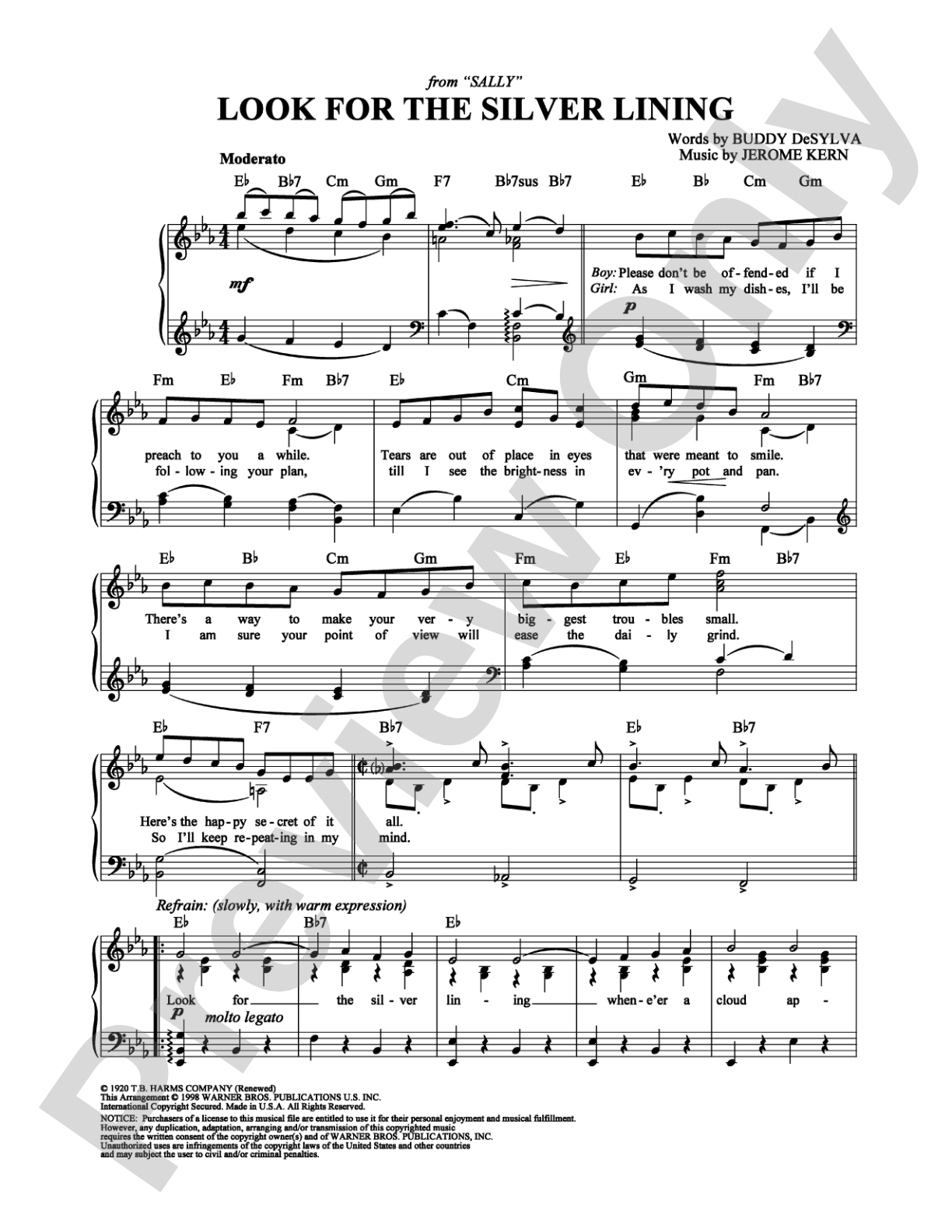
Look for the Silver Lining: Piano/Vocal/Chords Digital Sheet Music

Look for the Silver Lining: Piano/Vocal/Chords Digital Sheet Music

Jerome Kern, Judy Garland

Item: 00-PS-0006777

Digital Download
$3.99
Description

Look for the Silver Lining: Piano/Vocal/Chords Digital Sheet Music isn't in MakeMusic Cloud just yet...but it could be. Let us know you'd like to see it, and you'll help shape what comes next. In the meantime, start a free trial and dive into thousands of interactive titles your students can play along with today.

Sample Audio
No sample audio found.
Sample Video
Additional Details
SKU: 00-PS-0006777

More about this title

About the Artist: Judy Garland

Judy Garland (1922-1969) was an American singer, actress, and performer whose interpretive gifts shaped popular song standards for generations. Her vocal authority, emotional directness, and ability to inhabit a lyric made her recordings essential references for musicians learning the American songbook. Teachers and singers continue to study her phrasing and emotional authenticity as models of artistic commitment.

Why we love this

Garland's recording of this Jerome Kern and Billy Rose standard demonstrates how a truly great vocalist shapes a melody through phrasing, dynamic control, and emotional specificity. Using this arrangement in rehearsal gives singers a gold-standard interpretation to reference while building their own interpretive choices. The piano/vocal/chords format makes it accessible for studio work, coachings, and self-directed learning.

What to expect

The song radiates a hard-won hopefulness. Under the major-key brightness and accessible melody sits real emotional weight, a reminder that optimism sometimes requires work. Garland's treatment honors both the simplicity of the tune and the complexity of what it means to look for silver linings when clouds are dark.

Who it's for

Singers learning the American songbook will find this essential reference material. Voice teachers and choral directors preparing singers for art song or musical theater repertoire can use this arrangement for coaching sessions and performance study. Solo recitalists programming jazz standards or pop-influenced vocal literature will benefit from having this professionally prepared sheet music.

How to get the most out of it

  • Study Garland's recorded interpretation for phrasing ideas, but avoid copying her vibrato or timing wholesale; instead, analyze where she holds back and where she leans into emotion.
  • Balance the piano accompaniment so it supports the vocal line without overwhelming it; the chords are a roadmap, not a wall of sound.
  • Attend to the lyric's meaning in each phrase. This song about optimism in hard times asks for specificity of emotion, not just pretty singing.
  • Experiment with the tempo during early rehearsals; Garland's rubato is generous and musical, not metronomic.

How to use it

Include this in a recital exploring American songwriting from the 1920s-1940s, or pair it with contemporary art songs that also address resilience and hope. It works equally well as a cabaret-style feature or as part of a larger musical theater revue. The familiarity of the melody makes it an accessible choice for community concert programming.

Skills your students will build

  • Stylistic interpretation of American popular song standards
  • Phrasing and breath management across longer melodic lines
  • Emotional communication without oversinging
  • Reading and realizing chord changes from lead sheet notation
  • Collaboration between vocalist and accompanist

You May Also Like