
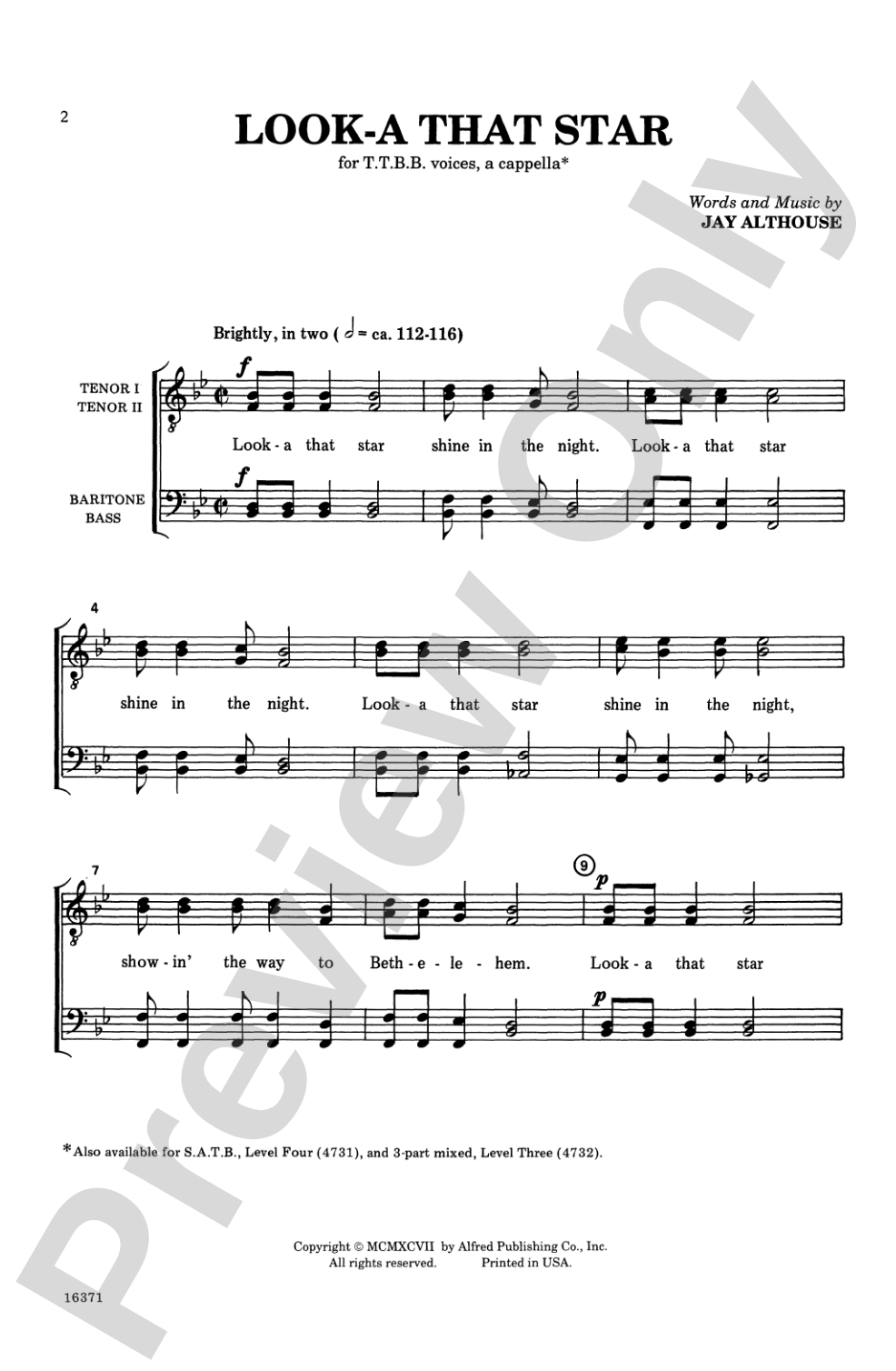

Look-A That Star: TTBB, a cappella Choral Octavo
Music by Jay Althouse
Item: 00-PO-0002103
$2.25
Minimum order quantity: 20 copies
Pickup currently not available
Description
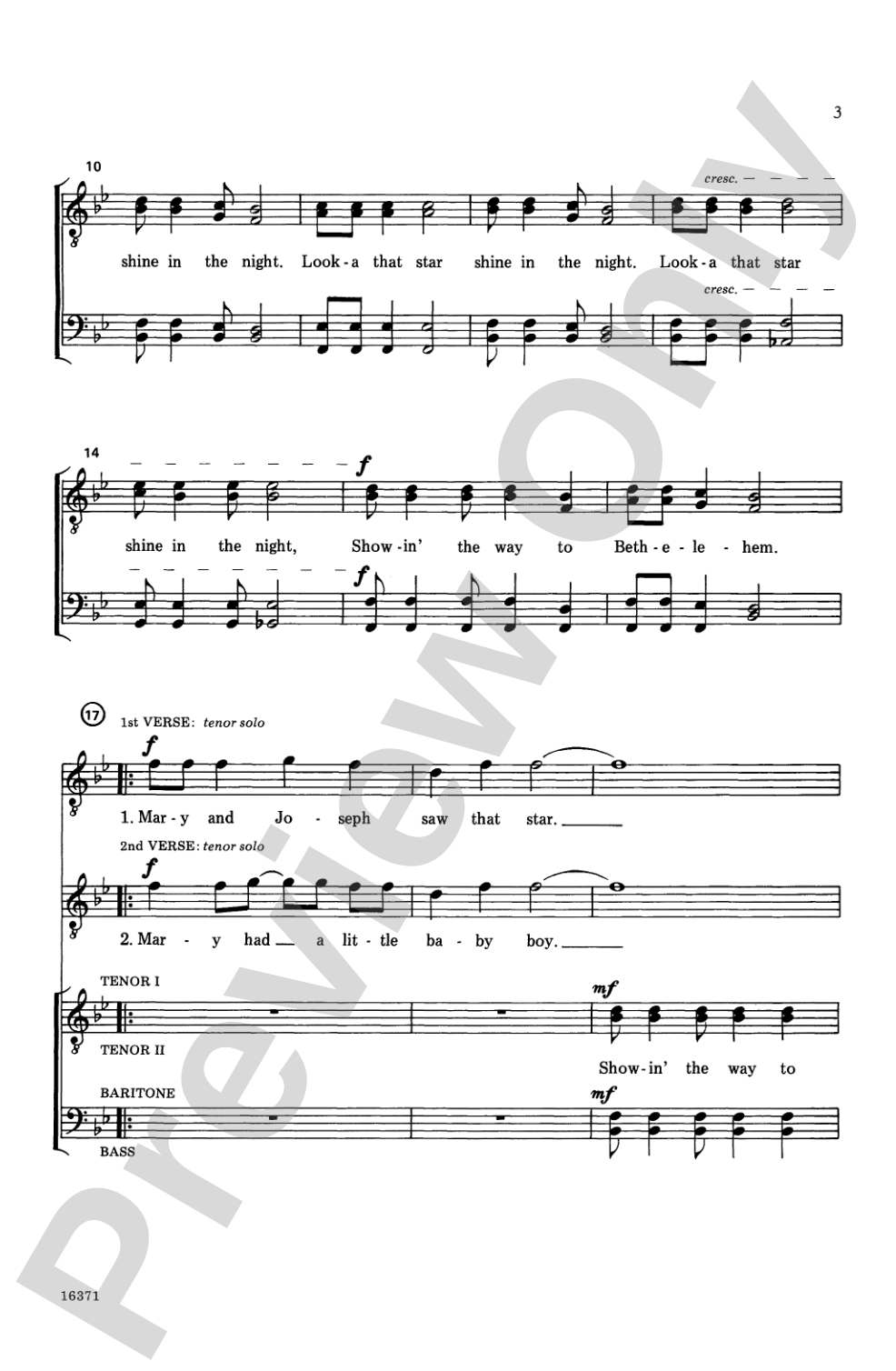
What a great new Christmas spiritual! It's the perfect a cappella number for your choir: the simple harmonies and rhythmic pulse propel this piece from beginning to end. Features dynamic contrasts, a lush middle section and two short solos. Your SATB and 3-part mixed choirs will sound their very best on Look-A That Star.


Look-A That Star: TTBB, a cappella Choral Octavo isn't in MakeMusic Cloud just yet...but it could be. Let us know you'd like to see it, and you'll help shape what comes next. In the meantime, start a free trial and dive into thousands of interactive titles your students can play along with today.
Request This Title
Tell us you want it.
Start Your Free Trial
Explore everything that's ready to play right now.
Sample Audio
No sample audio found.
Sample Video
No sample videos found.
Additional Details
Series:
Alfred Archive Edition: Alfred Choral Designs
Publisher:
Alfred Music
Page Count:
8
SKU:
00-PO-0002103
More about this title
About the Composer: Jay Althouse

Jay Althouse holds degrees in Music Education and Music from Indiana University of Pennsylvania, where he was honored with the Distinguished Alumni award. His compositional output spans over 800 choral works performed across the English-speaking world, and he has served as both a publisher's rights administrator and a member of the ASCAP Executive Board, receiving multiple ASCAP Special Awards for his contributions to standard choral literature.
Beyond composing, Althouse has co-created children's musicals with his wife Sally K. Albrecht, edited widely-used vocal solo collections, and authored influential pedagogical resources including The Complete Choral Warm-up Book and Accent on Composers. His collaborative work I Hear America Singing was performed by the San Francisco Girls and Boys Choirs at President Obama's 2009 Inauguration. He currently serves on the National Advisory Board of the Folk Art Society of America and resides in North Carolina.
Why we love this
Althouse writes with a clear understanding of what makes a cappella choral music work: straightforward harmonic language that never condescends, rhythmic drive that keeps singers engaged, and architectural contrasts that prevent the piece from sitting in one emotional space for too long. The inclusion of two short solos creates performance opportunities within the ensemble context, making this attractive for mixed-level choirs.
What to expect
This spiritual radiates warmth and forward motion. The simple harmonies create an intimate, grounded quality that honors the traditional spiritual idiom, while dynamic shifts and the lush middle section add dimension and prevent predictability. The rhythmic propulsion gives singers something tangible to hold onto, making the a cappella format feel secure rather than exposed.
Who it's for
TTBB choirs seeking substantial a cappella repertoire for holiday concerts, festivals, and competitions will find this piece accessible yet musically satisfying. It works equally well for established men's choirs and for mixed ensembles assigning the piece to tenor and bass sections.
How to get the most out of it
- Balance the two solo sections by rehearsing them with full harmonic support first, then gradually reducing the background voices so the soloist(s) develop confidence carrying the melody alone.
- The rhythmic pulse is the spine of this piece; use body percussion or foot taps during early rehearsals to lock in the underlying groove before layering harmonies.
- Shape the lush middle section with subtle dynamic shaping and vowel matching across all four parts, allowing the harmonic richness to emerge without pushing volume.
- Pay particular attention to how the transition back from the middle section returns to the opening rhythmic energy; rehearse this juncture separately to ensure no momentum is lost.
How to use it
Schedule this as the opening or closing number of a Christmas concert to establish an accessible, uplifting tone that audiences connect with immediately. Its modest page count and straightforward arrangement make it an ideal pairing with more complex seasonal works, creating variety in harmonic density and textural approach across your program.
Skills your students will build
- Balancing blend and intonation in four-part a cappella writing
- Singing sustained lines without instrumental support
- Responding to dynamic and tempo shifts as an ensemble
- Maintaining rhythmic precision while shaping lyrical phrasing
- Solo performance confidence within a choral context