
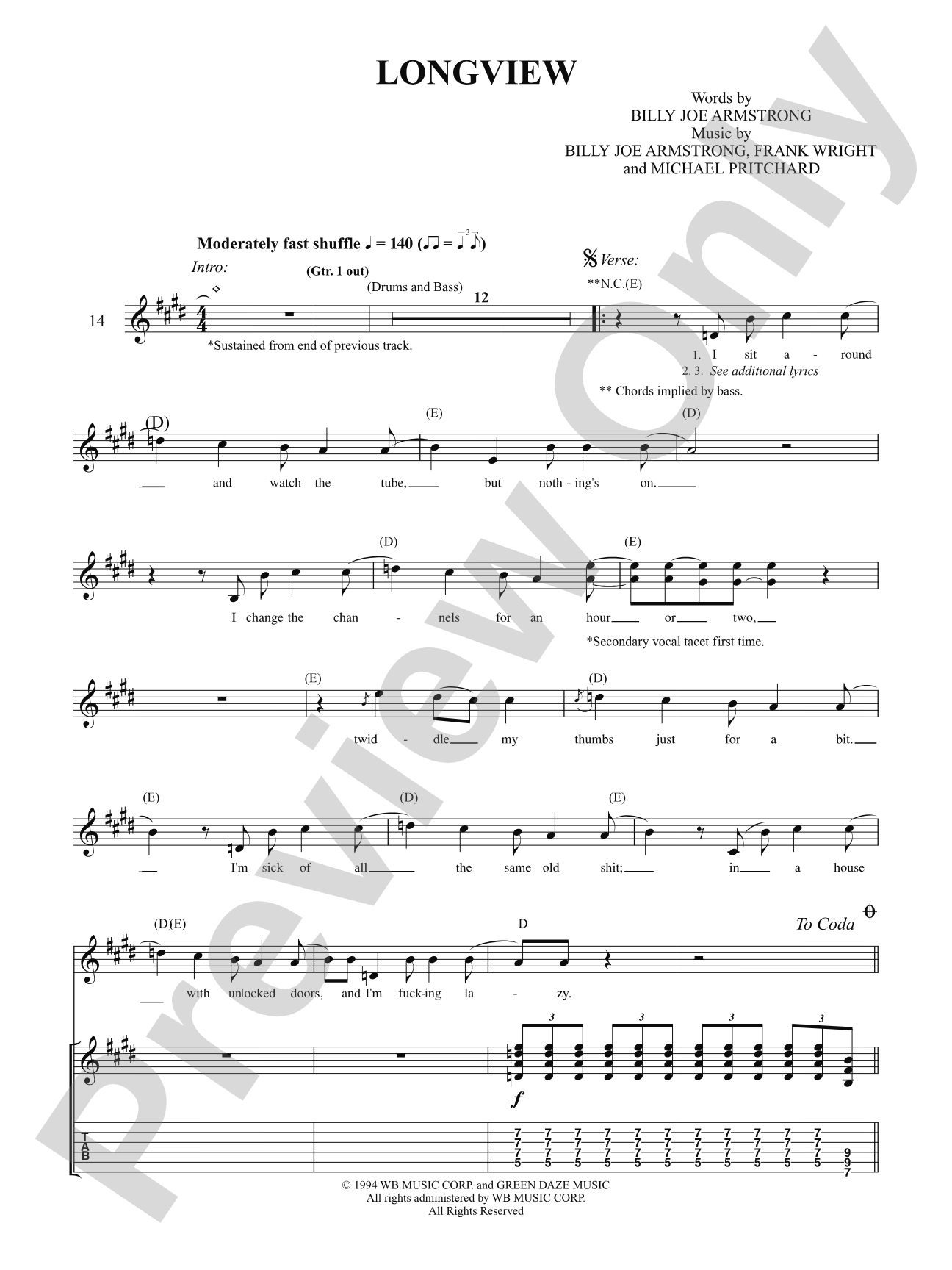

Longview: Authentic Guitar TAB
Green Day
Item: 00-PS-0000142
$4.99
One moment…
Description
This album-matching folio includes: Burnout * Having a Blast * Chump * Longview * Welcome to Paradise * Pulling Teeth * Basket Case * She * Sassafras Roots * In the End * F.O.D. and more.


Longview: Authentic Guitar TAB isn't in MakeMusic Cloud just yet...but it could be. Let us know you'd like to see it, and you'll help shape what comes next. In the meantime, start a free trial and dive into thousands of interactive titles your students can play along with today.
Request This Title
Tell us you want it.
Start Your Free Trial
Explore everything that's ready to play right now.
Sample Audio
No sample audio found.
Sample Video
No sample videos found.
Additional Details
Publisher:
Alfred Music
Page Count:
64
SKU:
00-PS-0000142
More about this title
About the Composer: Billy Joe Armstring
Billy Joe Armstrong is the guitarist, vocalist, and primary songwriter of Green Day, the punk rock band that emerged from the Berkeley, California scene in the early 1990s. His songwriting combines sharp melodic sensibility with direct, often autobiographical lyrics that resonated across generations of listeners. Armstrong's approach to guitar demonstrates that punk rock doesn't mean simplistic playing; his riffs are memorable, his chord progressions intentional, and his arrangements serve the song first.
As a composer, Armstrong developed a distinctive voice within punk rock by blending power chords with unexpected harmonic choices and building songs that balance aggression with hook-driven appeal. His work continues to influence guitarists who want to understand how accessible, radio-friendly music can maintain artistic integrity and energy.
Why we love this
This folio captures one of the most important rock albums of the 1990s in authentic tab, giving guitarists direct access to songs that defined a generation's sound. The collection spans the full dynamic range of 'Dookie,' from the explosive opener 'Burnout' to the quieter, introspective moments like 'She,' making it invaluable for understanding how to build song arrangement and maintain energy across an album. Students see real songwriting craft here, not just power chords and attitude.
What to expect
Sharp, immediate, and energetic. These songs move between explosive, distorted riffs and surprisingly melodic moments, capturing the restless emotional landscape of adolescence and young adulthood. The production is clean enough that every note reads clearly, yet the overall sound bristles with attitude and raw power.
Who it's for
Guitarists who want to learn authentic rock repertoire that sounds great and teaches genuine songwriting principles. Players exploring how punk rock can be both musically sophisticated and immediately accessible will find models for their own playing and arranging.
How to get the most out of it
- Study the rhythm guitar parts alongside the lead lines; Armstrong's strength lies in how the two complement each other, and learning both develops fuller musical understanding.
- Pay attention to dynamics and how the band enters and drops instruments throughout each track; this shapes the emotional arc of the song far more than speed or technical difficulty.
- Lock the kick and snare timing in your head before focusing on note accuracy; the pocket in these songs matters as much as the notes themselves.
- Use muting and palm damping techniques consistently, especially in the verses where space and definition prevent the music from becoming a wall of distortion.
How to use it
Assign individual tracks from this folio as performance pieces for rock ensemble or as featured solo guitar pieces in concerts that showcase contemporary music. The album's narrative arc works well as a programming unit, or select standout tracks like 'Basket Case' and 'Longview' for a showcase featuring student songwriting or arrangement projects inspired by this era of rock.
Skills your students will build
- Reading and executing power chord progressions with rhythmic precision
- Coordinating palm muting with open strings and fretted notes
- Understanding song arrangement and dynamic contrast within a fixed harmonic structure
- Playing in established rock rhythm patterns (straight eighths vs. syncopated feels)
- Translating recorded guitar tones and effects into acoustic execution