
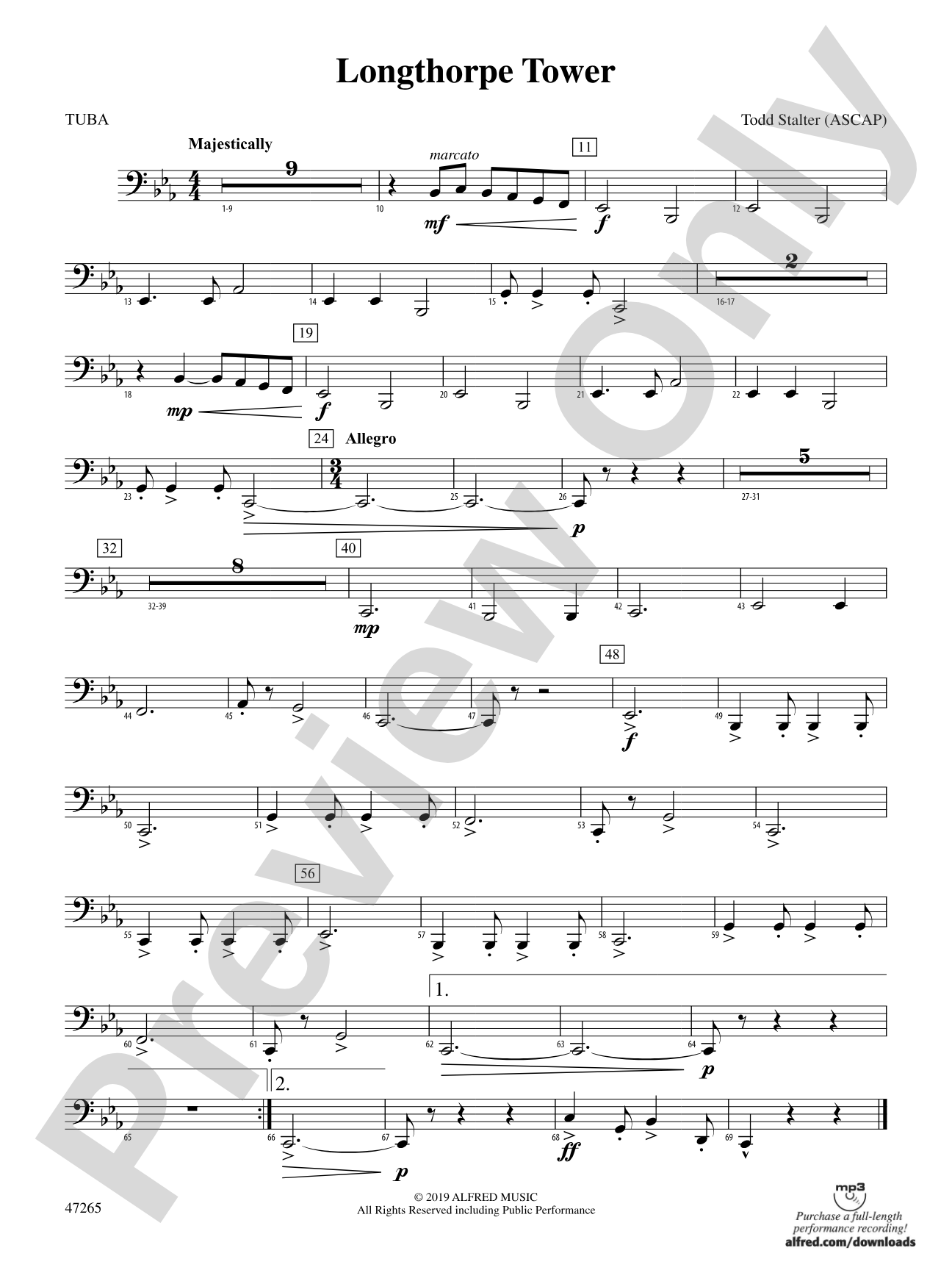

Longthorpe Tower: Tuba
By Todd Stalter
Grade: 1.5
Item: 00-PC-0017879_TB1
$3.00
Pickup currently not available
Description
Longthorpe Tower was a medieval castle of the Thorpe family and contains some of the most well-preserved and complete medieval wall paintings in Northern Europe. This piece represents the music of this period in English history.


Don't just read it, hear it, play along with it, and watch your students grow with it. In MakeMusic Cloud, Longthorpe Tower: Tuba comes alive with professional accompaniment, adjustable tempo, and built-in practice tools that turn solo practice into real progress.
Open in the Player
Jump straight in and assign it today.
Start Your Free Trial
Open this title and explore the full library in minutes.
Sample Audio
1
Audio File
--:--
0:00
0:00
Sample Video
Additional Details
Series:
Challenger Band Series
Publisher:
Alfred Music
Page Count:
122
SKU:
00-PC-0017879_TB1
More about this title
About the Composer: Todd Stalter

Todd Stalter built his reputation over 34 years as Director of Bands at Eureka High School in Illinois, where his ensembles earned 16 state marching championships, consistent Superior ratings in concert competition, and invitations to perform at Orchestra Hall in Chicago and Walt Disney World. Beyond the high school podium, he has conducted All-State Bands in Georgia and Delaware, served as an adjudicator and clinician across multiple states, and presented on composition and music education at regional and state conferences.
As a composer, Stalter's works for band and string orchestra circulate in schools nationwide and appear on state contest lists. Several of his band compositions are featured in the "Teaching Music Through Performance in Band" series published by GIA. He holds degrees from Illinois State University in music education and trumpet performance, where he studied conducting with Dr. Stephen K. Steele.
Why we love this
Stalter crafts programmatic music with genuine educational purpose. Rather than relying on empty impressionism, he anchors this piece in specific historical detail (the medieval wall paintings of Longthorpe Tower) and translates that visual and cultural richness into band writing that stays accessible at Grade 1.5. Conductors appreciate that the work delivers real musical storytelling without sacrificing teachability or ensemble balance.
What to expect
The music evokes the grandeur and austere beauty of medieval England, drawing listeners into a castle frozen in time. Period-influenced harmonies and textures create an atmosphere of age and ceremony without sounding artificial or forced, making the score feel both authentic and musically satisfying for student performers.
Who it's for
This score and parts set is designed for Grade 1.5 concert bands preparing repertoire for festival performance, school concerts, or classroom study of programmatic music. It works equally well for ensembles new to narrative-driven band music and for more experienced groups looking for accessible material with cultural and historical substance.
How to get the most out of it
- Balance the narrative clarity with ensemble blend. Because this is programmatic music, younger players need to hear how their section contributes to the overall story; let them play through without stopping so they can feel the arc from beginning to end.
- Pay attention to dynamic shape between sections. Medieval music often moved through stark contrasts, and this score likely reflects that sensibility. Help the band recognize when the color changes rather than treating each phrase as isolated.
- Give careful weight to any fanfare or processional figures that might suggest castle life or period instruments. These moments are your anchors for the program; they help the audience follow the story too.
- Rehearse the parts as blocks first (woodwinds, brass, percussion) to ensure each section understands its melodic or rhythmic role in the overall texture before the full ensemble comes together.
How to use it
Use this as an opening piece for a concert themed around history, architecture, or cultural heritage. It also pairs well in a program that explores music across centuries, offering a bridge between folk tradition and modern concert writing. For younger ensembles building confidence with longer works, the Grade 1.5 level makes it an ideal choice for a full-length festival entry or end-of-year performance.
Skills your students will build
- Understanding musical narrative and how composers translate visual or historical imagery into sound
- Ensemble balance and blend in textures that may feature layered melodic lines
- Sensitivity to dynamic and tempo changes that support programmatic storytelling
- Reading and executing parts with clear melodic purpose in the context of the whole