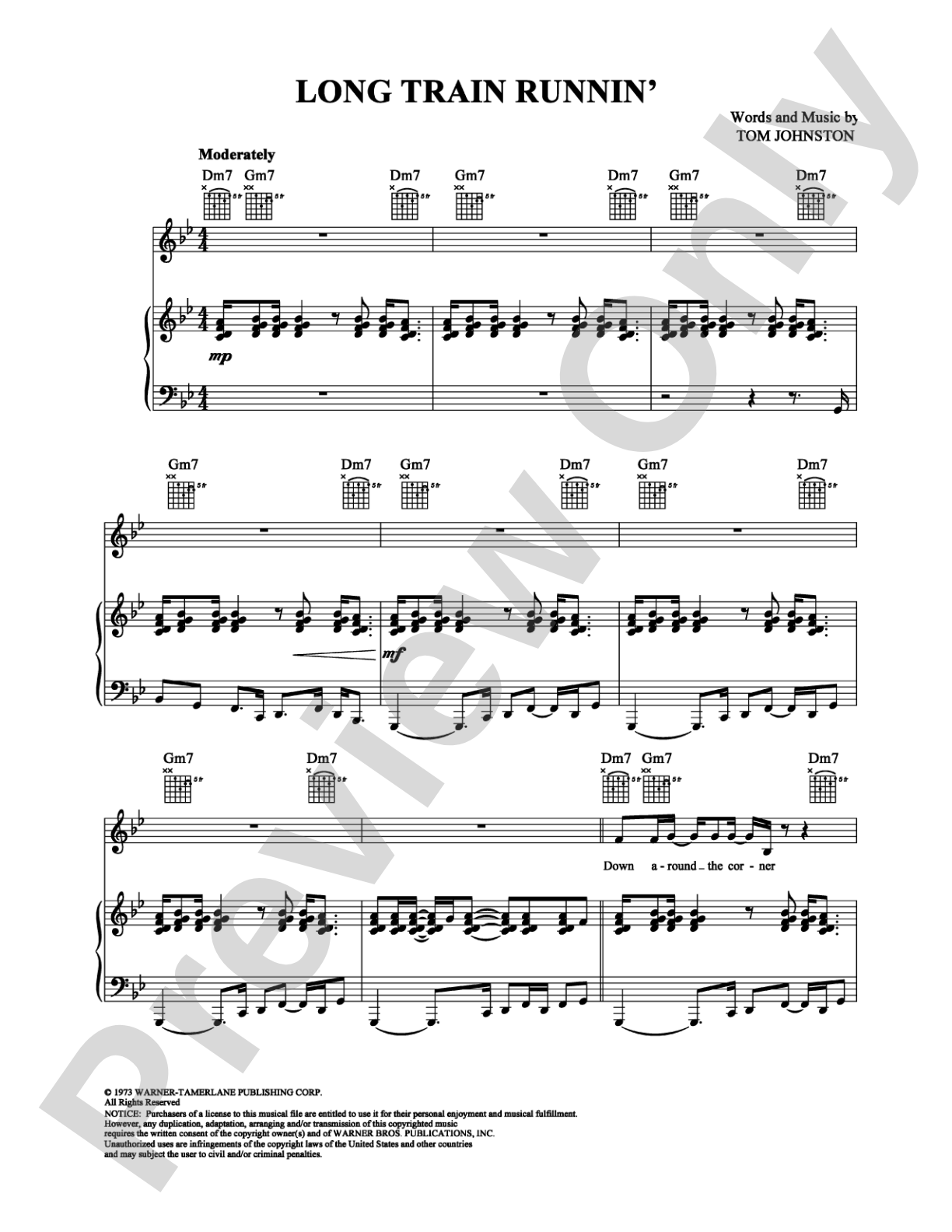
Long Train Runnin': Piano/Vocal/Chords Digital Sheet Music

Long Train Runnin': Piano/Vocal/Chords Digital Sheet Music

Tom Johnston, Doobie Brothers

Item: 00-PS-0002283

Digital Download
$3.99
Description

Long Train Runnin': Piano/Vocal/Chords Digital Sheet Music isn't in MakeMusic Cloud just yet...but it could be. Let us know you'd like to see it, and you'll help shape what comes next. In the meantime, start a free trial and dive into thousands of interactive titles your students can play along with today.

Sample Audio
No sample audio found.
Sample Video
Additional Details
SKU: 00-PS-0002283

More about this title

About the Artist: Doobie Brothers

The Doobie Brothers emerged from San Jose in 1970 with a sound that blended rock energy, soulful vocals, and sophisticated harmonies. Built on a foundation of tight musicianship and memorable hooks, the band became one of the defining acts of 1970s rock, earning multiple Grammy Awards and a devoted following that spans generations. Their catalog remains a staple of classic rock radio and a masterclass in how to write songs that endure.

For music educators, the Doobie Brothers represent an accessible entry point into studying composition and arrangement in popular music. Their songs reward close listening and reveal how layered instrumentation, vocal counterpoint, and rhythmic precision combine to create songs that are both commercially successful and musically substantial.

Why we love this

This is a song that singers genuinely want to perform, and the vocal line sits comfortably for most voices while offering enough character to engage an audience immediately. The piano/vocal/chords format gives vocalists and pianists room to interact and build arrangement ideas together, whether you're using it for a jazz choir, a pop ensemble, or a recital with a collaborative pianist.

What to expect

There's an unhurried ease to this song, a sense of forward motion without urgency. The groove carries you; the vocal line unfolds with conversational warmth, inviting the listener in rather than demanding attention. It's the sound of musicians who know how to pocket a groove and let the song breathe.

Who it's for

Singers working toward independence and confidence in a pop/rock idiom will find a supportive vehicle here; the song's familiarity builds confidence while the vocal range and melodic shape offer real musical content. Pianists exploring chord-based improvisation and comping will appreciate the harmonic movement and space to interpret the accompaniment. Any ensemble (vocal jazz group, pop choir, jazz combo) looking for repertoire that audiences recognize and that performers enjoy will connect with this song.

How to get the most out of it

  • Let the groove breathe. The rhythm section feel here relies on pocket playing rather than rigid tempo; anchor the eighth-note subdivisions and allow space between phrases for the song's laid-back character to land.
  • The vocal melody sits low enough that many singers can own the entire range without strain. Find the key that lets the singer inhabit the line naturally rather than reaching for it.
  • Use the chord symbols as a starting point, not a boundary. A jazz pianist can comp freely over these changes; a pop accompanist might lock into a specific rhythm figure. The progression is open enough to support both approaches.
  • Balance the vocal narrative with instrumental interest. This song gives you room to expand the piano part or add instrumentation, so resist the temptation to underplay the accompaniment just because the melody is strong.

How to use it

This works beautifully in a pop or jazz choir concert, especially as a solo feature for a vocalist with a strong sense of groove and dynamics. It's also an excellent choice for a jazz ensemble or combo performance, where the piano/vocal foundation can expand into a fuller arrangement. For a more intimate setting, pair it with other classic rock standards in a recital that celebrates songwriting across decades.

Skills your students will build

  • Singing against a groove; resisting the pull to rush or drag
  • Reading and interpreting lead sheet notation (melody, chord symbols, rhythmic feel)
  • Navigating a moderate vocal range while maintaining phrase shape and lyrical intent
  • Piano comping over ii-V-I and blues-influenced progressions
  • Building arrangement concepts from a simple lead sheet

You May Also Like