
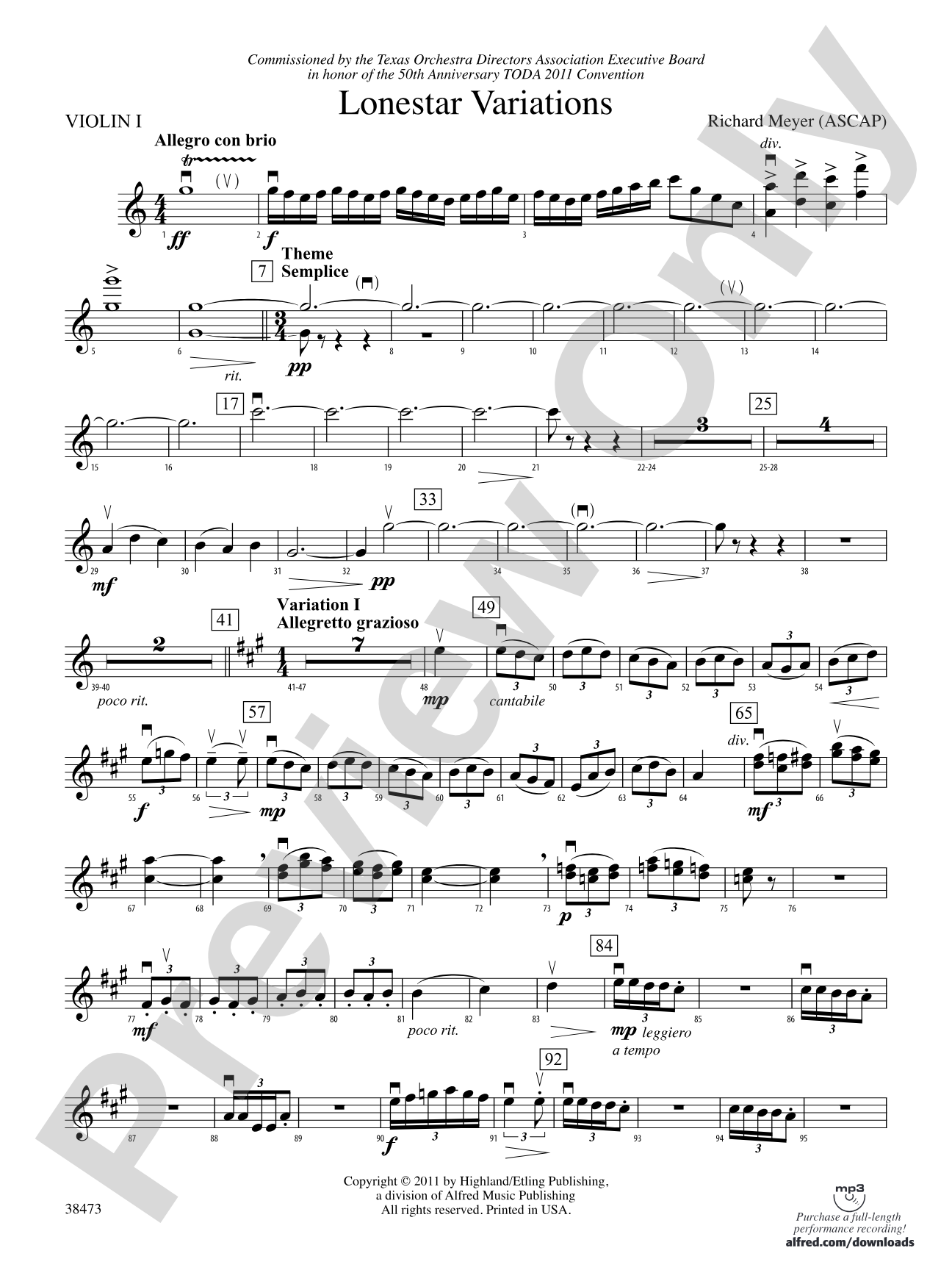

Lonestar Variations: 1st Violin
By Richard Meyer
Grade: 3.5
Item: 00-PC-0015521_VN1
$5.99
Pickup currently not available
Description
Written in honor of the Texas Orchestra Directors Association 50th anniversary, Lonestar Variations is the perfect way to show off all facets of your orchestra's playing abilities. The five variations on the folk tune "Streets of Laredo" go through five different keys, five different time signatures, and five very distinct moods. Each section is featured in their own variation, followed by a virtuosic finale that is sure to stir up everyone in your audience. As educational as they come, this selection is a must for your next festival or contest! This title is available in MakeMusic Cloud.


Don't just read it, hear it, play along with it, and watch your students grow with it. In MakeMusic Cloud, Lonestar Variations: 1st Violin comes alive with professional accompaniment, adjustable tempo, and built-in practice tools that turn solo practice into real progress.
Open in the Player
Jump straight in and assign it today.
Start Your Free Trial
Open this title and explore the full library in minutes.
Sample Audio
1
Audio File
--:--
0:00
0:00
Sample Video
No sample videos found.
Additional Details
Series:
Highland/Etling String Orchestra
Publisher:
Alfred Music
Page Count:
124
SKU:
00-PC-0015521_VN1
More about this title
About the Composer: Richard Meyer

Richard Meyer brings four decades of string education experience to his composing work, having spent 35 years teaching orchestral musicians from elementary through high school. His tenure directing orchestras at Oak Avenue Intermediate School in Temple City, California transformed the program from 29 students to 200, while he simultaneously oversaw the city's elementary string curriculum. Beyond the classroom, Meyer served as music director of the Pasadena Youth Symphony Orchestra for 16 years, leading ensembles on international tours to Vienna, Australia, and Canada.
Meyer's reputation as a clinician and guest conductor spans major conferences including the A.S.T.A. National Conference and the Texas Orchestra Directors' Association Conference. His "Giving Bach" program, launched in 2009, has earned national recognition for its creative use of interactive concerts to serve special needs and underserved student populations throughout Southern California. As a composer, he has published over 190 works and arrangements while serving 16 years as string editor for Alfred Publishing Company. Meyer is also co-author of influential string method resources, including the String Explorer Series and Sight-read It for Strings.
Why we love this
Meyer has written this work from the ground up to showcase what a well-trained string orchestra can do at grade 3.5. The five variations structure gives every section a featured moment, which means your violins, violas, cellos, and basses all walk away from rehearsal knowing they carried the piece. A conductor who understands student motivation will recognize immediately that this kind of sectional spotlight builds both technical confidence and ensemble ownership.
What to expect
Lonestar Variations opens with the timeless simplicity of a Western folk melody, then transforms it repeatedly, moving through different keys and time signatures as if the tune is being viewed through different lenses. Each variation brings its own character and technical demand, from lyrical exploration to rhythmic drive, culminating in a finale that gives the entire ensemble a chance to shine with virtuosity and polish.
Who it's for
String orchestra directors at the intermediate to early advanced level who want a single work that covers multiple pedagogical and programming bases. This piece serves both the student orchestra building ensemble identity and the director preparing for festival or contest performance without sacrificing educational value.
How to get the most out of it
- Balance the folkloric simplicity of "Streets of Laredo" against the harmonic and rhythmic complexity Meyer adds in each variation; the tune should always remain recognizable even as the accompaniment becomes more sophisticated.
- Use the key changes as an opportunity to reinforce intonation work specific to each tonality; students often need extra attention when a familiar tune moves to an unfamiliar key.
- Shape the virtuosic finale by drilling the rhythm section (cellos and basses) first so that upper strings can layer their faster figures with confidence.
- Give each variation its own rehearsal focus: one section might emphasize rhythmic precision, another might emphasize tone color or dynamic control, keeping the work fresh across multiple rehearsals.
How to use it
Program this as a showstopper on a spring festival or contest performance where you want to demonstrate full-ensemble development. The work's celebration of sectional features makes it ideal for a concert where each section has a solo moment, or place it as the finale of a program built around American folk music and variations.
Skills your students will build
- Reading mixed meters across five time signatures
- Transposing familiar melodies to five different keys and maintaining intonation
- Balancing melody and accompaniment in varied orchestration
- Sectional independence and featured ensemble writing
- Ensemble precision in rhythmically complex finales
- Dynamic and tone color contrast across extended variations