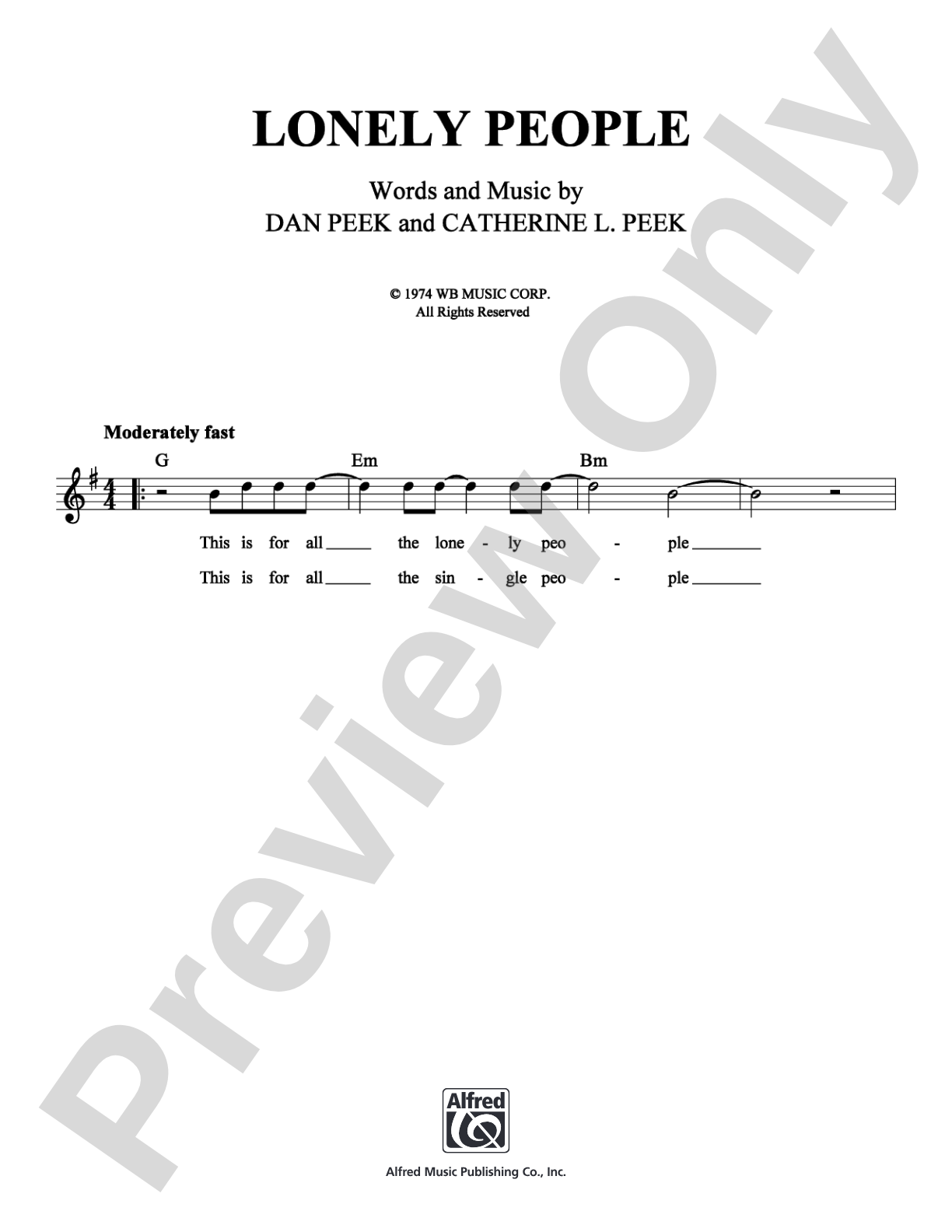
Lonely People: Lead Sheet Digital Sheet Music

Lonely People: Lead Sheet Digital Sheet Music

America, Dan Peek, Catherine L. Peek

Item: 00-PS-0008703

Digital Download
$1.99
Description

Lonely People: Lead Sheet Digital Sheet Music isn't in MakeMusic Cloud just yet...but it could be. Let us know you'd like to see it, and you'll help shape what comes next. In the meantime, start a free trial and dive into thousands of interactive titles your students can play along with today.

Sample Audio
No sample audio found.
Sample Video
Additional Details
SKU: 00-PS-0008703

More about this title

About the Artist: America

America formed in 1970 as a folk-rock trio, quickly establishing themselves as one of the defining voices of 1970s soft rock. The band's sophisticated harmonies, intricate acoustic guitar work, and thoughtful songwriting earned them a devoted following and multiple platinum albums. Their catalog remains a touchstone for understanding how pop and rock songwriting evolved during that era, and their influence appears regularly in contemporary music education settings.

Why we love this

"Lonely People" captures the emotional restraint and harmonic richness that made America essential to the songwriting canon of its time. Directors value this lead sheet for its accessibility to students working with jazz voicings and pop song structure, while the song's introspective lyrical content and balanced arrangement offer performers a chance to explore subtlety and dynamic control in a piece that sounds deceptively simple.

What to expect

The song unfolds with a gentle melancholy, anchored by fingerpicked guitar figures and warm harmonic colors that feel both timeless and intimately familiar. There's a quiet wisdom in the way the melody moves through the changes, inviting reflection without demanding dramatic expression.

Who it's for

This lead sheet works well for vocalists, pianists, and small ensembles exploring 1970s popular songwriting and jazz-influenced pop arrangements. It suits musicians comfortable reading chord symbols and improvising or adapting accompaniment to fit their performing context, whether that's a solo recital, classroom performance, or informal music-making.

How to get the most out of it

  • Study the harmonic movement carefully; the song's emotional weight lives in the chord changes rather than rhythmic complexity, so voice leading clarity matters more than tempo precision.
  • Shape the melody with gentle phrasing that honors the song's introspective quality. Resist the urge to oversell; understatement is the song's natural strength.
  • Pay close attention to how the accompanying voices support the lead line. This is not a melody-with-chords arrangement but an interlocking harmonic texture where every line carries melodic weight.
  • Reference the original recording to internalize the song's tempo and feel, then find your own interpretation. The lead sheet format gives you freedom to reshape the accompaniment to match your ensemble's strengths.

How to use it

Include this on a recital exploring songwriting across genres or as part of a unit on 1970s popular music. It pairs effectively with other art-song arrangements or contemporary classics that emphasize harmonic sophistication over instrumental flash, making it ideal for showcasing a vocalist's interpretive maturity or a pianist's collaborative skills.

Skills your students will build

  • Reading and interpreting lead sheet notation with jazz voicings
  • Shaping melodic phrasing with emotional restraint and subtlety
  • Understanding song form and harmonic progression in popular music
  • Adapting or improvising accompaniments from chord symbols
  • Balancing melodic clarity with harmonic complexity in ensemble settings

You May Also Like