
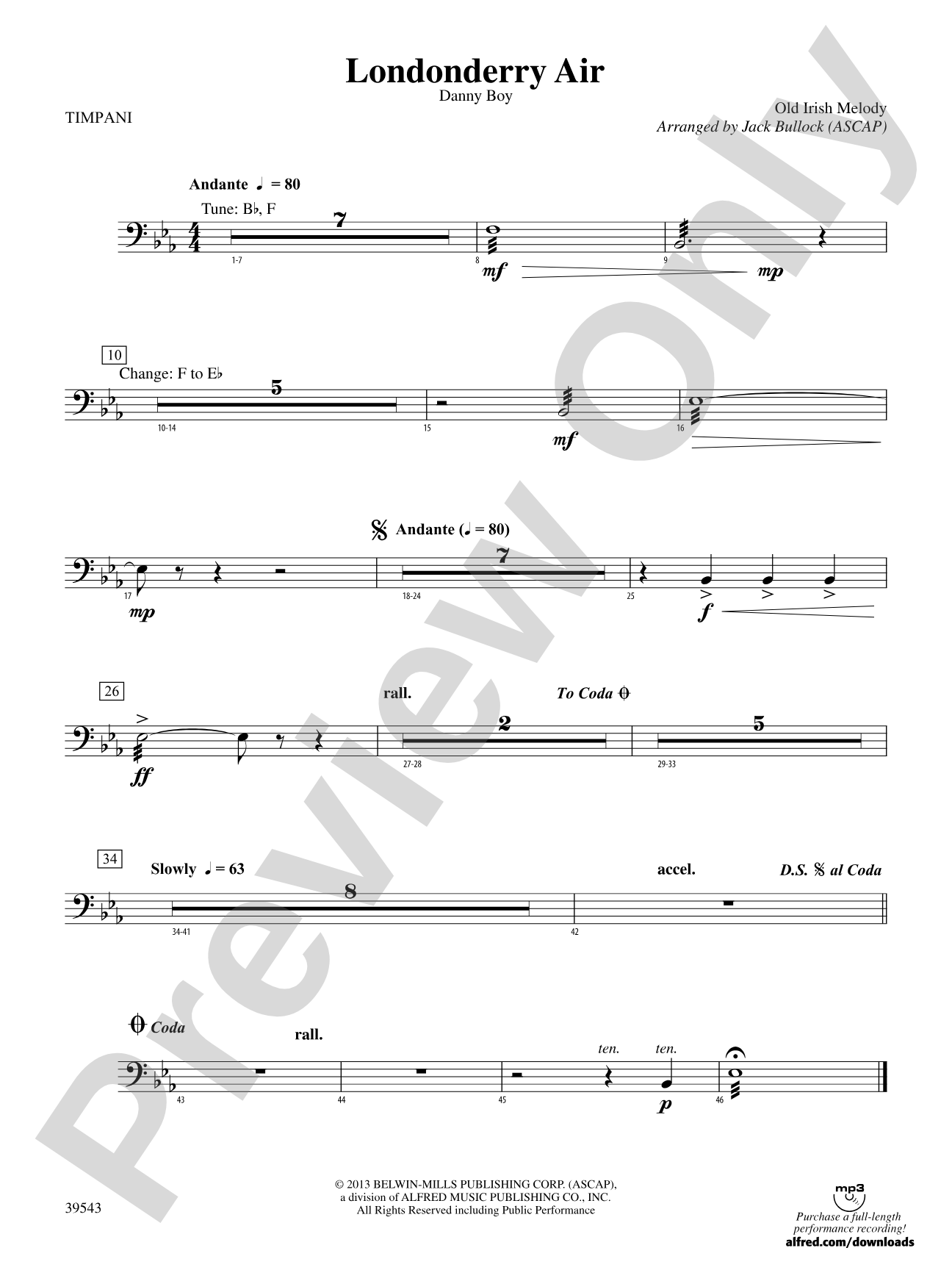

Londonderry Air: Timpani
(Danny Boy)
Old Irish Melody / arr. Jack Bullock
Grade: 2 (Easy)
Item: 00-PC-0015856_TMP
$3.00
Pickup currently not available
Description
Titled for the County Londonderry in Ireland, this famous song is performed in Northern Ireland as a victory anthem. This arrangement is rich with texture, supporting the familiar melody---this is an endearing and musical choice for inclusion on any program. (3:15)
This title is available in MakeMusic Cloud.


This title is available in MakeMusic Cloud.
Don't just read it, hear it, play along with it, and watch your students grow with it. In MakeMusic Cloud, Londonderry Air: Timpani comes alive with professional accompaniment, adjustable tempo, and built-in practice tools that turn solo practice into real progress.
Open in the Player
Jump straight in and assign it today.
Start Your Free Trial
Open this title and explore the full library in minutes.
Sample Audio
1
Audio File
--:--
0:00
0:00
Sample Video
No sample videos found.
Additional Details
Series:
Belwin Young Band
Publisher:
Alfred Music
Page Count:
116
SKU:
00-PC-0015856_TMP
More about this title
About the Arranger: Jack Bullock

Jack Bullock brings decades of professional experience as a performer, educator, and prolific arranger to every score he creates. His background includes performance on trumpet with the Miami Philharmonic Orchestra and Miami Opera Company, as well as extensive work with regional and touring ensembles. He holds degrees through the doctoral level in music education and taught instrumental music in school settings for 20 years, including seven years as an assistant band director at Ithaca College's School of Music, where he also chaired the Music Education Department.
With more than 600 published arrangements and compositions across concert band, orchestra, jazz ensemble, and marching band, Dr. Bullock has shaped the repertoire young musicians encounter in rehearsal. He co-authored the Belwin 21st Century Band Method and contributed arrangements to Music Expressions, Alfred Music's innovative curriculum. His work has earned recognition through listings in Marquis Who's Who and membership in ASCAP since 1980, and he remains an active clinician across the United States, Canada, and England.
Why we love this
Bullock's arrangement honors the emotional core of this Irish melody while providing young bands with genuine musical substance at an accessible grade level. The textures are sophisticated enough to hold audience attention and rewarding enough to keep students engaged through sectional rehearsals, making this a standout choice for early-season concerts or festival programs where you want to program something both recognizable and musically satisfying.
What to expect
The familiar melody floats above warm, supporting harmonies that create intimacy rather than grandeur. You hear the melody's wistful character preserved while the arrangement wraps it in an envelope of ensemble sound that feels both comforting and present.
Who it's for
Young concert bands at the Grade 2 level will find this arrangement within their technical reach while experiencing a piece with genuine musical depth. Conductors seeking programming for early fall concerts, county festivals, or cultural celebration events will value both its accessibility and its cultural significance.
How to get the most out of it
- Balance the familiar melody against the supporting harmonies; the enchanting quality depends on ensemble transparency rather than volume. Listen for inner voices in rehearsal with accompaniment parts playing at dynamic parity with the melodic line.
- Shape phrases with gentle swells and retreats rather than block dynamics. This folk melody benefits from breath and direction that mirrors vocal phrasing conventions, even for instrumental performers.
- Establish a steady, unhurried tempo that allows the harmonic movement to bloom. Resist the urge to rush; the three-minute-fifteen-second duration feels natural when conducting with patience rather than momentum.
How to use it
This works beautifully as an opening or closing selection on a concert, establishing a reflective, accessible mood. It also pairs well with other folk-based or multicultural selections, allowing you to build a thematic program segment that showcases world music traditions alongside developing young musicians' cultural literacy.
Skills your students will build
- Balancing melody and accompaniment within band texture
- Sustaining steady phrasing across entire sections
- Responding to subtle dynamic shaping and sectional independence
- Understanding folk melody characteristics and arranging conventions