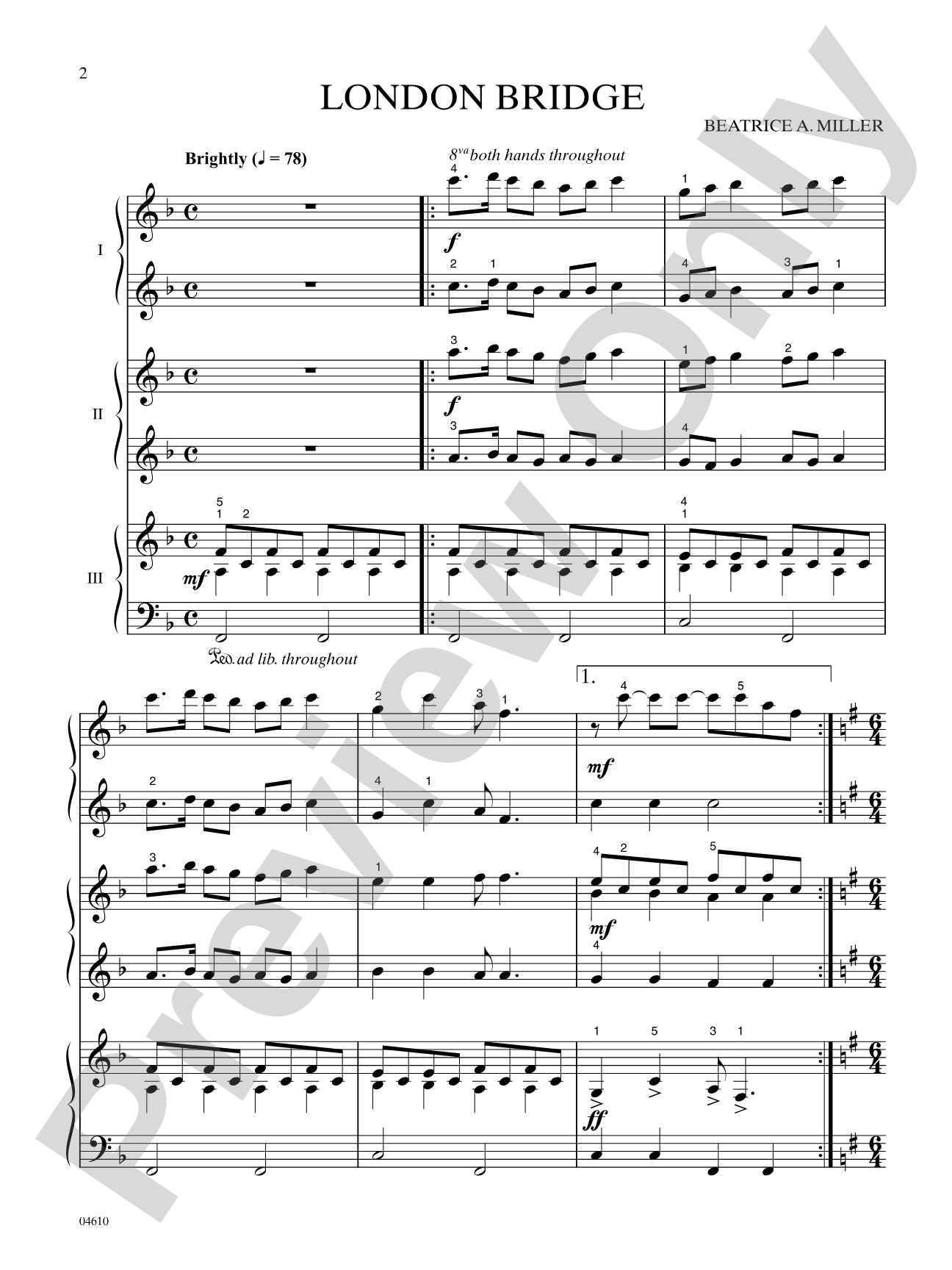
London Bridge - Piano Trio (1 Piano, 6 Hands) Sheet Music Preview

London Bridge - Piano Trio (1 Piano, 6 Hands): Piano

Arranged by Beatrice A. Miller

Level: Early Intermediate

Item: 00-PB-0000746

Digital Download
$3.50
Description
"London Bridge" will conjure up memories from childhood, both as a song and as a game. But it will never be the same after a trio of students gets through with this arrangement! Each individual part of the trio offers a fun musical challenge that will aid a student's growth at the keyboard. This will make a fine addition to any recital. A Federation Festivals 2016-2020 selection.

London Bridge - Piano Trio (1 Piano, 6 Hands): Piano isn't in MakeMusic Cloud just yet...but it could be. Let us know you'd like to see it, and you'll help shape what comes next. In the meantime, start a free trial and dive into thousands of interactive titles your students can play along with today.

Sample Audio
No sample audio found.
Sample Video
Additional Details
Publisher: Alfred Music
Page Count: 4
SKU: 00-PB-0000746

More about this title

About the Arranger: Beatrice A. Miller

Beatrice A. Miller

Beatrice A. Miller grew up in Detroit, Michigan, in a musical household where her father, a Lutheran pastor and skilled musician, anchored the family's evenings in hymn singing. Her four older brothers became captivated by music after noticing that nine-month-old Bea was mimicking the cadence of hymns with her baby sounds, a moment that sparked a lifelong joy in making music together.

Miller earned her Master's degree in music composition from Northwestern University and spent decades teaching piano, directing church choirs, and serving as a church organist in Corvallis, Oregon. After retiring from teaching in 1979, she devoted herself fully to composing and began publishing her work in 1987. The Oregon Music Teacher's Association honored her as Composer of the Year in 1997.

Why we love this

Miller's six-hand arrangement transforms a nursery song into a genuine ensemble experience where all three pianists share equally interesting musical material. The piece works beautifully on a recital program because it captures the charm of the original tune while giving each student a legitimate musical role that demands attention and skill.

What to expect

The piece carries the playful familiarity of the childhood song while adding sophisticated keyboard texture through the three-piano-six-hands writing. What starts as a simple memory becomes something richer, with interlocking parts that reward careful listening and create genuine ensemble magic.

Who it's for

Three piano students at the early intermediate level who are ready to collaborate on a formal recital piece. This works especially well for students in a private studio setting or for studio recitals where groups of three pianists can take the stage together.

How to get the most out of it

  • Balance the parts so the melody stays clear even when the other hands weave around it; six hands at one piano can easily become a muddle without careful listening and voice independence.
  • Practice hands separately within each student's part before bringing all three pianists together; this arrangement gives each player a mix of melody and accompaniment figures that require secure fingering.
  • Lock in the pulse as a trio by playing through the piece without the piano first, clapping or tapping the beat together, then adding the keyboard layer once the three of you breathe as one unit.
  • Experiment with voicing and dynamics to highlight different sections; the arrangement likely brings the familiar tune to the foreground at key moments, so adjust dynamics to let those moments shine.

How to use it

This trio sits perfectly in a studio recital or festival performance where you want to showcase collaborative work among your students. It also works well as a bridge between solo repertoire and larger ensemble experiences, giving students a taste of the discipline required to blend and balance in an ensemble context.

Skills your students will build

  • Playing as an ensemble while sharing one instrument (voice independence at a shared keyboard)
  • Balancing multiple melodic and accompaniment lines without a conductor
  • Listening to and adjusting intonation and voicing in real time with two other pianists
  • Maintaining steady tempo while coordinating hand placement and movement across three performers
  • Reading mixed rhythmic figures and syncopation (depending on the arrangement's specific demands)

You May Also Like