
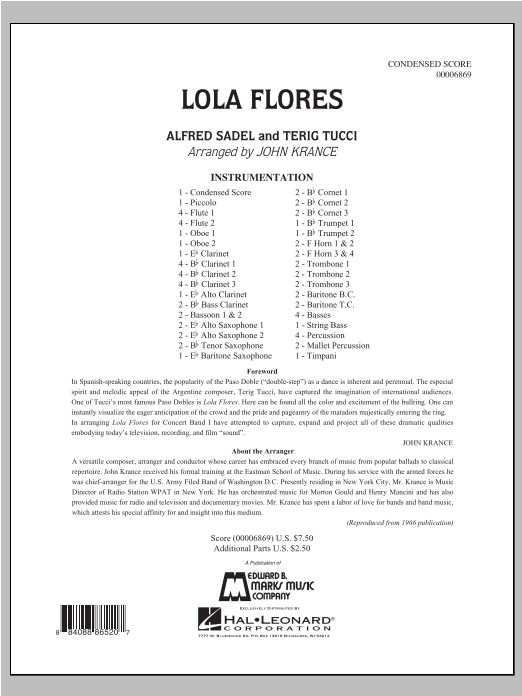

Lola Flores: Concert Band Conductor Score & Parts
Arranged by John Krance
Grade: 4
Item: 35-PK00248327
$100.00
Pickup currently not available
Buy Extra Parts (Digital PDF Download)
Parts Added to Cart!
Description
The lively dance style of the Paso Doble (double-step) is inherent in Spanish culture and claims its roots from the excitement and drama of the bullfight arena. Here in one of the most famous Paso Dobles can be heard the anticipation and pageantry as the matadors majestically enter the ring. John Krance's classic 1966 setting is a distinctive and important work for band. (Grade 4) Dur: 4:00


Lola Flores: Concert Band Conductor Score & Parts isn't in MakeMusic Cloud just yet...but it could be. Let us know you'd like to see it, and you'll help shape what comes next. In the meantime, start a free trial and dive into thousands of interactive titles your students can play along with today.
Request This Title
Tell us you want it.
Start Your Free Trial
Explore everything that's ready to play right now.
Sample Audio
No sample audio found.
Sample Video
No sample videos found.
Additional Details
Publisher:
Hal Leonard
SKU:
35-PK00248327
More about this title
About the Arranger: John Krance
John Krance established himself as a composer and arranger with a keen ear for the dramatic and the danceable. His 1966 setting of Lola Flores became a staple of the concert band repertoire, demonstrating his gift for capturing the essence of a style and translating it effectively for wind ensemble forces.
Krance's work spans multiple genres and difficulty levels, but he remains best known in music education circles for arrangements that balance authenticity with accessibility. His ability to preserve the character and excitement of source material while writing idiomatically for band has made his scores reliable choices for festivals and concerts across the country.
Why we love this
This arrangement holds its ground against every other Paso Doble in the concert band canon. The orchestration brings out the swagger and pageantry of the bullfight procession without overwhelming younger players, and the four-minute runtime fits perfectly into the middle or closing spot of a mixed program. You'll hear your students connect immediately to the Spanish character; the rhythmic vitality does the teaching for you.
What to expect
You're standing in the Spanish sun as the matadors process into the ring. The excitement builds with each entrance; there's pageantry, anticipation, and a kind of fierce elegance running through every bar. The piece pulses with energy without ever feeling frantic, and the bright harmonies and rhythmic drive create an atmosphere that's both grand and infectious.
Who it's for
Concert bands at the Grade 4 level looking for a crowd-pleasing work with genuine cultural authenticity. This piece works equally well for festival play or community concert programming, and it gives students a chance to sit inside a style that's instantly recognizable and genuinely exciting.
How to get the most out of it
- Shape the dotted rhythms with crisp articulation and forward momentum. These figures drive the piece's Spanish personality, so avoid letting them feel heavy or dragging.
- Balance the melodic voices across the ensemble so the theme sings over the rhythmic foundation. In a piece built on ostinato patterns, clarity of line prevents the texture from muddying.
- Bring out the contrast between sections by adjusting the character and weight of the ensemble sound. The transitions should feel like costume changes in the arena rather than shifts in tempo.
- Lock the percussion and low brass into a unified pulse; their partnership anchors everything above them and makes the syncopations sit securely.
How to use it
This is an ideal closer for a concert mixing lighter works with more serious repertoire. Its four minutes of pure energy and Spanish flair follow well after a ballad or a classical arrangement, and audiences leave the hall humming the main theme. Consider programming it as the final number of a spring concert or festival set where you need to send the crowd out energized.
Skills your students will build
- Articulation control in dotted rhythm figures
- Rhythmic unison across sections with syncopated patterns
- Stylistic interpretation of Spanish dance idioms
- Balance and blend between melody and accompanimental ostinatos
- Sustained energy and character across a four-minute work