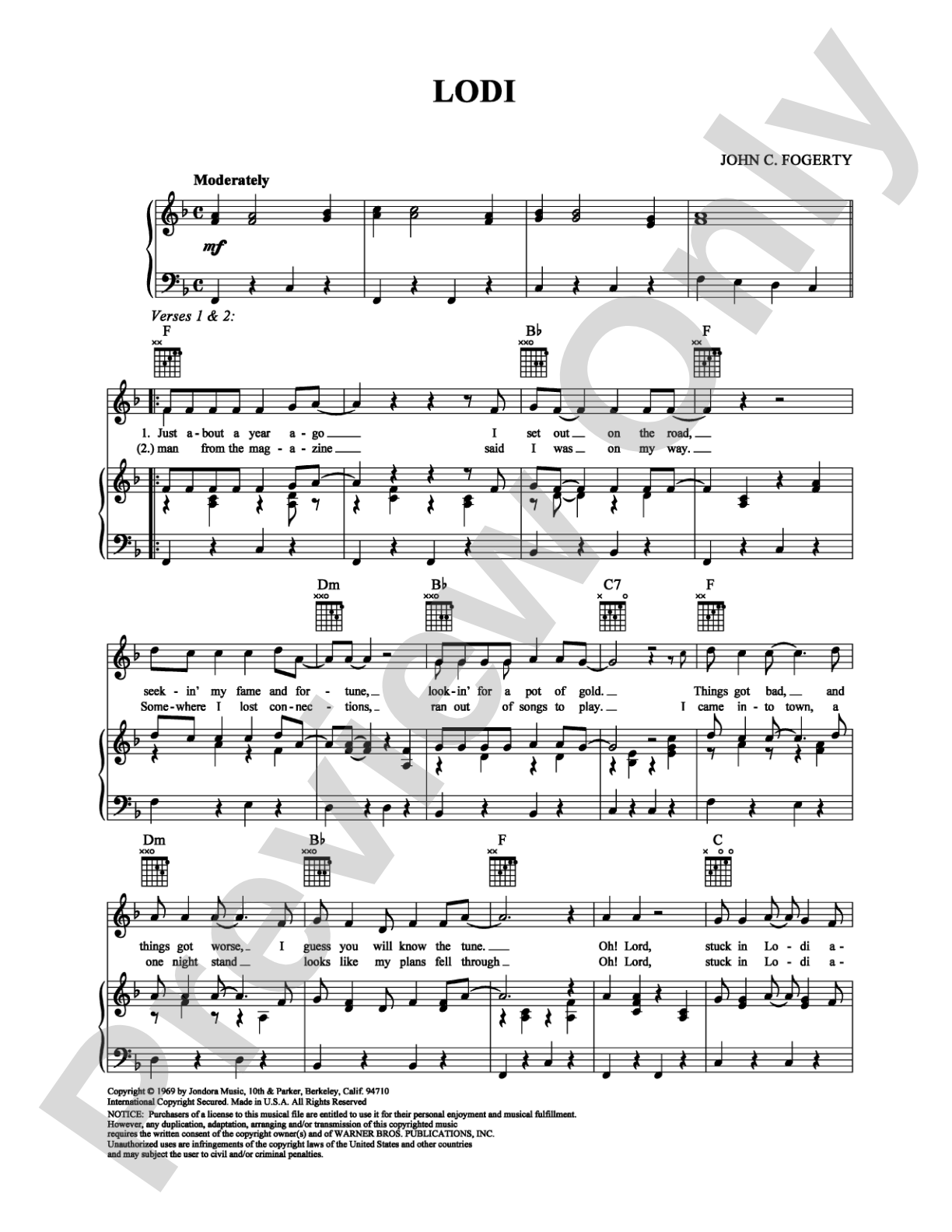
Lodi: Piano/Vocal/Chords Digital Sheet Music

Lodi: Piano/Vocal/Chords Digital Sheet Music

Creedence Clearwater Revival, John C. Fogerty

Item: 00-PS-0007629

Digital Download
$3.99
Description

Lodi: Piano/Vocal/Chords Digital Sheet Music isn't in MakeMusic Cloud just yet...but it could be. Let us know you'd like to see it, and you'll help shape what comes next. In the meantime, start a free trial and dive into thousands of interactive titles your students can play along with today.

Sample Audio
No sample audio found.
Sample Video
Additional Details
SKU: 00-PS-0007629

More about this title

About the Artist: Creedence Clearwater Revival

Creedence Clearwater Revival emerged from El Sobrante, California in 1967 and became one of the most prolific rock bands of the late 1960s and early 1970s. Led by John Fogerty's distinctive vocals and songwriting, the band released five studio albums in just three years, each spawning multiple hits that dominated radio and remain staples of classic rock radio today. Their catalog includes some of the most recognizable songs in American popular music, from swamp rock anthems to introspective ballads.

The band's influence extends far beyond their commercial success. Their tight instrumental arrangements, memorable hooks, and Fogerty's evocative storytelling established a template for rock songwriting that educators and students continue to study. Though the original lineup disbanded in 1972, their music endures as essential material for understanding American rock history and remains valuable for teaching contemporary song arrangement and performance.

Why we love this

Lodi captures the restless energy of Creedence Clearwater Revival's best work, making it an excellent choice for students learning to balance rock rhythm patterns with lyrical sensitivity. The chord progression is straightforward enough for developing pianists yet musically substantial, and the song's narrative quality gives singers real dramatic material to work with. It's a song that sounds contemporary to modern ears while teaching the fundamentals of classic rock arrangement.

What to expect

Lodi carries a wistful, slightly weary quality, evoking the feeling of being stuck in a small town with dreams deferred. The minor tonality and steady groove create forward momentum even as the narrator grapples with stalled ambition. The song settles into a comfortable groove that feels both resigned and defiant, balancing melancholy with rock and roll energy.

Who it's for

This digital sheet music suits intermediate piano students and singers looking to expand beyond classical repertoire into rock and pop song performance. It also works well for singers and pianists preparing material for recitals, competitions, or auditions where contemporary songs strengthen a balanced program. Voice students benefit from the accessible melodic range and clear chord structures that reinforce functional harmony.

How to get the most out of it

  • Root the rhythm section feel in the steady eighth-note pulse; this foundation allows the vocal melody to breathe over it rather than competing with it.
  • Shape the vocal phrases around the story being told. The repetition of "Lodi" works best when each instance carries slightly different emotional weight.
  • Balance the piano part between accompaniment and rhythmic anchor. The chords should support without overwhelming the vocal line.
  • Pay attention to dynamics between verses and choruses. A subtle swell into the chorus intensifies the emotional arc without needing a drastic tempo shift.

How to use it

Include this song in a recital or showcase that celebrates American songwriting across genres, pairing it with art songs or other contemporary pieces to demonstrate stylistic range. It also works as a teaching tool for combining piano accompaniment with vocal repertoire in studio instruction or ensemble settings where singers are developing independence with a non-string accompanist.

Skills your students will build

  • Reading and performing chord symbols and lead sheet notation
  • Balancing vocal line with accompaniment in a rock/pop idiom
  • Sustaining narrative expression through repetitive melodic material
  • Maintaining groove-based rhythm patterns on piano
  • Negotiating the interplay between vocal phrasing and chord changes

You May Also Like