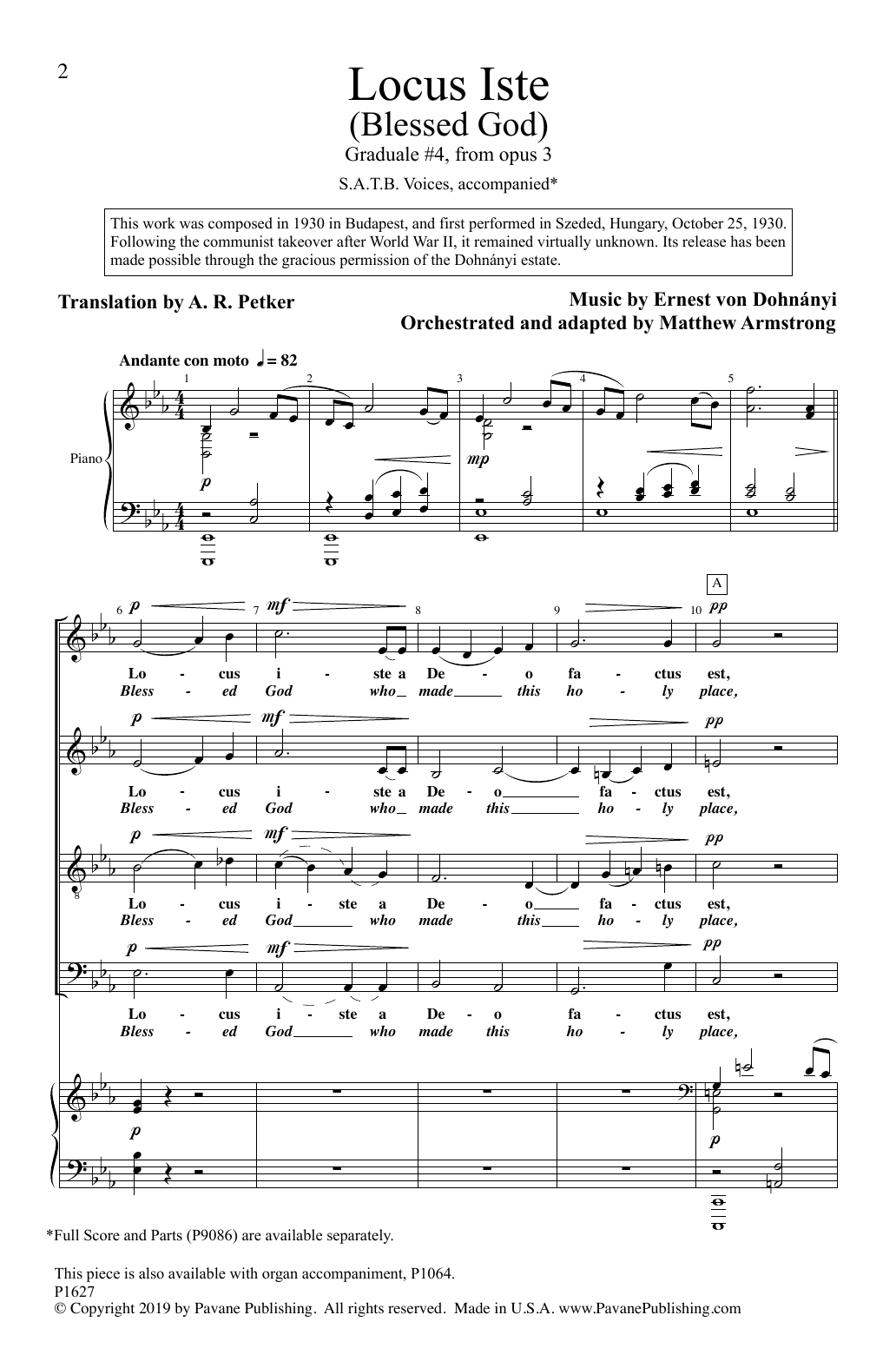
Locus Iste (Blessed God) (Graduale #4, from Opus 3) (adapted by Matthew Armstrong): SATB Choral Octavo

By Ernest von Dohnányi / Arranged by Matthew Armstrong / Edited by Allan Robert Petker

Item: 35-DS00456868

Digital Download
$2.99
Description

Locus Iste (Blessed God) (Graduale #4, from Opus 3) (adapted by Matthew Armstrong): SATB Choral Octavo isn't in MakeMusic Cloud just yet...but it could be. Let us know you'd like to see it, and you'll help shape what comes next. In the meantime, start a free trial and dive into thousands of interactive titles your students can play along with today.

Sample Audio
No sample audio found.
Sample Video
Additional Details
Publisher: Hal Leonard
Page Count: 11
SKU: 35-DS00456868

More about this title

About the Composer: Ernest von Dohnányi

Ernest von Dohnányi (1877-1960) was a Hungarian composer, pianist, and conductor who bridged Romantic and early modern sensibilities with remarkable craft. His sacred choral works, while less frequently performed than his orchestral pieces, showcase the same harmonic sophistication and structural clarity that define his larger output. Dohnányi's approach to liturgical music reflects his deep respect for counterpoint and voice leading, making his sacred settings invaluable resources for choirs seeking substantive, musically rewarding repertoire.

As a pedagogue and musician of stature, Dohnányi influenced generations of composers and performers across Europe and America. His understanding of choral sonority and architectural form made him naturally suited to sacred composition, where restraint and precision serve the text rather than obscure it.

Why we love this

Dohnányi's harmonic language here is deceptively sophisticated; the piece unfolds with quiet confidence and never resorts to obvious gestures to achieve its effect. Matthew Armstrong's adaptation preserves the work's liturgical dignity while making it accessible to ensembles working at the intermediate to advanced level, and the 11-page length keeps rehearsal time reasonable without sacrificing musical substance.

What to expect

A space of focused reverence that trusts silence and stillness as much as sound. The piece moves through gently shifting harmonic colors without ever announcing itself loudly, creating an atmosphere of contemplation that feels both timeless and utterly refined.

Who it's for

Intermediate to advanced SATB choirs seeking sacred music with genuine harmonic interest and structural integrity. This arrangement works equally well for collegiate ensembles, church choirs building toward more challenging liturgical programs, and competitive concert programs seeking a quieter, more sophisticated alternative to the usual sacred repertoire.

How to get the most out of it

  • Shape the harmonic progressions with purposeful but subtle dynamic gradations; Dohnányi's writing rewards attention to how each chord resolves into the next rather than dramatic swells.
  • Balance the SATB voices to emphasize the inner lines where the most interesting movement occurs, especially in the second and third sections.
  • Establish a tempo that allows the text to breathe naturally without rushes; the piece's contemplative character depends on singers having time to shape phrases fully.
  • Attend carefully to the junction points between sections; clear releases and entrances maintain architectural integrity across the work's unfolding design.

How to use it

Pair this with longer works on a concert to provide tonal and textural contrast; its relative brevity and introspective character make it an excellent pairing alongside more extroverted pieces. Churches and faith-based ensembles will find it deepens a liturgical or sacred music series, while secular concert programs benefit from the compositional gravitas it brings without requiring thematic programming.

Skills your students will build

  • Reading and executing subtle dynamic shaping across phrase arcs
  • Balancing interior voice independence with overall harmonic cohesion
  • Sustaining pitch and tonal quality in passages without text
  • Responding to harmonic movement with vocal line adjustments
  • Executing clean ensemble releases and sectional transitions

You May Also Like