
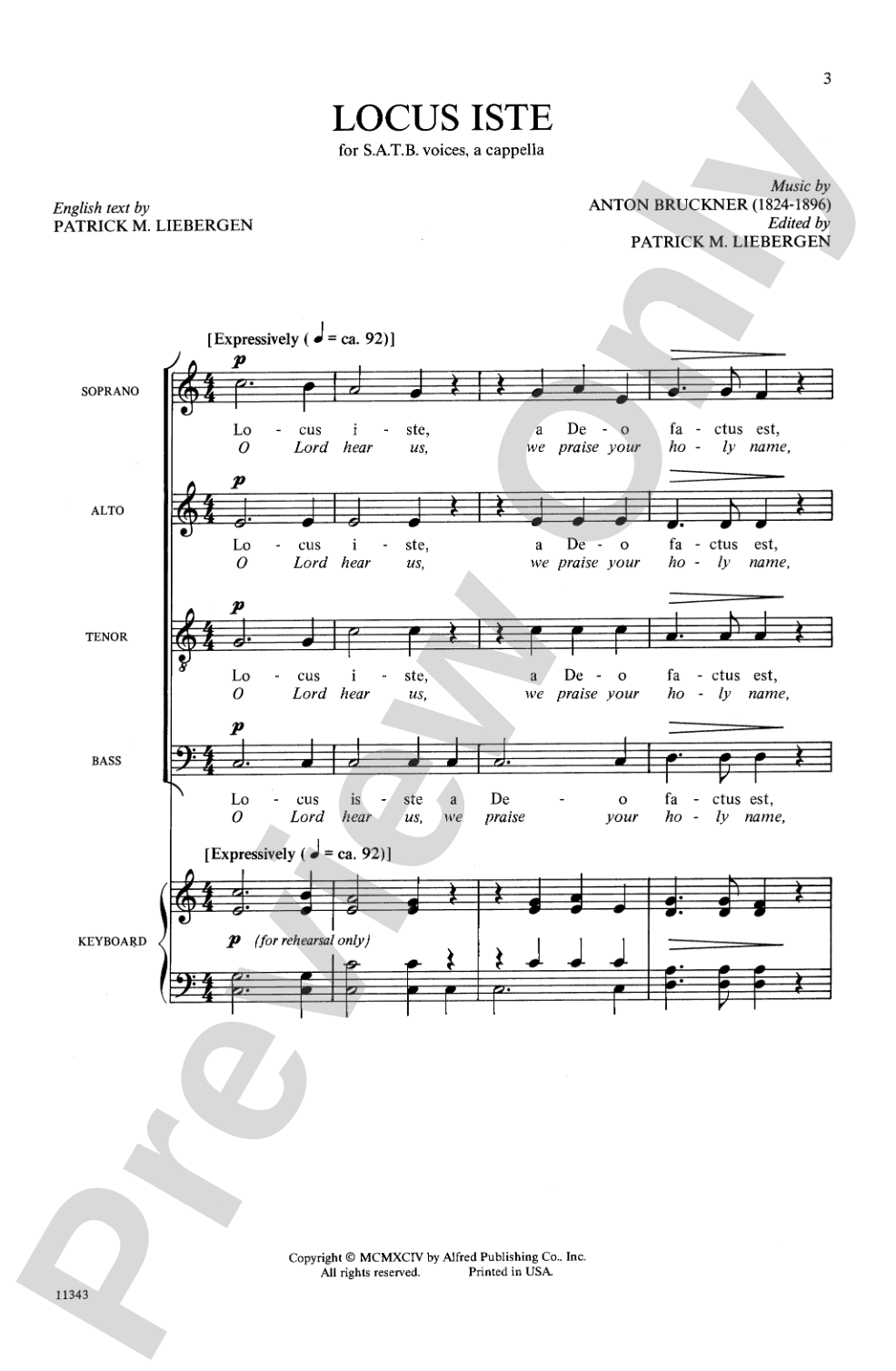

Locus Iste: SATB, a cappella Choral Octavo
Music by Anton Bruckner / arr. Patrick M. Liebergen
Item: 00-PO-0003796
$2.25
Minimum order quantity: 20 copies
Pickup currently not available
Related Items
Locus Iste: SATB, a cappella Choral Octavo |
$2.25
|
View |
Description
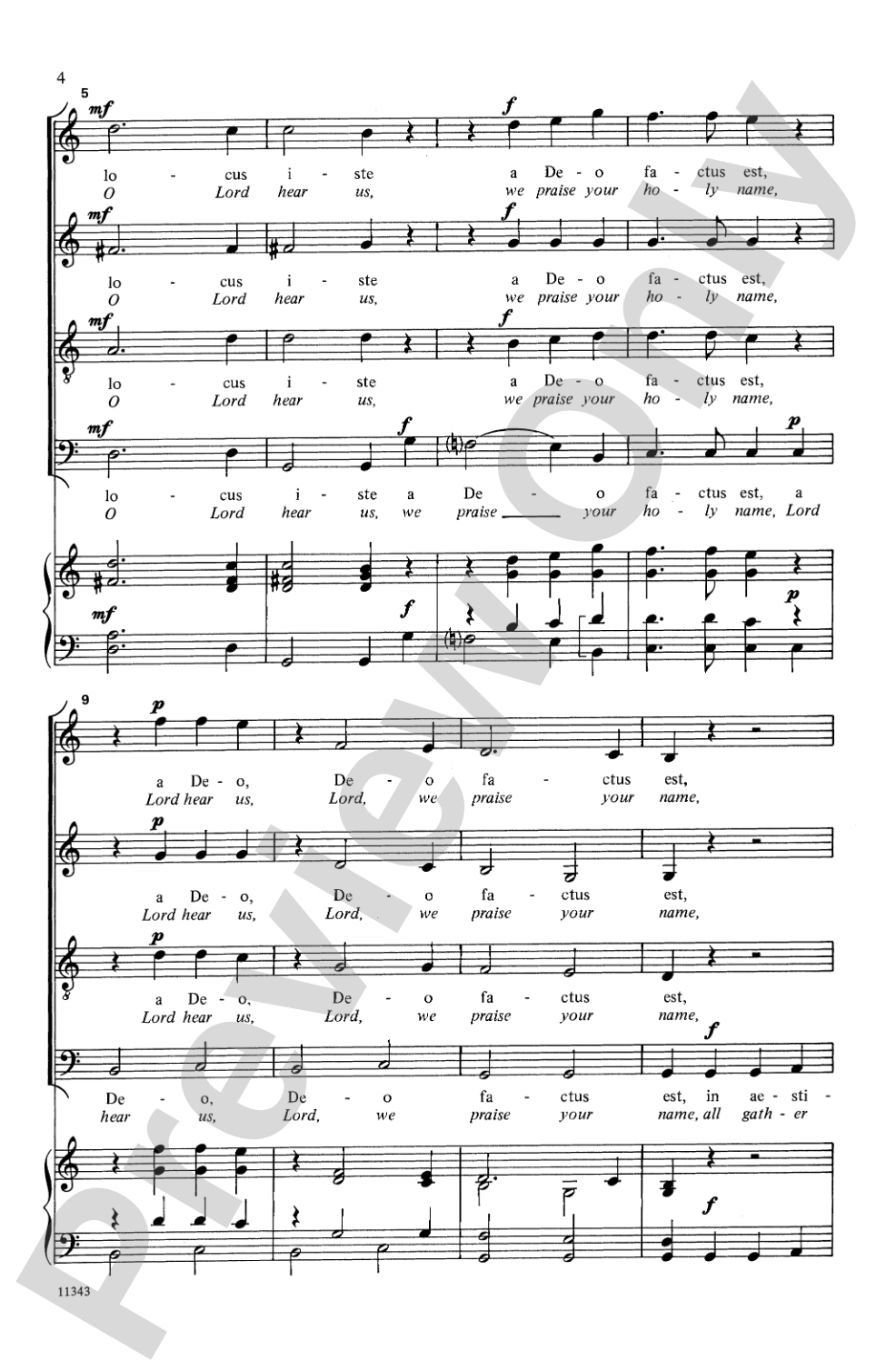
Patrick Liebergen's edition of Bruckner's masterwork brings this 19th Century choral treasure to life for contemporary choirs. An excellent selection to develop phrasing, dynamics and legato choral technique with your SATB choir. Note learning is easy...then work on choral fundamentals. ABA form. A cappella. Open score. Includes a Latin pronunciation guide, optional English text, and historical notes.


Locus Iste: SATB, a cappella Choral Octavo isn't in MakeMusic Cloud just yet...but it could be. Let us know you'd like to see it, and you'll help shape what comes next. In the meantime, start a free trial and dive into thousands of interactive titles your students can play along with today.
Request This Title
Tell us you want it.
Start Your Free Trial
Explore everything that's ready to play right now.
Sample Audio
No sample audio found.
Sample Video
No sample videos found.
Additional Details
Series:
Alfred Archive Edition: Alfred Choral Designs
Publisher:
Alfred Music
Page Count:
8
SKU:
00-PO-0003796
More about this title
About the Composer: Anton Bruckner
Anton Bruckner (1824-1896) was an Austrian composer and organist whose sacred choral works stand among the most profound achievements of the Romantic era. A master of counterpoint and harmonic innovation, Bruckner spent much of his career in Vienna, where he held positions as a church musician and teacher while composing symphonies and liturgical works of extraordinary spiritual depth. His choral writing combines Renaissance polyphonic traditions with 19th-century harmonic language, creating music that demands both technical control and emotional restraint from singers.
Bruckner's sacred compositions, including motets like Locus Iste, reveal a composer deeply engaged with Catholic liturgy and the expressive possibilities of the human voice. His influence on choral music remains essential; conductors and teachers return repeatedly to his motets as models for understanding how simplicity of material can yield profound musical and spiritual results.
Why we love this
This edition strips away technical barriers so your singers can focus on what Bruckner demands: absolute precision in legato, sophisticated dynamic shaping, and the discipline to serve the text rather than display individual voices. The ABA form provides clear structural landmarks for rehearsal, and the optional English text makes it accessible for choirs less comfortable with Latin while honoring the original liturgical context.
What to expect
Locus Iste unfolds with the quiet grandeur of a cathedral interior. Bruckner's harmonies shimmer and shift almost imperceptibly, supported by floating counterpoint that seems to suspend time. The piece feels sacred without sentimentality, inviting singers and listeners into a space of profound stillness and contemplative depth.
Who it's for
SATB choirs seeking repertoire that teaches fundamental choral technique through a canonical work rather than an exercise. This selection suits intermediate to advanced ensembles; singers need solid note-reading skills and the ability to sustain long phrases, but the harmonic language and part-writing are transparent once learned.
How to get the most out of it
- Shape the opening phrase with a gentle swell that arrives naturally rather than mechanically; Bruckner's harmonic movement will do the work if you let it breathe.
- Balance the soprano line against the inner voices with restraint; this is polyphonic writing where no single part dominates, and clarity emerges from ensemble precision rather than projection.
- Use the Latin pronunciation guide as a rehearsal tool early on, then return to it in final weeks to ensure consistency across sections and authentic vowel placement.
- Mark dynamic arrivals and departures clearly in your score; Bruckner's dynamics are sparse, making each marking consequential and easy to miss in ensemble rehearsal.
How to use it
Program this as a cornerstone of a sacred or concert program where it can receive full attention without rushing. Its concentrated emotional power makes it an excellent pairing with Romantic or modern works of similar scope, and its modest performance demands (a cappella, no soloists, moderate length) make it suitable for both concert and festival settings.
Skills your students will build
- Sustained legato singing across long phrases without breath
- Dynamic control through subtle crescendos and diminuendos
- Polyphonic balance and independence within four-part harmony
- Latin text accuracy and Catholic liturgical pronunciation
- Listening to inner voices while maintaining ensemble cohesion