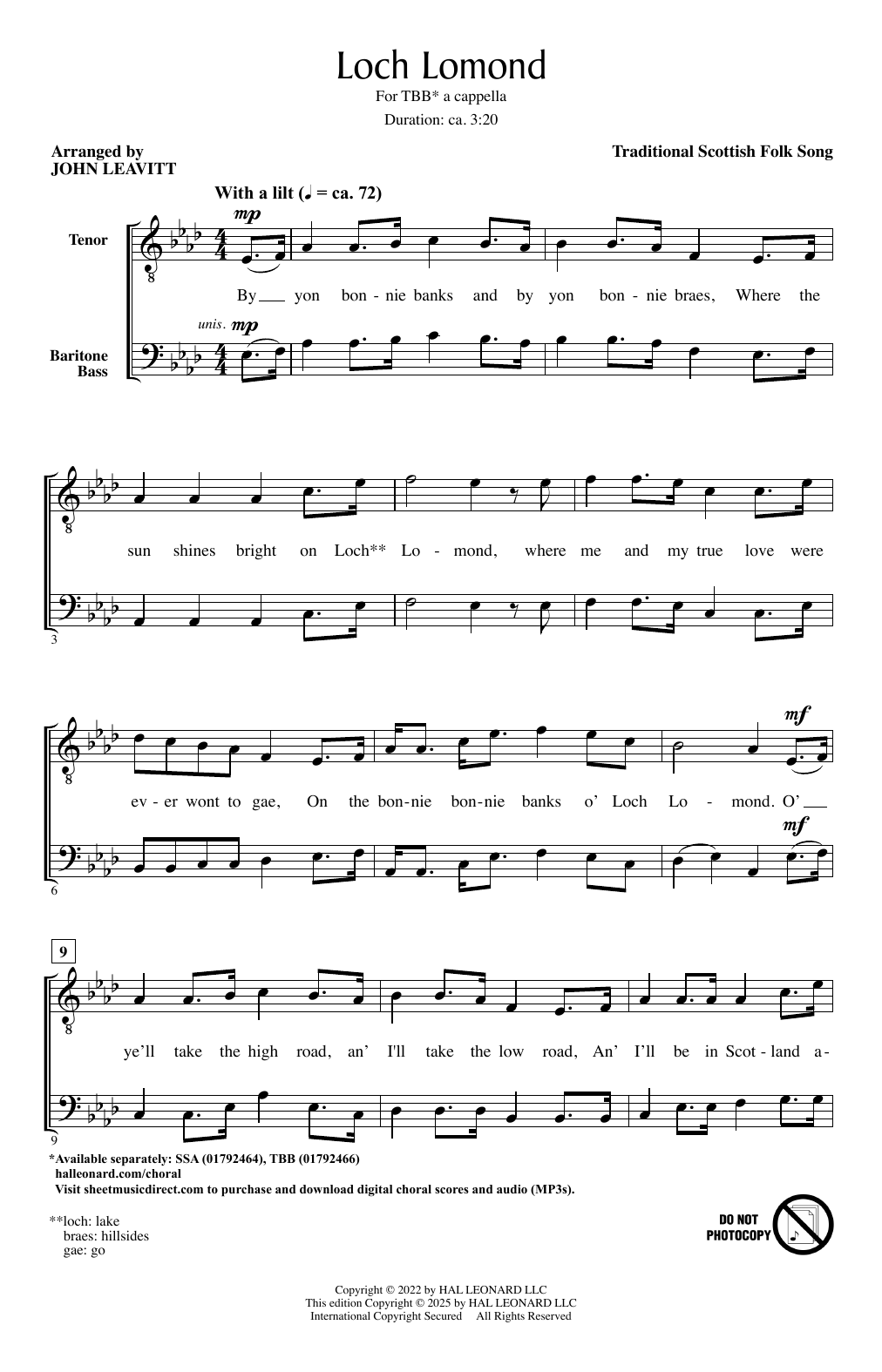
Loch Lomond (arr. John Leavitt) Sheet Music Preview

Loch Lomond (arr. John Leavitt): TBB Choral Octavo

Arranged by John Leavitt

Item: 35-DS01666178

Digital Download
$2.50
Description

Loch Lomond (arr. John Leavitt): TBB Choral Octavo isn't in MakeMusic Cloud just yet...but it could be. Let us know you'd like to see it, and you'll help shape what comes next. In the meantime, start a free trial and dive into thousands of interactive titles your students can play along with today.

Sample Audio
No sample audio found.
Sample Video
Additional Details
Publisher: Hal Leonard
Page Count: 4
SKU: 35-DS01666178

More about this title

About the Arranger: John Leavitt

John Leavitt is an accomplished choral arranger whose work spans secular and sacred repertoire at all levels, from middle school through professional ensembles. His arrangements balance accessibility with musical substance, a philosophy evident in how he opens up folk material for diverse voicing configurations without sacrificing the integrity of the source tune.

Why we love this

Leavitt's treatment of this Scottish standard respects the melody's power while creating genuine three and four-part writing that engages every voice. The flexible voicing (TB/TTB/TBB/TTBB) means you can program this regardless of your current roster needs, and the four-page length makes it realistic for mid-season learning without overwhelming rehearsal time.

What to expect

The song carries the emotional weight of its source material, a Scottish lament whose simple melody masks deep longing. Leavitt's arrangement honors that restraint, letting the text and tune do the emotional heavy lifting while the harmony provides subtle, sophisticated depth.

Who it's for

Intermediate to advanced male and mixed choirs who want accessible folk material with real harmonic interest. This works equally well for treble choirs and groups looking to introduce younger tenors to traditional arranging techniques.

How to get the most out of it

  • Shape the phrase contours with the first note landing on a gentle arrival rather than forcing the tune's opening. The melody will feel more inevitable that way.
  • Balance inner parts so harmonic support never masks the tune itself. In sectional rehearsals, have non-melody singers drop back dynamically as the arrangement progresses.
  • Sustain attention across the middle section where the harmonic movement likely shifts texture. Mark these transitions in your scores so singers understand the architecture, not just their individual lines.

How to use it

Pair this with other folk material for a concert section, or use it as a cultural literacy bridge between popular and concert repertoire. Its brief length and straightforward charm make it an effective opener for programs with broader thematic scope.

Skills your students will build

  • Singing legit melodic lines while maintaining sensitivity to harmonic context
  • Voice blending within flexible voicing configurations
  • Expression through sustained tone and phrase shaping rather than text or tempo manipulation
  • Reading and performing inner harmony parts that move independently from the melody

You May Also Like