
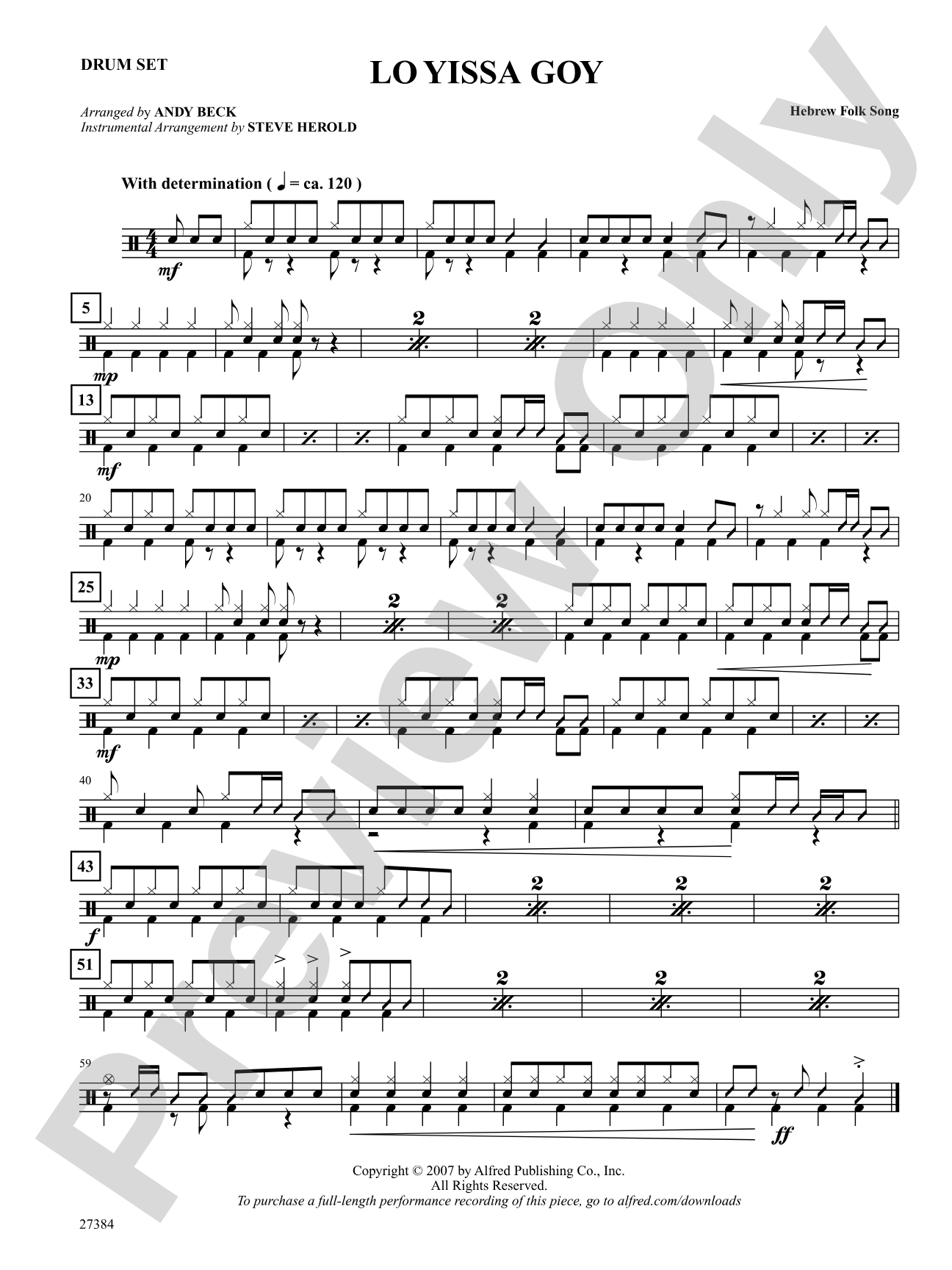

Lo Yissa Goy: Drums: Choral SoundPax
Hebrew Folk Song / arr. Andy Beck
Item: 00-PC-0001311_D
$3.00
Pickup currently not available
Description
The "Klezmer" music of this traditional Hebrew folk song is vibrant and tuneful, while the text is an impassioned cry for peace. A canonic counterline animates the second verse, and the choral writing is noticeably solid throughout. Two simple Hebrew phrases and an original English stanza deliver a determined message.


Don't just read it, hear it, play along with it, and watch your students grow with it. In MakeMusic Cloud, Lo Yissa Goy: Drums: Choral SoundPax comes alive with professional accompaniment, adjustable tempo, and built-in practice tools that turn solo practice into real progress.
Open in the Player
Jump straight in and assign it today.
Start Your Free Trial
Open this title and explore the full library in minutes.
Sample Audio
1
Audio File
--:--
0:00
0:00
Sample Video
No sample videos found.
Additional Details
Series:
Alfred Choral Designs
Publisher:
Alfred Music
Page Count:
22
SKU:
00-PC-0001311_D
Instrumentation:
SoundPax
More about this title
About the Arranger: Andy Beck

Andy Beck directs choral publications at Alfred Music and has become one of the most widely performed arrangers in contemporary choral music, with more than 450 works currently in print across choral ensembles, vocal resources, and musical theatre. His choral literacy resources, including Sing at First Sight and Foundations in Choral Sight Singing, have shaped how singers develop musicianship in rehearsals nationwide. Beck regularly appears as a guest conductor, adjudicator, and clinician, and in recent years has worked with honor choirs and all-state ensembles across the Southeast as both commissioned composer and conductor.
A trained tenor with degrees from Ithaca College and Northwest Missouri State University, Beck brings deep pedagogical insight to his arrangements and compositions. His commitment to choral artistry and music literacy is visible throughout Alfred's choral catalog, which he has shaped through thoughtful curation and commissioning. He has sung as an Alfred Music studio artist since 1992 and continues to perform with the North Carolina Master Chorale Chamber Choir while directing musical theatre productions.
Why we love this
Beck's arrangement balances the rhythmic vitality and melodic warmth of klezmer music with a message that resonates deeply. The second verse's canonic counterline lifts the texture without complicating the harmonic foundation, making this piece work equally well for developing choirs and experienced ensembles. The combination of Hebrew and English text creates a natural bridge between cultural specificity and universal accessibility.
What to expect
The opening melody has the buoyant, somewhat sly character of klezmer dance music, full of rhythmic snap and minor-key warmth. When the canon enters in the second verse, the piece gains architectural interest without losing its folk-rooted heart; the Hebrew text carries an intensity that transforms the tune from entertainment into declaration.
Who it's for
This arrangement suits choirs at intermediate to advanced levels who are ready to blend cultural authenticity with choral depth. Programming directors seeking repertoire that speaks to peace and social consciousness while maintaining musical substance will find this a strong choice for concerts, festivals, and competitions.
How to get the most out of it
- Treat the rhythmic figures of the klezmer style as a living element; dancers and choreographers often respond to these arrangements, so encourage singers to physically feel the pulse and articulation rather than sing it as a concert piece frozen in place.
- Balance the recorded accompaniment so it supports the singing line without masking it, especially during the canonic section where clarity between voice parts determines success.
- Emphasize the Hebrew pronunciation work early in rehearsals so singers can own the text's emotional weight; the shift to English in the final stanza will land with more power if the opening phrases feel native to the singers' voices.
- Shape the dynamics across both verses to reflect the arc from vibrant celebration to determined advocacy; the canon provides textural lift, but the emotional intent should guide how much the second verse swells.
How to use it
This piece works well in a program exploring Jewish heritage and peacemaking themes, or as a cultural bridge in concerts mixing world music with classical repertoire. Its moderate length and clear sectional structure make it an effective festival entry, and the English text makes it accessible to diverse audiences. Consider pairing it with other folk-based arrangements to highlight how arranger choices shape meaning.
Skills your students will build
- Reading and performing Hebrew pronunciation and diction
- Singing canonic counterpoint with rhythmic clarity
- Balancing melody and accompaniment in contemporary folk arrangements
- Understanding how textual meaning shapes dynamic and interpretive choices
- Responding to klezmer rhythmic figures and articulation conventions