
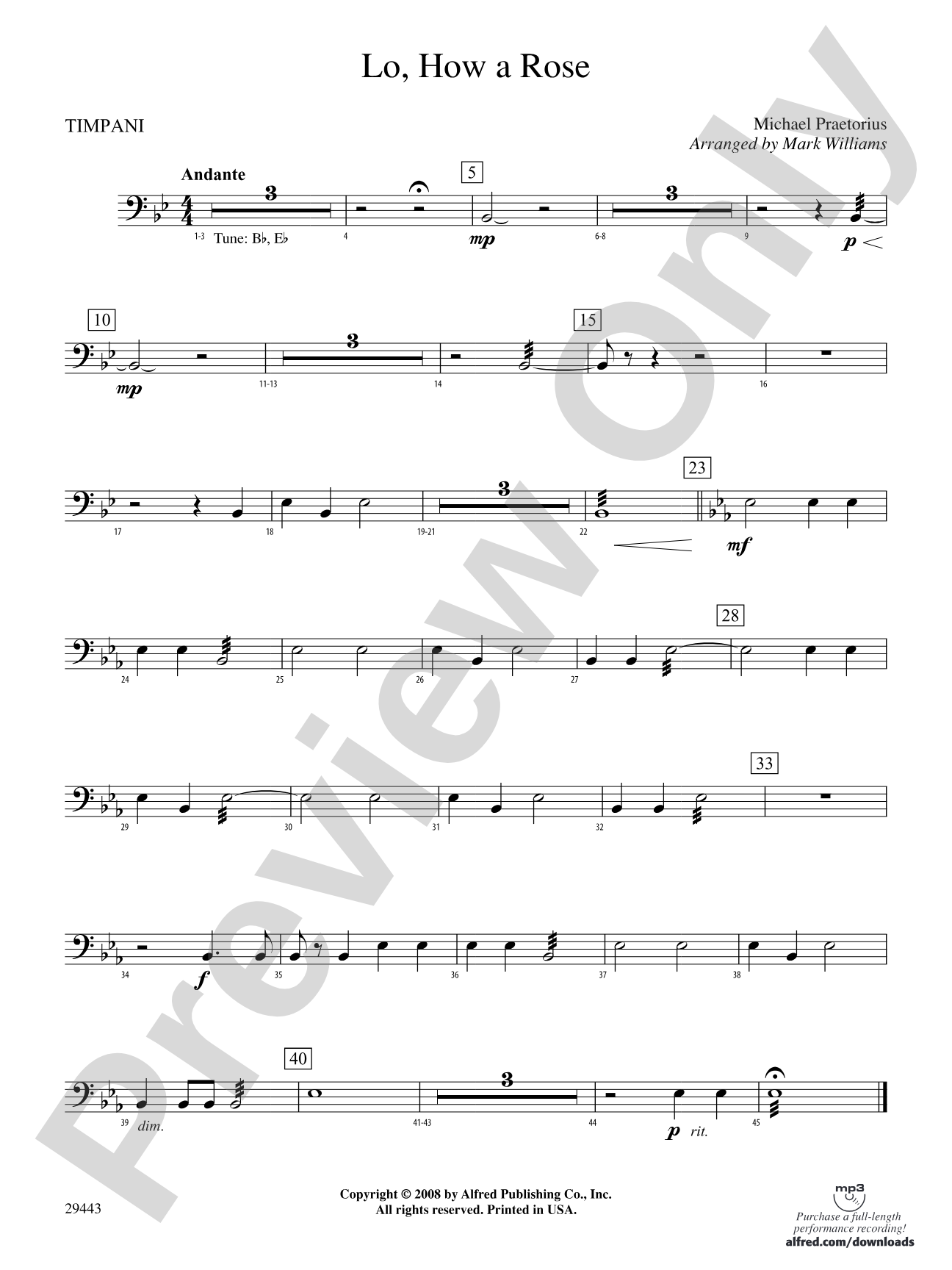

Lo, How a Rose: Timpani
By Mark Williams
Grade: 1.5 (Easy)
Item: 00-PC-0001400_TMP
$3.00
Pickup currently not available
Description
This beautiful carol truly shines in this sensitive, creative treatment. After a gentle introduction and an introspective first statement of the tune, a key change signals the pairing of the main theme with "Hark, the Herald Angels Sing" and "The Twelve Days of Christmas." Great for developing tone quality and intonation, this is an ideal holiday program selection. (2:25)
Correlated with Accent on Achievement, Book 2, page 24.


Correlated with Accent on Achievement, Book 2, page 24.
Don't just read it, hear it, play along with it, and watch your students grow with it. In MakeMusic Cloud, Lo, How a Rose: Timpani comes alive with professional accompaniment, adjustable tempo, and built-in practice tools that turn solo practice into real progress.
Open in the Player
Jump straight in and assign it today.
Start Your Free Trial
Open this title and explore the full library in minutes.
Sample Audio
1
Audio File
--:--
0:00
0:00
Sample Video
No sample videos found.
Additional Details
Series:
Accent on Achievement
Publisher:
Alfred Music
Page Count:
126
SKU:
00-PC-0001400_TMP
More about this title
About the Composer: Mark Williams

Mark Williams built his reputation as one of the most prolific and respected composers for school ensembles, with over 200 published works spanning band, orchestra, and choral literature. A native of Chicago who spent his formative years in Spokane, Washington, he dedicated much of his career to elementary band instruction while maintaining an active presence as a clinician and guest conductor across North America and Australia. His work as co-author of the Accent on Achievement Band Method shaped how generations of young musicians learned to read and play.
Beyond the page, Williams was an accomplished bassoon performer and arranger who served with the 560th Air Force Band. He held leadership roles including Conductor and Artistic Director of the Spokane British Brass Band, and his compositions earned recognition through the Western International Band Clinic's Gralia Competition and multiple ASCAP Special Awards. His degrees from Eastern Washington University grounded his pedagogical approach in both music education theory and performance practice.
Why we love this
Williams treats this venerable carol with genuine sensitivity rather than turning it into a crowd-pleaser. The architecture is smart: after setting a contemplative mood, he threads in "Hark, the Herald Angels Sing" and "The Twelve Days of Christmas" in a way that feels inevitable rather than gimmicky. For a Grade 1.5 band, this is substantive work that develops listening and blend without complexity.
What to expect
Serene and reflective, then gradually warming into something richer and more layered. The carol's familiar melody provides anchor and comfort, while the clever interweaving of complementary tunes adds dimension without losing the hymn-like dignity of the original.
Who it's for
Young concert bands at the elementary to middle school level who need substantive repertoire that rewards careful musicianship. This works equally well for holiday programming and for players building tone quality and ensemble listening skills in rehearsal.
How to get the most out of it
- Shape the gentle introduction with careful dynamic control; let the band find the softer dynamic palette before the first statement of the tune enters
- Approach the key change as a genuine structural moment. The shift in tonal center should feel like a fresh perspective on familiar material, not just a modulation
- Balance the three themes when they combine. Ensure the main melody dominates while the complementary tunes support without competing
- Use this as a tone-quality rehearsal. The exposed writing at grade 1.5 means every voice's sound matters; intonation problems become obvious, so address them directly
How to use it
This anchors a holiday concert's middle section, offering contrast to more energetic seasonal fare. The emotional restraint and gentle key change make it an excellent bridge between upbeat opening selections and closing celebrations. It also works beautifully in a winter assembly or church performance where musical maturity matters more than showiness.
Skills your students will build
- Sustained tone quality and breath support over longer phrases
- Listening for intonation across the ensemble, especially in soft dynamics
- Balancing primary melody against secondary themes
- Responding to key changes and understanding harmonic function
- Ensemble blend and matching vowel shapes in sustained passages